
Navratri Garba Night: Hosting and Invitations
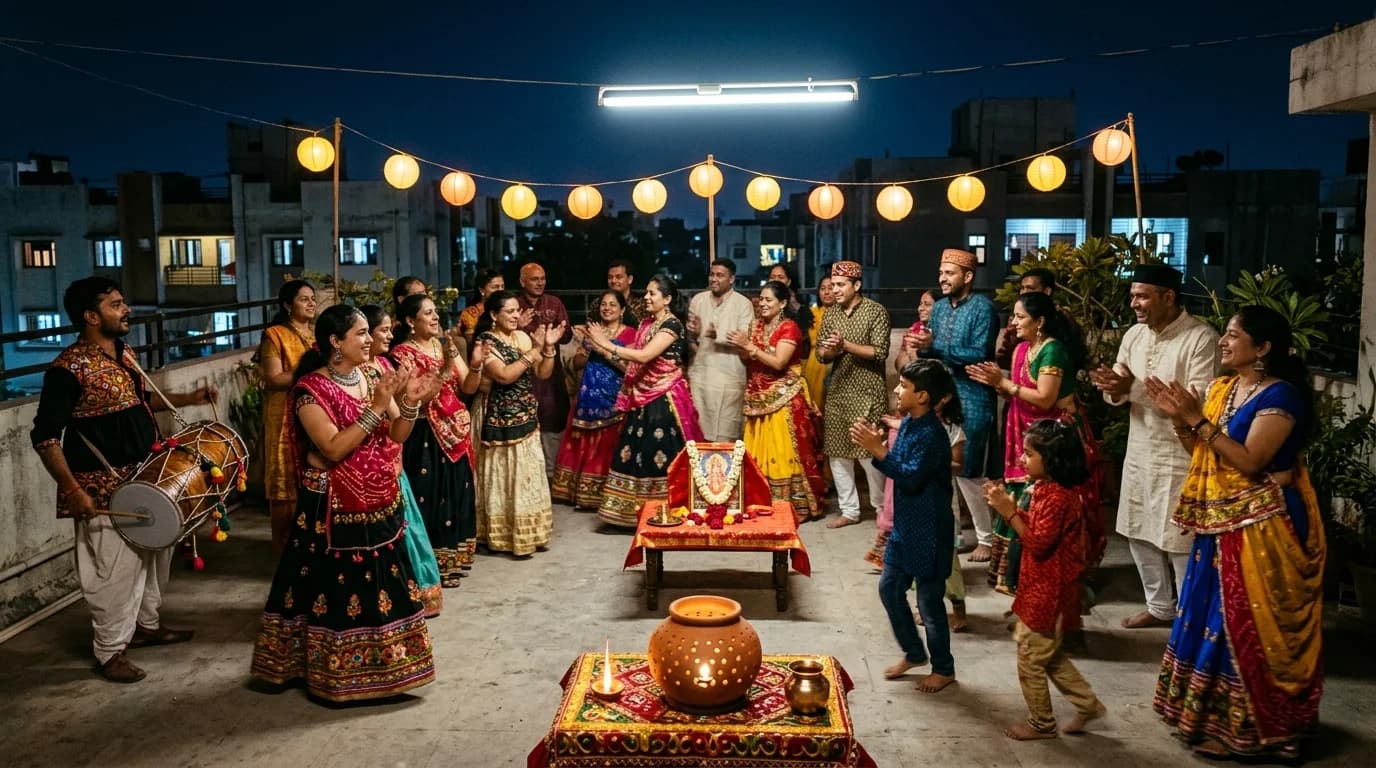
The best Navratri garba night I have ever danced at was on a cracked parking-level slab in a society in Rajkot, lit by two tube lights and a string of paper lanterns somebody's mother had wired up that afternoon. One dhol player. A garbo with a diya burning inside it, on a stool draped in red. Maybe forty people, a third of them children who gave up around the fourth round and went off to bother the sev puri man at the gate.
The worst was a ticketed ground in the suburbs, where I queued twenty minutes past a metal detector on a two thousand two hundred rupee pass and got maybe four clean rounds before the floor packed too tight to lift an arm. Superb sound system. No garba in it anywhere.
That gap is why I host my own now instead of buying passes, and why so many people I know have gone back to the terrace and the society compound. A garba you host yourself is smaller and far cheaper. It also has what the big grounds sold off years ago, which is floor space, and it ends at an hour that lets you turn up to work.
Nine nights, and the one you should actually pick
Navratri 2026 opens on Sunday 11 October with Ghatasthapana and runs through Maha Navami on Monday 19 October, with Dussehra on Tuesday 20 October. Check your local panchang for the Ghatasthapana muhurat before you fix anything, since the window moves between cities.
Now read that calendar like a host. Ashtami lands on Sunday the 18th and Navami is a public holiday across a good number of states on the Monday, with Dussehra on the Tuesday behind it. That makes the tail end of the festival a four-day run for a lot of families, and the stretch when the commercial grounds are fullest and priciest.
Please do not try to host all nine nights. I know a man who tried it in a building of thirty-two flats, and by the sixth evening it was four teenagers and a bored dhol player looking at each other. Host one night. Two, if the enthusiasm is genuinely there.
If you want a full circle and a proper crowd, take Friday 16 or Saturday 17 October. If you want good garba, take a weeknight early on, Tuesday the 13th or Wednesday the 14th. Nobody schedules those, so the grounds are half empty and everyone who turns up came to dance. Forty of them beat three hundred who came for photos.
The other thing hosts get wrong is the clock. Garba traditionally never warmed up before half past nine, but the loudspeaker cut-off in residential areas is ten, relaxed to midnight only on the few festival nights your state actually notifies. Call people for eight. An invite that says "8 pm, aarti at 8.30, floor opens straight after" gets a circle moving by nine and buys you a full hour before anyone has to touch the volume.
Set the garbo down before you plug in the speakers
Garba is a dance performed around a light. The word comes from garbha, and the garbo, that perforated earthen pot with a lamp inside it, sits at the centre while everyone circles it anticlockwise. That is the architecture of the whole evening.
So build the centre first. A low table, red or bandhani cloth over it, the framed picture of Mataji with a chundadi across the top, the garbo, and beside it the kalash with jowar sown in soil on the first day. Those seeds are a fist of pale green shoots by Ashtami, and handing them out is how the festival closes. Do the aarti at a stated time before the dancing, rather than at eleven when someone remembers.
The mistake societies make every single year is giving the middle of the floor to the DJ console and pushing the garbo into a corner near the chairs. Then everyone dances in a vague blob facing the speakers, which makes a lovely wedding sangeet and a completely different evening from the one you meant to throw. Put the sound at the edge and keep the light in the middle. And if friends are coming who have never done this, tell them in one sentence what the pot is. Nobody minds being told. Everybody minds standing at the rim of a religious observance guessing whether they are allowed in.
Teach three steps in ten minutes and keep the sticks in the bag
A floor where two-thirds of the room is at the edge holding a paper plate is a failed garba, and it happens because the host assumed everyone knew the steps. Ten minutes, three steps, done early while people are still arriving. Start with be taali, the simple two-clap: step forward, step across, clap, keep the circle turning anticlockwise. Then tran taali, the three-clap with the low dip. Then dodhiya if the crowd has it in them. Get three people who can actually dance to hold the inner ring, because beginners copy whoever is in front of them.
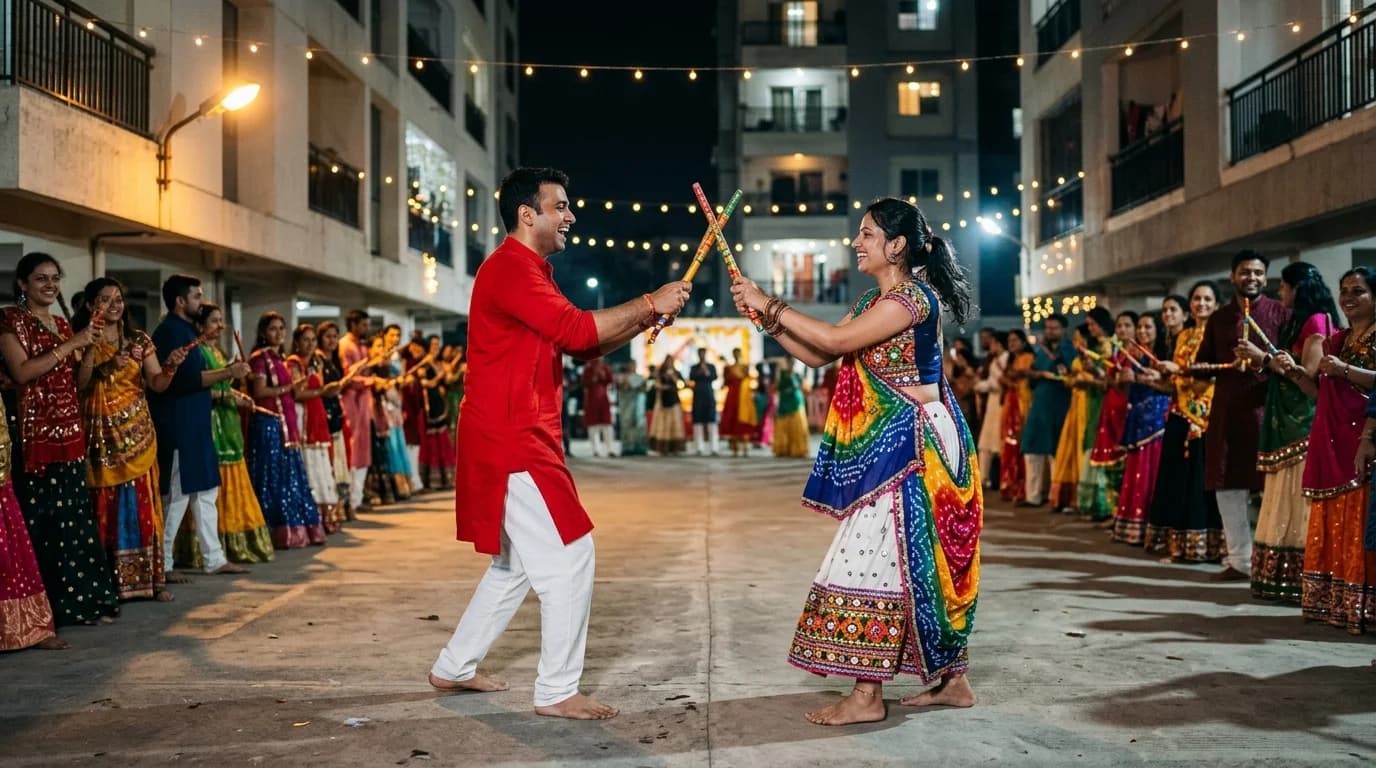
The dandiya sticks stay in the bag until at least an hour in. Handing them out at eight gets you a bruised nine-year-old and a circle that never forms, because raas is a partner dance and needs a floor that has already found its rhythm. When the sticks do come out, split the room into two facing rings and rotate. The same logic I use for keeping a mehndi function's dance floor moving applies here: give people a structure to step into and they will step in.
The music has a shape, and a shuffled playlist doesn't
Hire the dhol. Even if the rest of the night runs off a phone and a Bluetooth speaker, a dhol player for two hours costs less than four passes to a decent ground and does something to a circle no recording manages. Ours charges about three thousand five hundred and stays for chai afterwards.
Build the recorded set as a curve. Slow traditional garba first, while half the room is still working out where their feet go. Mid-tempo as the floor fills. Then the fast run late, Sanedo and Popatiyu and the entire Falguni Pathak canon, when everyone is warm and slightly reckless. Bring it down before the closing aarti so the night lands instead of just stopping.
What flattens a home garba is going to the Bollywood remixes at half past eight because a cousin asked. Save those for the last twenty minutes.
Put the dress code in the invite, in words
Nobody wants to be the one person in jeans. Write it down: chaniya choli with a bandhani dupatta and oxidised jewellery, kediyu and kafni pyjama for the men. Kolhapuris or mojdi on the feet. Say it plainly on the invitation and people will do it, and your terrace will look extraordinary at no cost to you.
Two practical notes nobody gives you. Half the room will be barefoot within twenty minutes, so wash the floor in the afternoon and walk it checking for grit and stray screws, especially on a parking slab. And say no heels, in writing. Every year somebody turns an ankle on the third round and spends the rest of Navratri on a sofa with an ice pack.
Also resist letting it become a rental arms race. A chaniya choli borrowed from a cousin and worn hard is exactly the spirit of this; a designer outfit nobody dares sweat in will sit at the edge all night.
Feed a room where half the people are fasting
Plenty of your guests keep upvas through all nine days, or at least on Ashtami, and ordinary party food is closed to them. Every year a host forgets that until an aunty is standing at the table looking down at a plate of pav bhaji with genuine sadness.
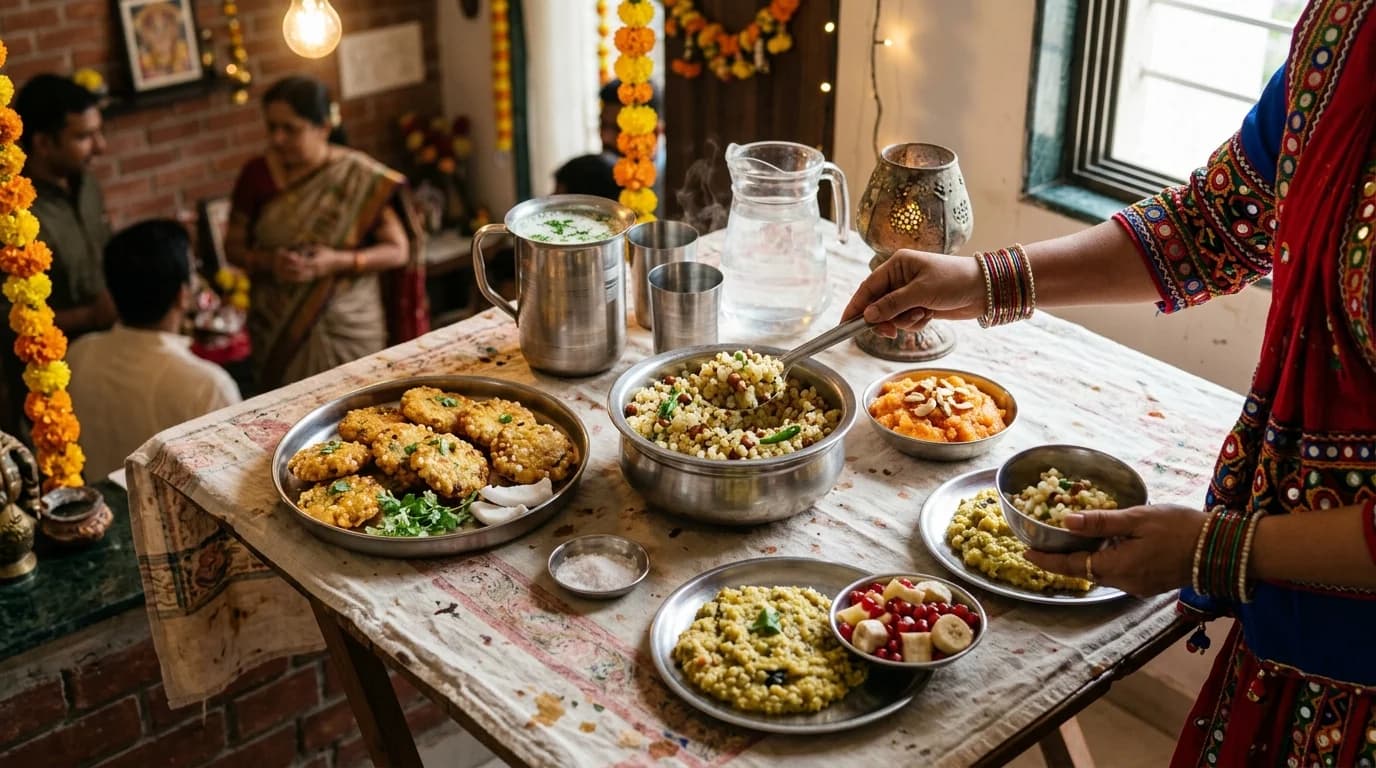
So run a small farali counter. Sabudana khichdi, rajgira sheera, moriyo, farali pattice, a bowl of fruit. Cook that batch with sendha namak and no onion or garlic, and put a handwritten card beside each dish saying which is which. The labelling is what turns a nice gesture into a guest who feels thought about.
Nobody does forty minutes of tran taali on a full plate of dabeli, so keep it light before the dancing. Serve chaas and something small early, then bring out the real food and hot jalebi after ten, once the speakers are down.
None of this should land on one kitchen. A society garba divides beautifully across four or five flats, and our potluck guide covers how to split a menu by category so you do not end up with three sabudana khichdis and nothing sweet. It is the same instinct behind keeping the aartis at Ganpati open to the whole building: a festival one person carries turns into a chore by day three.
Send a Navratri garba night invite that people answer
Most home garbas fall over at the invitation. Word goes out as a forward in the society WhatsApp group at eleven at night, buried under forty messages about the water tanker and a photo of somebody's badly parked car. Twenty flats never see it. Then you spend the week before unsure whether thirty people are coming or ninety, which is expensive when there is a dhol player to book and a guard downstairs asking for the list of outside guests. Navratri is the clearest argument I know for keeping an event out of the group chat.
So send a real invitation. I describe the look I want to Lemonvite's design engine, usually something close to "Navratri garba night, bandhani red and yellow, dandiya sticks, mirror-work border, diya glow," and it designs the festive invitation in seconds. Then it goes out by text, which people open, and each guest taps once to RSVP. That one number is worth more than everything else in this post, because it decides how much sabudana you soak.
Put the working details in the words too: the sharp start time, the aarti slot, the dress code, whether children are welcome, and where cars go. Then chase the silent ones about four days out, since half of them meant to reply and forgot. Our notes on following up with guests who haven't RSVPed cover doing that without sounding like you are taking attendance.
And then it's Dussehra morning
Nine nights go faster than you expect. On the tenth day the jawara get cut and handed around while the ravan burns somewhere down the road. If you are anywhere in Gujarat, the whole state is eating fafda and jalebi by nine that morning, hoarse, with shins that hurt.
The garba you will still be talking about in November is the one with forty people on a wet-mopped slab under two tube lights, going anticlockwise around a clay pot until the watchman comes down and gives you the look. Block one night in October now, before your building signs up to somebody's pass scheme, and put the invite together on Lemonvite while the date is still yours to claim.