
Deepavali Open House Ideas and Invitations
The first Deepavali open house I hosted in my own flat, I put "open house, drop by anytime from noon" on the invitation and felt generous about it. Thirty-one people came through the door between 12.40 and half past one. My four-room in Sengkang seats fourteen. People ate standing up in the kitchen and out by the lift lobby. The murukku tin was empty by two. By four the flat was silent and I was lying on the parquet with my shoes still on, which is when my cousin arrived with three children expecting lunch. They got Milo and the last two athirasam.
An open house is a shift pattern, and I had planned it like a party. Everybody here reads "anytime" as lunchtime, particularly on a public holiday when they have two more houses to get to before dinner. Your guests are doing a circuit. Your job is to give that circuit a shape.
So these are the ideas I use now, seven years and a great deal of murukku later. They assume a flat with nowhere near enough chairs and a guest list that runs well past your own relatives. Half the people who come to a Singapore Deepavali have never set foot in a Hindu home, and that changes how you set the day up.
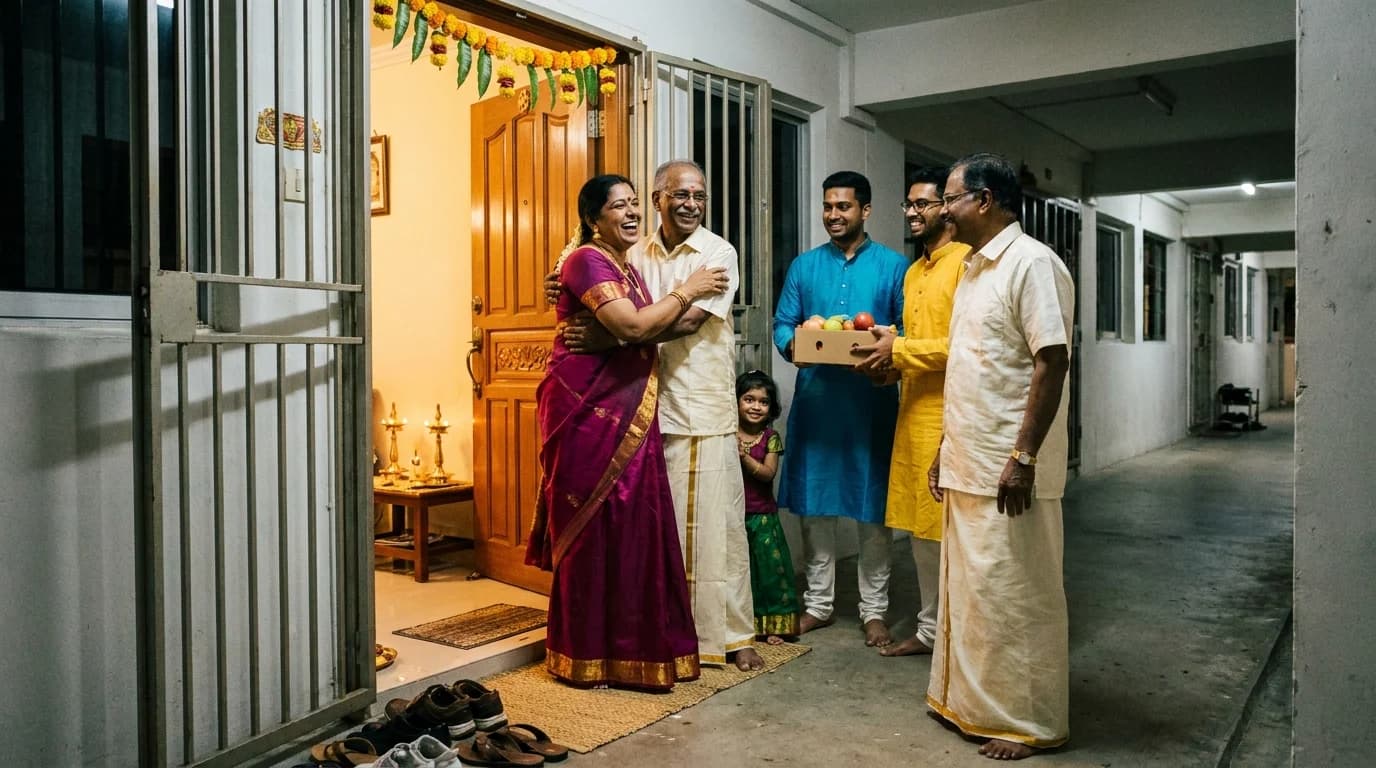
Deepavali 2026 lands on a Sunday, and you get the Monday too
Deepavali falls on Sunday, 8 November 2026. Because it lands on a Sunday, Monday 9 November is gazetted as the holiday in lieu for anyone whose rest day is that Sunday, which for most people on a normal work week means a two-day window. That doesn't come round often. Use it.
My split is family on the Sunday and everyone else on the Monday. The Sunday morning belongs to the household anyway: the oil bath before it gets light, new clothes, a spoon of Deepavali marundhu that nobody enjoys, then the temple. Serangoon Road is shoulder to shoulder by eight and Sri Mariamman has a queue down South Bridge Road, so nobody is free to visit anybody before about eleven. So the Sunday starts late and stays in the family. Monday is where colleagues and neighbours and everybody's kids go, with the ritual pressure off and a lunch that can drift into the evening.
If you only have the energy for one day, take the Monday.
Either way, start earlier than you think. The Little India light-up goes up along Serangoon Road weeks ahead and the Festival Village at Campbell Lane opens with it, so the season is underway by mid-October. Your invitation should be out before the lights are.
A Deepavali open house runs on arrival waves
The one change that fixed my open house was writing down two or three arrival windows and telling each group which was theirs.
- 11am to 1pm for relatives and anyone coming straight from the temple, which in practice means the aunties and uncles first.
- 2pm to 5pm for neighbours and colleagues, plus any friend with a toddler who has to be home for a nap.
- 6pm onwards for the people who'll still be on your sofa at ten.
Suggest a window to each group as you invite them. Almost everyone takes it, because most guests would much rather be told than guess. And once arrivals are spread across six hours, you can cook in rounds instead of laying everything out at noon and watching it die by three.
Two things I'd avoid. Don't let a Sunday open house run past nine when a chunk of your guest list is back at work on Tuesday. And don't greet every arrival at the door yourself, which is how a host ends up with eleven identical thirty-second conversations and no afternoon. Give the door to a cousin for an hour and go sit down with somebody.
The kolam, and what an HDB corridor will take
Most Tamil households here say kolam. You'll hear rangoli too. Singapore's Indian community was never only Tamil, and the two words end up meaning much the same thing at a front door in Yishun.
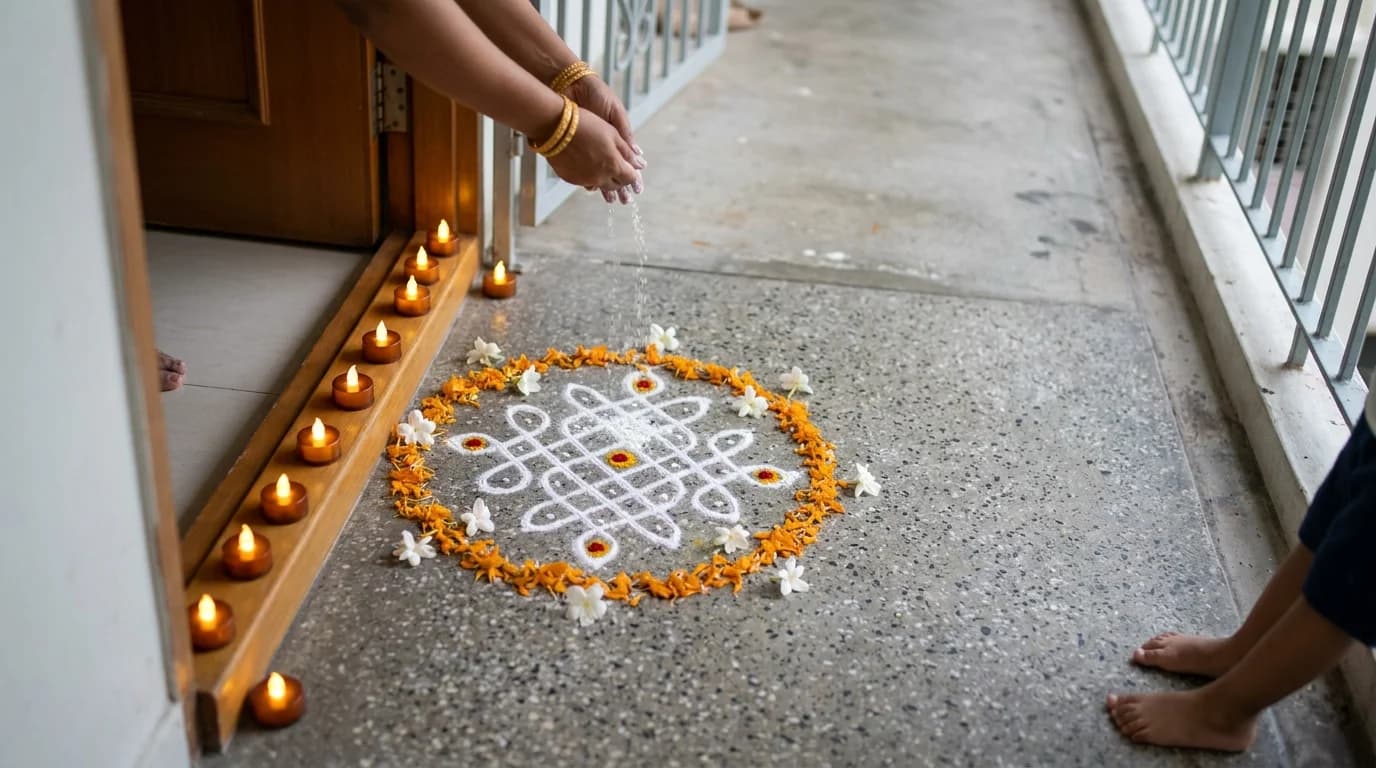
Rice flour is what I use at the threshold, and it will be a smudge within the hour once thirty pairs of feet cross it. That is the point of putting it where feet go.
The bit people get wrong is the corridor. Common corridors have to stay clear, and a row of lit clay agal lamps on the floor of a shared walkway is a conversation you don't want with your town council or with the neighbour manoeuvring a pram past it. Keep real flames inside your own doorway and on the altar. Outside, use the LED agal, which look perfectly good in a dim corridor and won't catch the recycling bag next door.
If you can't draw, do what half my block does and lay a flower kolam. Marigold heads pulled apart, a ring of rose petals, a handful of loose jasmine from Tekka. It's forgiving in a way powder never is, and it sweeps up in one pass at midnight. Sticker kolam mats are on every five-foot-way in Little India by mid-October and I refuse to be snobbish about them. Buy one for the lift lobby and do the real one at your own door. The children get a square of floor and a bowl of colour powder.
For the dot grids and how a pulli kolam gets built out from them, my Diwali party and rangoli notes go through it properly. The Singapore part is only scale and surface: smaller, and on something you can lift.
Food that has to survive eight hours
An open house menu has a requirement a dinner party never has. It still has to be good at half past four.
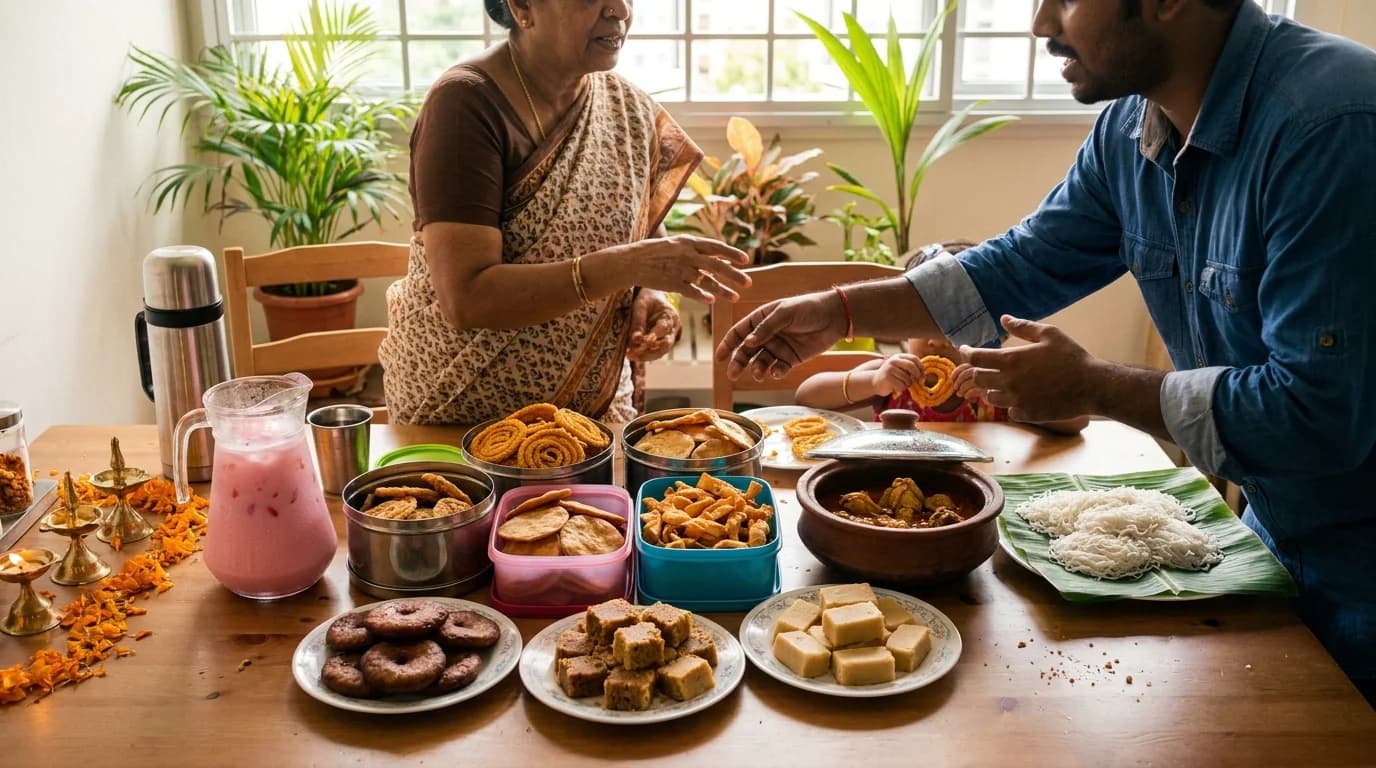
So build the table around the tins: murukku, athirasam, mysore pak, palkova, thattai, ribbon pakoda, and whichever one your family is weird about. Order them in October. The home cooks in Sembawang and Ang Mo Kio close their books early, and the sweet shops along Serangoon Road stop taking orders in the final week.
Then add one hot savoury that you top up in rounds. Mine is a pot of chicken curry with idiyappam, refreshed at noon and again at three and at seven. A biryani in a warmer does the same job if your numbers are big. Whatever you choose, don't put out anything delicate. Vadai is soft in twenty minutes, and a plated sit-down lunch is the wrong shape for a day where people arrive in waves. Keep the payasam in a flask rather than a pot on the stove, because reheating semiya at five o'clock while eight people watch you is nobody's idea of a festival.
Drinks are where most open houses fall down. A cooler of iced rose milk and a big flask of tea will do more for your afternoon than any dish on the table. It's November in Singapore. People are hot.
Keep the spread vegetarian if anyone in your family observes it on the day, and leave beef off regardless. Once you invite colleagues the halal question arrives with them, and my notes on hosting a multicultural celebration in Singapore cover it without making anyone feel like an accommodation. And don't cook the lot yourself. Deepavali food spreads across a family beautifully if you let it, and our potluck guide has a sane way to split a menu so you don't end up with four kinds of murukku and no rice.
Invite the whole corridor, and answer the questions nobody asks
The open house is one of the genuinely good things about this country. Hari Raya, Chinese New Year and Deepavali all run on the same understanding: the door is open, and you don't have to be of the faith to walk through it. Deepavali is the easiest of the three to share: no fast to work around, and the whole thing is built on light and food and visiting.
Your non-Hindu guests are more anxious about it than they let on, though. A colleague once asked me, entirely sincerely, whether she was allowed to come inside. So put the answers on the invitation before anyone has to ask:
- Shoes come off at the door and there's a mat for them.
- Come any time between 2 and 5. Leaving after forty minutes is completely normal.
- Bring nothing. If you truly can't, bring fruit.
- Wear something bright. Nobody expects a saree, though if you want to wear one you'll make an aunty's entire week.
- There's a short prayer at the altar in the morning. Watch it or skip it, both fine.
Five plain lines. The alternative is your colleague standing outside your gate at two o'clock, googling whether it's rude to arrive empty-handed.
One invitation, three windows
The reason my first open house turned into a 1pm crush is that the invitation was a forwarded picture of a diya in a group chat. There was nowhere for anyone to say when they were coming, so nobody said, so everybody came at once.
Now I describe the day to Lemonvite's design engine, something close to "Deepavali open house, brass lamps and jasmine, deep magenta and gold, kolam border", and it designs a custom festive open house invitation in seconds with no template hunting. It goes out by text, which is the one channel that doesn't get muted. Each guest taps once to RSVP, so the count builds through October in front of me and the sweet order stops being a gamble.
The windows are what changed the day, though. Put the arrival slots in the description and ask people to say roughly when they're coming, and the crush spreads itself out with no chasing from you. Some people never open the message at all, and that's when you nudge them one by one; our guide to following up on RSVPs covers doing it without sounding like a debt collector. The relatives in Chennai and KL get the same invitation on their phones, which matters when a few of them are deciding whether to fly in for the long weekend.
Before you order the sweets
A Deepavali open house is the most generous day in a Singapore host's year: the door propped open for eight hours, the kolam getting steadily wrecked, and people who'd never otherwise share a room eating out of the same tin.
Fix your two dates this week and work backwards. Sweets ordered by mid-October, and the invitation out early enough that the aunties can slot you into their rounds before somebody else does. You can describe yours to Lemonvite tonight and have the arrival windows sitting on everyone's phone by morning. Deepavali Nalvazhthukkal, and may your murukku last past two o'clock.