
Diwali Party Ideas, Rangoli and Invitation Wording
Two Diwalis ago I sent out a Diwali party invite for the evening of Lakshmi Puja itself. Eight o'clock, badi Diwali, our flat in Powai, come hungry. Fourteen people said haan. Four turned up, and two of those were my in-laws, who already live with us. My mausi rang at nine to apologise: the puja had run long, then my uncle's office people had landed up, and could she come tomorrow instead?
She was being kind. What she meant was that I had picked the one evening when every Indian household is sitting in its own drawing room, waiting on the muhurat.
These are the Diwali party ideas I use now, all of them out of that mistake: which of the five nights to grab, what rangoli survives contact with actual guests, how to feed people who are nine kaju katli deep, and the wording that gets you a reply instead of a folded-hands sticker.
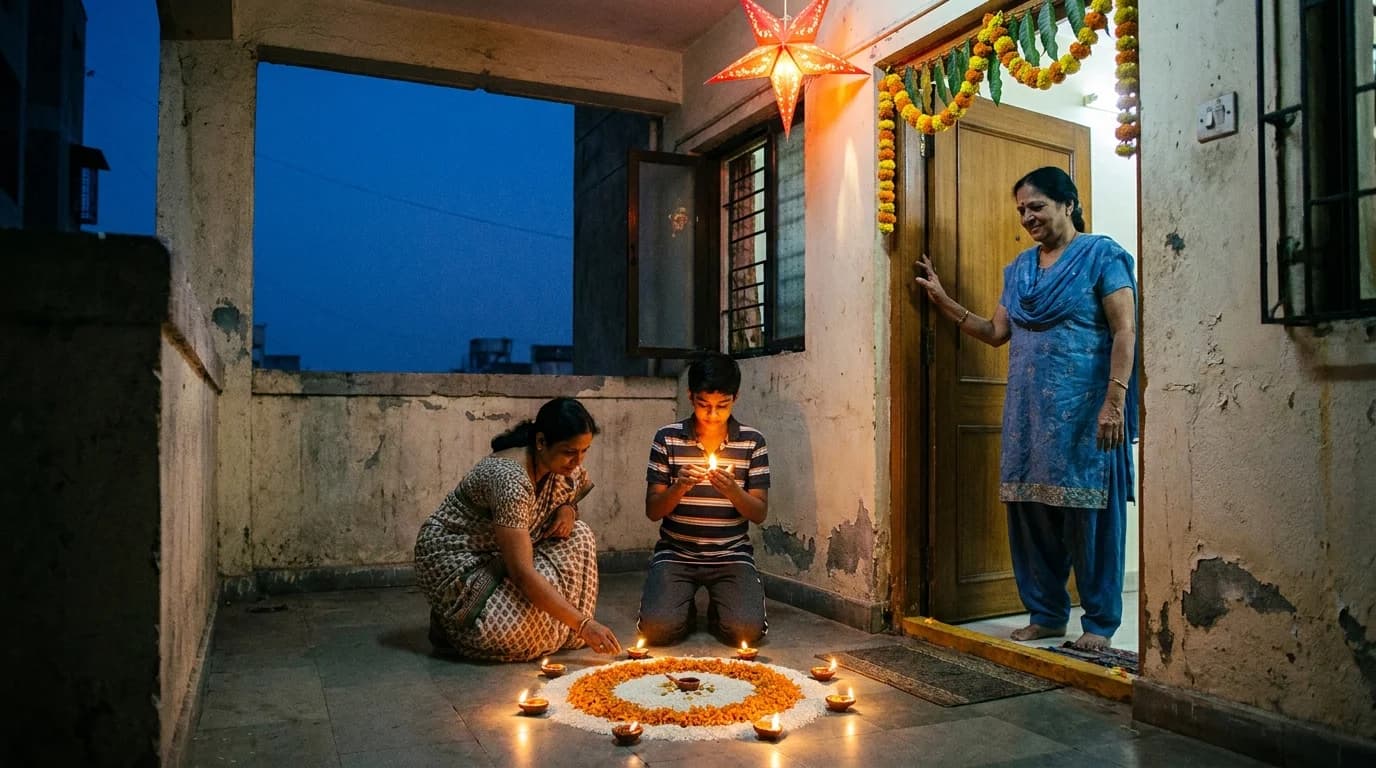
Diwali party ideas start with picking the right night
Diwali 2026 runs Friday 6 November to Tuesday 10 November. Dhanteras is the Friday, Chhoti Diwali (Naraka Chaturdashi) the Saturday. Lakshmi Puja, the main night, is Sunday 8 November. Govardhan Puja and Balipratipada follow on Monday the 9th, which is Bestu Varas if your family keeps the Gujarati new year, and Bhai Dooj closes it on Tuesday.
The spread is kind this year: both nights you can actually throw something on land on a weekend.
My pick is Chhoti Diwali, Saturday the 7th. The house is already cleaned and lit by then, and nobody has to be up for a Monday morning. Dhanteras Friday works too, if your crowd finishes its shopping early. Leave Sunday alone. Badi Diwali belongs to whichever house you grew up in. Bhai Dooj is for siblings, and Padwa morning is when half of Gujarat and Maharashtra is out doing its own rounds.
Saturday has one more thing going for it. In Tamil Nadu, Kerala and much of Andhra, Deepavali is the Naraka Chaturdashi morning: oil bath before dawn, lehiyam, crackers at six. So by Saturday evening that half of your guest list is done, while the North Indian half is still a day short of its own puja. The 7th suits both.
If your friends all take the week off to travel, use the Saturday before, 31 October.
Light it properly, then stop
The mistake I see in every second society is quantity. Somebody wraps forty metres of colour-changing LED around the balcony grill and puts it on chase mode. By eight the flat looks like a mobile shop.
Pick warm white and stay there. One clean line of earthen diyas along the parapet does more than every inch of railing you can cover.
Things I have learned the expensive way:
- Soak new diyas in water for half an hour before filling them. Dry terracotta drinks the oil and you will be refilling by nine.
- Mustard oil burns longer than ghee and costs a fraction of it. Keep the ghee for the puja thali.
- Buy the wicks pre-rolled. Rolling sixty batti by hand at 6 pm is how a good evening starts badly.
- Hang one big paper kandeel where the road can see it. A dozen small ones read as nothing from below.
Test last year's jhalar in the third week of October, because half the box will be dead and the warm-white strings sell out first. And put up the marigold and mango-leaf toran on the morning of the party. A week-old one is worse than none.
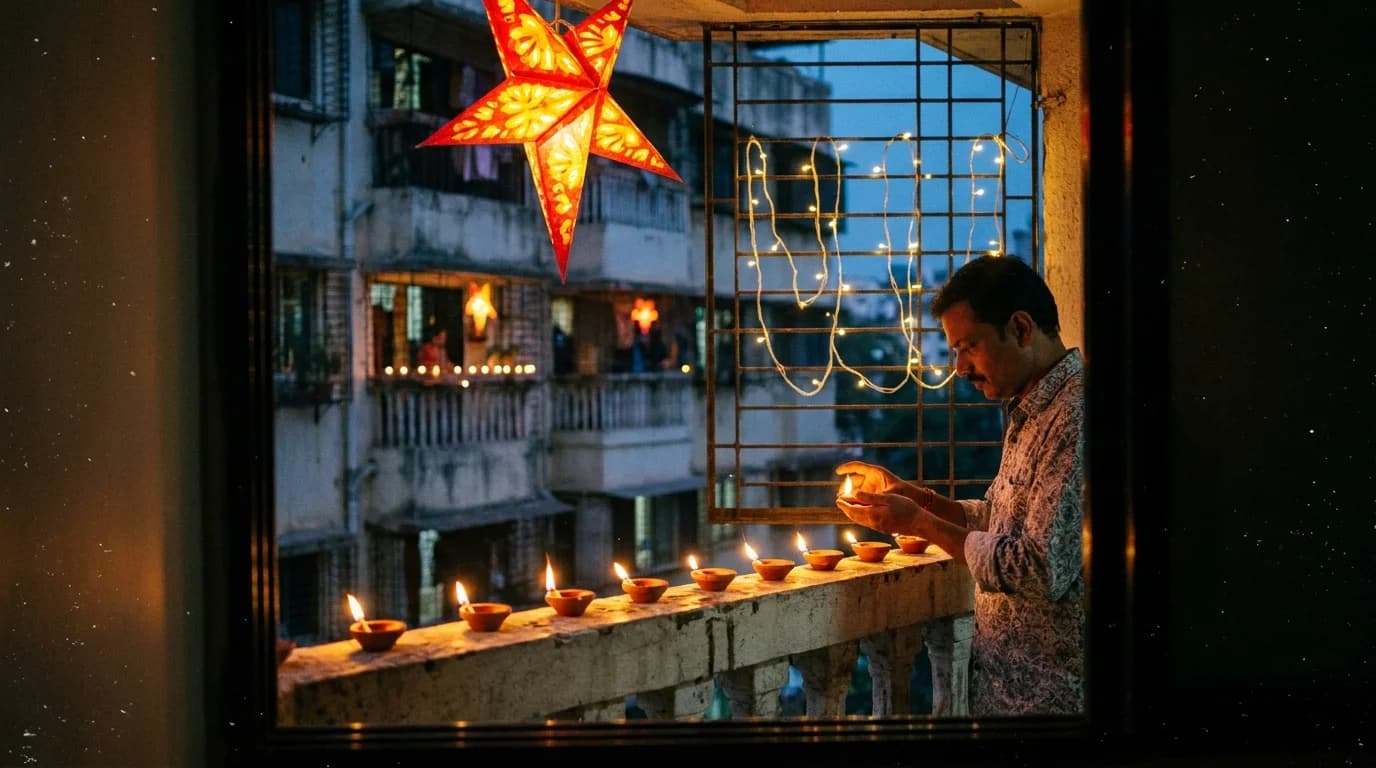
Rangoli, honestly
A freehand rice-flour rangoli at the doorstep is the most beautiful thing in the house, and it will last about forty minutes once guests start arriving. That is fine. It is a welcome laid out for Lakshmi and it is meant to get scuffed by chappals.
So plan two. A modest one at the threshold that you accept will be wrecked, and the ambitious one somewhere nobody walks: the middle of the dining table, or a ring around the puja thali.
If you cannot draw, use flowers. A rangoli built from pulled-apart marigold heads, rose petals and a few loose genda strings is forgiving in a way powder never is. No line work, no steady hand. It survives feet and sweeps up in one go at midnight. With powder, rice flour and haldi and gerua and crushed hibiscus give you every colour you need. The fluorescent pink synthetic stuff looks like poster paint under a phone flash.
Stencils are fine. Nobody at your party is running a purity check. Use the stencil for the outline and fill it freehand so the thing has some hand in it. Set your diyas into the pattern while you are still drawing. Placing them afterwards smudges an hour of work.
Give the children a square of floor and a bowl of colour. You will get a lopsided sun with eight legs. Put it at the front door.
Serve faral and one hot thing
By the evening of the 7th, everyone on your guest list is done with sweets. So lead with the savoury. Faral is the whole point: chakli, chivda, shankarpali, karanji, mathri, namak pare, whatever your family's version of the tin is. Put it out in the dabbas so people graze all evening.
Then add exactly one hot thing that turns it into a meal. A chaat counter is my favourite for a Diwali crowd: hire one person for three hours and let them turn out ragda pattice and dahi puri to order. A degh of biryani works too, if you would rather everyone sat down. One hot dish done properly, and the faral carries the rest.
Order your mithai in the second week of October, because any halwai worth queuing at closes his books by Dhanteras week. And break the dry-fruit box habit. That laminated tray does three laps of the colony before anyone opens it.
If frying faral alone at five in the morning is what has been putting you off hosting, hand it out. My potluck guide covers splitting a menu so you don't end up with four tins of chivda and no karanji.
Set up a taash table
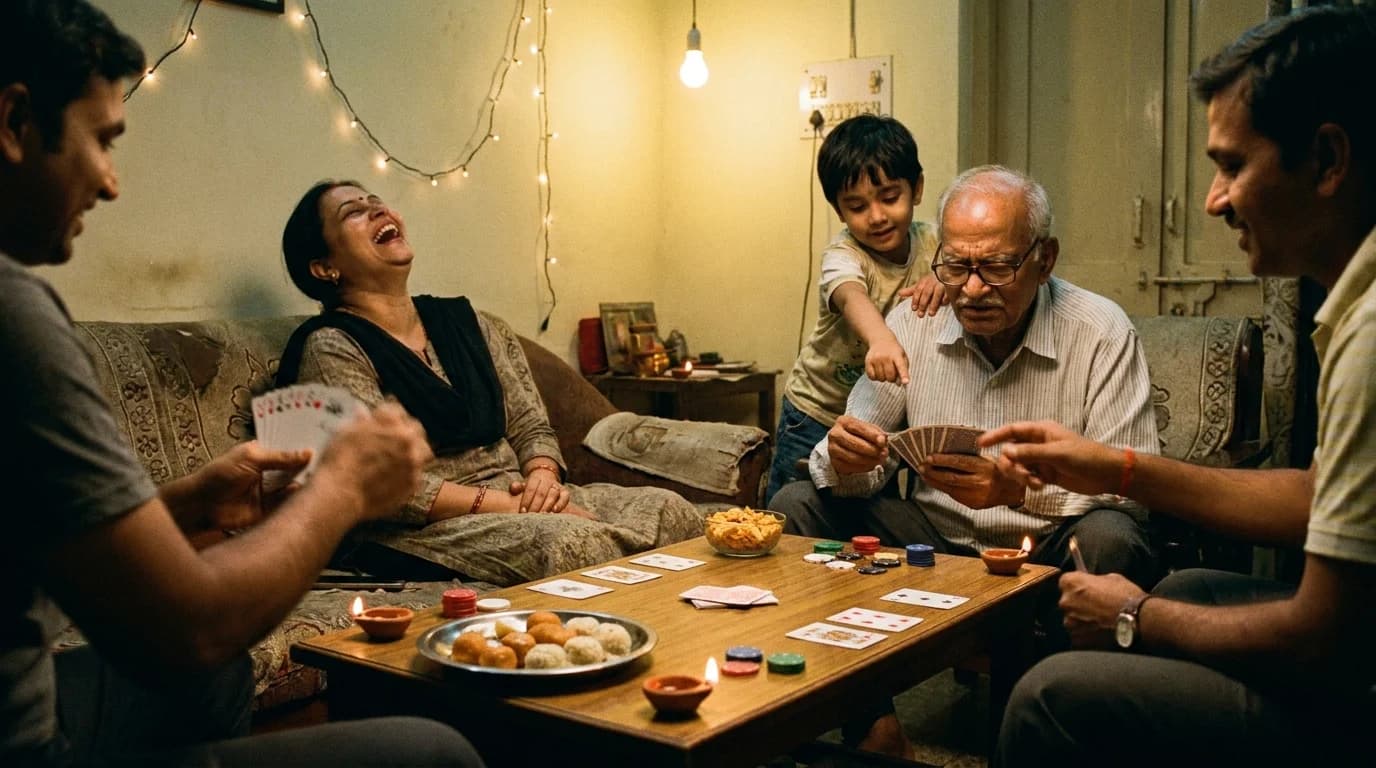
Somewhere between the puja and dinner, the cards come out. Plan for it rather than pretending it won't happen.
Set the stakes on the invitation and play with chips. A Rs 500 buy-in, chips on the table, no cash moving until the end of the night. Nothing sours a Diwali evening like one cousin sitting eight thousand rupees down at half past one while everybody else studies the ceiling.
Keep a second table for the people who don't play. Housie with a mithai box as the prize pulls in the aunties and the ten-year-olds at once.
Put the children's phuljhadi at seven, while there is light and the adults are still sober enough to supervise. Then a room with a projector, so nobody is underfoot when the second round of flush starts.
The crackers conversation
The rules move every year and by city: green crackers only in many places, permitted evening hours, hard bans in pockets of Delhi NCR. Check what applies where you live, because being the flat that drew a police complaint is a poor way to spend Diwali.
Beyond the law, use judgement about the building. Every society in India has a newborn on the third floor and a terrified dog on the fifth. Anaar with the kids at seven makes a happier memory than a 200-shot at midnight, and costs a tenth as much. Put your building's rule on the invitation so nobody turns up with a boot full of ladi.
Diwali invitation wording that gets you a reply
The invitation is where most at-home Diwali plans come apart, because there usually isn't one. Word goes out as a forward in the family group at eleven at night. Three people react. You then spend the week unsure whether to order mithai for fifteen or for forty. The same thing goes wrong with an at-home Ganpati, and it costs you the same sleep.
Some wording you can lift:
Dhanteras evening, family and neighbours. "Diwali at ours. Friday 6 November, from 7 pm. Lakshmi puja at 7.30 if you would like to join, dinner after. Come whenever, stay as long as you like."
The taash night. "Taash and faral at our place. Chhoti Diwali, Saturday 7 November, 8 pm onwards. Flush and rummy, chips only, Rs 500 buy-in. Nobody is mortgaging the house."
The Padwa drop-in. "Our door is open on Monday 9 November, 11 am till the chakli runs out. No need to fix a time with us. Just come."
For friends doing three other houses that night. "Come any time between 8 and 11 on Saturday, whenever your rounds let you. There will be food the whole way through."
Four rules I would hold to. Give people a window instead of a fixed start time, because a Diwali evening is a circuit. Mention the puja and when it starts, so nobody walks in mid-aarti with their shoes on. Be clear about the food, since "dinner" and "faral and drinks" are different instructions about whether to eat at home first. And drop "gifts not necessary", which no Indian guest has ever believed. Ask for something real: "Bring nothing. Or bring a box of your mother's karanji." Our guide to writing an event description goes deeper on the parts hosts leave out.
For the invitation itself, I describe what I want to Lemonvite's design engine in one line, something like "Diwali at home, rows of diyas, marigold and deep maroon, gold rangoli border", and it designs the festive invitation in seconds. Then it goes out by text, which is the one channel a family group cannot swallow. Each guest taps once to RSVP, so by the first week of November I know whether the mithai order is fifteen boxes or forty.
Get it out in October
Diwali invitations want to be out in the third week of October, around the time the garba nights wind up. Leave it later and you are competing with four other houses and a set of in-laws who fixed their round a month ago. If you hosted a Navratri garba night this season, that guest list is already sitting there.
My mausi did come the next evening, as it happens. She sat on the floor with the karanji tin while I swept up what was left of a rangoli that hadn't survived an hour, and it was a better night than the party I had planned. I would still rather have both. Describe yours and send it from Lemonvite this month, then spend November lighting diyas instead of chasing replies.