
How to Get a Block Party Permit in San Antonio
San Antonio does not have to be talked into closing a street. Every April the city hands whole neighborhoods over to Fiesta for a week and a half of parades and street food, with lawn chairs staked out on curbs by nine in the morning. Closing a road here is a municipal reflex.
That works in your favor when you go get a block party permit in San Antonio, though not the way you would hope. It is no cheaper or faster here than anywhere else. What you get is an office that has processed this request a thousand times and knows exactly what it wants from you. Show up with the answers and it moves. Show up vague about who is placing your barricades and you will be back on the phone next week.
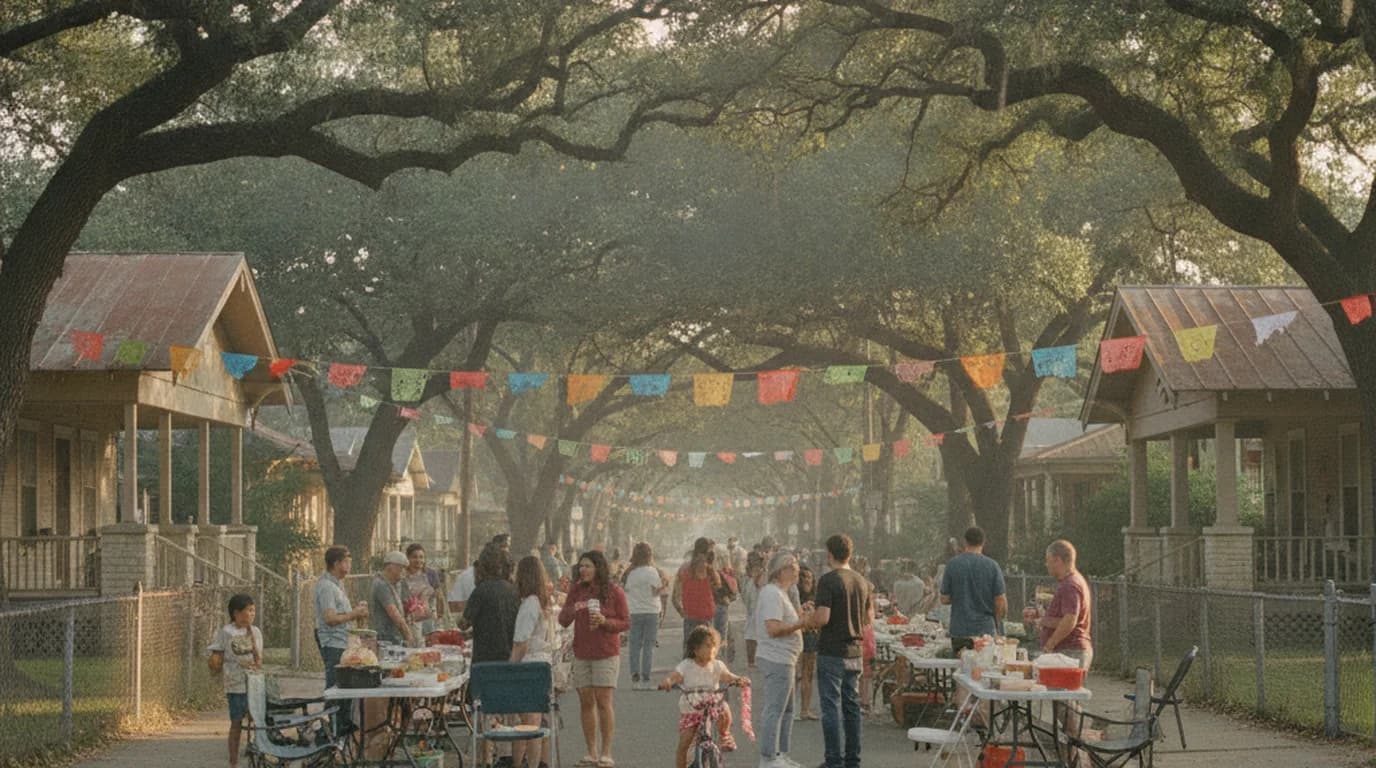
Two Names for a Block Party Permit in San Antonio
The city's own page calls it a Block Party Permit. The forms and the ordinance behind it call it a Temporary Street Closure Permit. Same document. Every city names this thing differently, which is half the reason this series exists.
It comes out of the Public Works Department, specifically the Right-of-Way Management Division. Two other offices will sound to you like they should own it and do not. Center City Development and Operations runs downtown vending and street performer permits. Parks and Recreation handles events inside city parks. A neighborhood block party is a right-of-way matter, and the number for it is 210-207-6949.
Fire and police read your application, but neither issues the permit. ROW staff judge the traffic feasibility, route the request to SAFD and SAPD, notify EMS and VIA Metropolitan Transit, then recommend approval to the Office of the City Manager. SAFD's part of that is essentially a yes or no on whether a fire truck can still get down your street, which is why your site map has to show a continuous 20-foot emergency vehicle lane through the closure. Your council member sits nowhere in that chain, even though the application asks which district you are in.
A Hundred Dollars a Block, Per Day
$100 per block, per calendar day. The figure traces to Ordinance 2009-09-17-0731L and appears on the live city page and in the city's instruction PDFs. Two blocks on one Saturday is $200. One block across Saturday and Sunday is also $200.
There is no separate application fee, and you do not pay at filing. ROW contacts you once the City Manager's office signs off. Pay online, by phone with a requested cashier call-back, or in person at the Cliff Morton Development and Business Services Center, 1901 S. Alamo, counter 23.
Then there is everything the city declines to price. Barricades are mandatory and the city says flatly that it does not supply them, so you hire a certified company at whatever they quote. Off-duty police officers, if PWD or SAPD decides your closure needs them for traffic control, are also yours to provide and pay for. Neither number is published anywhere. Call two barricade vendors early, since a quote also tells you whether they can cover your date.
Insurance is the honest question mark. Nothing in the block party materials mentions it. The parent right-of-way page does carry heavy requirements, starting at $5 million of combined general liability and umbrella coverage plus performance bonds and an annual $45 registration. But that block is written for contractors cutting into streets, while the block party instructions tell an individual to select "Myself" and "None Applicable" under licenses. Whether any of it reaches a resident throwing a potluck is published nowhere I could find. Five minutes on the phone settles it before you build a budget on the wrong assumption.
Every Fronting Property Signs, and a No Does Not Sink You
San Antonio's neighbor rule gets misread in both directions.
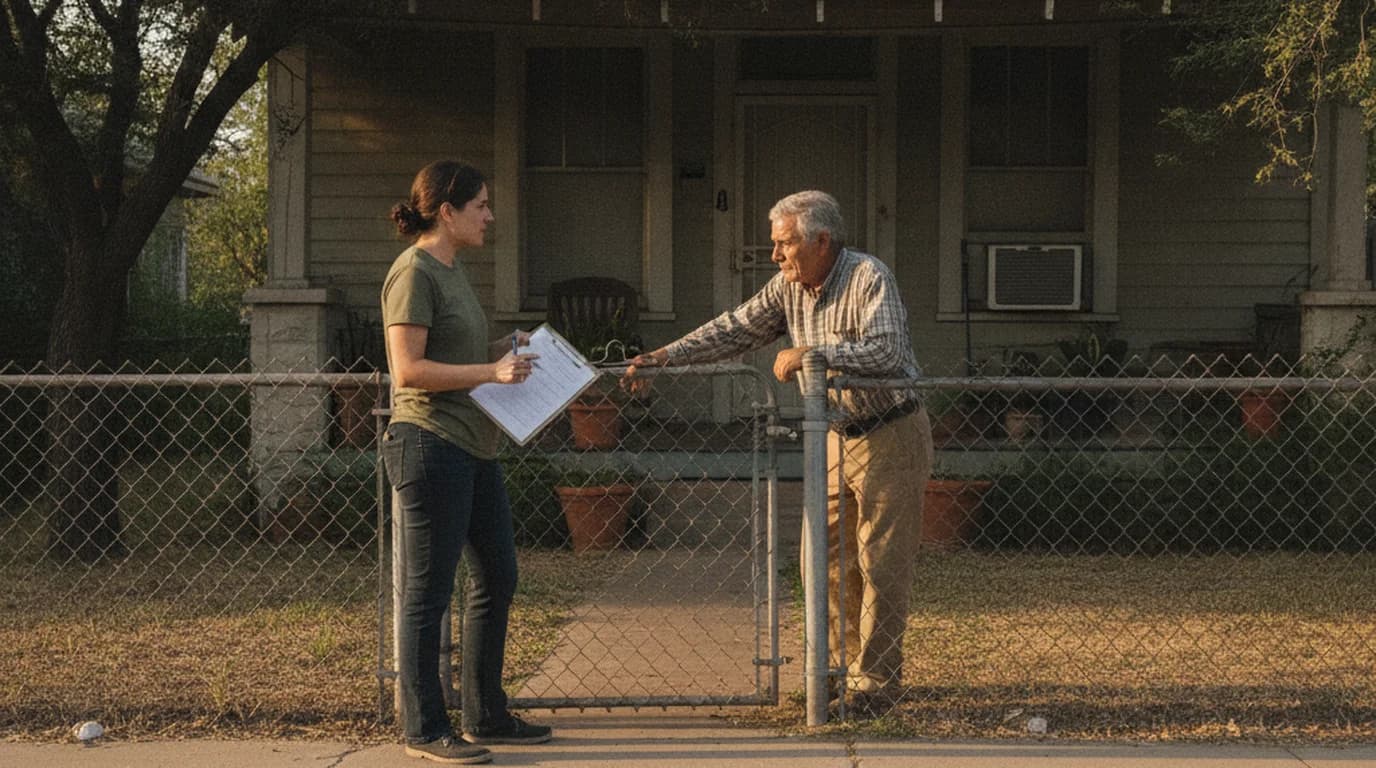
The city wants written acknowledgement from all residents and businesses whose property or driveways front the street being closed, regardless of whether they are participating. Every one of them. There is no majority threshold and no frontage formula. The shop on the corner that will be walled off all afternoon still signs.
Then read what they are signing. Every line on the acknowledgement form pairs a signature and address with a box marked approval or disapproval, and the form says outright that the closure may be permitted even if a signer indicates disapproval. It is a notification requirement wearing a petition's clothes.
Which flips the usual anxiety. The neighbor who hates the idea is not your obstacle. The one who is never home is. A disapproval is still a signature on the sheet, while a blank line is a hole in your application.
Fill in the top of the sheet before you circulate it, since the form instructs signers not to sign an incomplete one. It holds ten numbered lines, so a long block runs to a second page.
Primarily Residential, and Nothing More Specific
One sentence does most of the gatekeeping: streets that are not primarily residential in character will not normally be considered for this type of closure. The city publishes no list of banned roads, so the test is judgment: an arterial is a bad bet, a quiet residential block an easy one.
A bus route is not automatically disqualified. VIA gets notified, and accommodating public transit is one of the conditions that can trigger a custom traffic control plan. That is an escalation, and escalation eats into your 30 days.
The other thing that can sink a date without any published rule behind it is a conflict with another closure. San Antonio publishes no blackout calendar and no lottery. Reviewers check whether something else is already booked nearby, which in a city with this much appetite for street events is not a theoretical risk on a spring weekend.
Thirty Days Is the Floor, and Barricades Set the Real Deadline
Submit at least 30 calendar days before the closure date, and treat that as a floor rather than a target. Every review in that routing chain has to finish inside it, and then the money still has to move, since you pay after approval. A permit that clears review on day 29 is not a permit until the payment lands.
You also cannot file until a barricade company's name is in hand, which pushes your real start earlier than the deadline suggests. Placement has to be done by people certified under the Texas Manual on Uniform Traffic Control Devices, so you name a certified company or supply certificates for whoever is doing the placing.
Usually a TxDOT standard detail covers a residential closure and nobody asks for anything custom. But the city can require a traffic control plan drawn by a Texas-certified designer under special conditions, one of which carries its own deadline: lighted dynamic message boards posted a full week ahead on high-volume roads. If your closure touches anything busy, plan around that week.
And if SAPD does require officers, the city is explicit that they cannot be co-utilized for event security. They direct traffic at the spots SAPD names. Anyone keeping an eye on your party is a separate arrangement.
The Permit Closes a Street and Nothing Else
The street closure permit closes a street. That is its entire scope, and the city says so: approval does not imply approval of activities that require other permits.
Alcohol is the one the city names. If you are serving, a separate application goes to the TABC, with its own fee. Past that the block party materials go quiet. Bounce houses, grills, tents and food vendors are not addressed in them anywhere. The city's only instruction is the catch-all, that you work out whether any other permits apply to what you are doing in the right-of-way. Ask ROW rather than assuming an inflatable in the road is fine because nobody wrote down that it isn't.
The noise ordinance is what will actually end your party. No curfew appears in the closure permit. Chapter 21 of the city code does that work instead, and the numbers are tighter than people expect. The ceiling on residentially zoned property is 63 dBA, measured from a neighboring property under separate ownership. Daytime and evening runs 6am to 10pm Sunday through Thursday, 6am to 11pm Friday and Saturday. After that a 7 dB correction applies, dropping the effective residential ceiling to roughly 56 dBA. The chapter's exemption list covers permitted parades and city-sponsored celebrations, and a block party you requested privately is neither.
63 dBA is conversation and a speaker you can talk over, nowhere near DJ territory. Build the evening around the food table instead, which is the better party anyway. Hand out real assignments rather than an open-ended "bring something," and the potluck guide covers how to do that without a spreadsheet nobody opens.
Filing It, Screen by Screen
The review never pauses while you go find a vendor, so the job is arriving with the answers.
- Set your date, then your close and re-open times with setup and removal inside them. Barricades out at 10am for a 2pm party means your closure starts at 10.
- Get a contact person and a phone number from the barricade company. The form asks for both.
- Draw the site map, closure limits named by the cross street at each end, 20-foot lane running through. Room for three segments if you are closing more than one block.
- Collect the acknowledgements.
- Register at the city's permit portal, aca-prod.accela.com/COSA. The city publishes an eight-page walkthrough of the screens if you want to see them first.
- Under the Public Works tab, choose Create an Application, select "Myself" and "None Applicable" under licenses, then expand the list and pick Block Party. It is easy to land on an excavation permit by mistake.
- Fill in the record with your event, the closure limits and your council district, then add contacts for both the applicant and the barricade company.
- Upload the site map under Supporting Documentation with the document type set to Sketch, then submit. The confirmation page gives you a record number, which is your permit number in the system.
- Pay after approval, $100 per block per calendar day, then give ROW the receipt number.
Where the City's Own Paperwork Will Mislead You
More than one version of this process is live on the internet, and search engines prefer the wrong one.
The legacy packet, "Procedure for Applying for a Temporary Street Closure Permit," still sits on a city server and still ranks. It tells you to email a signed form to TEMPBLKPTYSTCL@sanantonio.gov or drop it at counter 20. The current process is the portal. Older revisions of that document call the department "TCI," short for Transportation and Capital Improvements, which is now Public Works. Stale, all of it, right down to the fee ordinance number, which the packet prints with a typo. The correct one is 2009-09-17-0731L.
Two links your results will hand you are dead outright: the 311 knowledge base article on temporary street closures, which now resolves to a "resource not found" page, and rowpermits.sanantonio.gov, which no longer resolves at all. Third-party summaries sometimes circulate 210-207-5749, while the number on the city's current pages is 210-207-6949.
The portal itself is contractor-shaped. Its instructions tell you to name your application "Company name - Address of Block Party" while also telling an individual to pick "Myself" and "None Applicable." A resident does have a path through. It just does not feel built for you, which is reason enough to call 210-207-6949 first and let someone walk you in.
Signing Is Not the Same as Coming
Once the permit lands you have a closed street with a fire lane you have to keep clear, plus forty households who signed a form six weeks ago. Signing an acknowledgement tells them nothing about what time the tables go out or whether they were supposed to bring a side.
The city can give you the street for a day. The rest of it is getting the block to walk outside.
Signing the acknowledgement is not the same as showing up, and the gap between those two is where block parties die. Feed the details to Lemonvite and the invitation comes back made for them, sent by text. Publish it, then put the RSVP page's QR onto a flyer for the doors along the closure. A scan is an RSVP, which is a headcount, which is how you know whether you are feeding forty people or ninety. Then message all of them.