
How to Get a Block Party Permit in Austin
Austin has an entire interdepartmental coalition whose job is closing streets. The Austin Center for Events exists because this city routinely hands downtown over to festivals with six-figure attendance, and at that job it is excellent.
It is also the wrong building for what you want, which is one residential block, one Saturday afternoon, and the forty people who already live there. A block party permit in Austin comes from somewhere else: Transportation and Public Works runs a program called Living Streets, whose Neighborhood Block Party permit is a deliberately smaller process costing $52 total. Four things push you back onto the expensive festival track: vendors, alcohol sales, structures big enough to need a fire department tent permit, or a closure on an arterial or collector street. Avoid all four and everything below is your entire process.
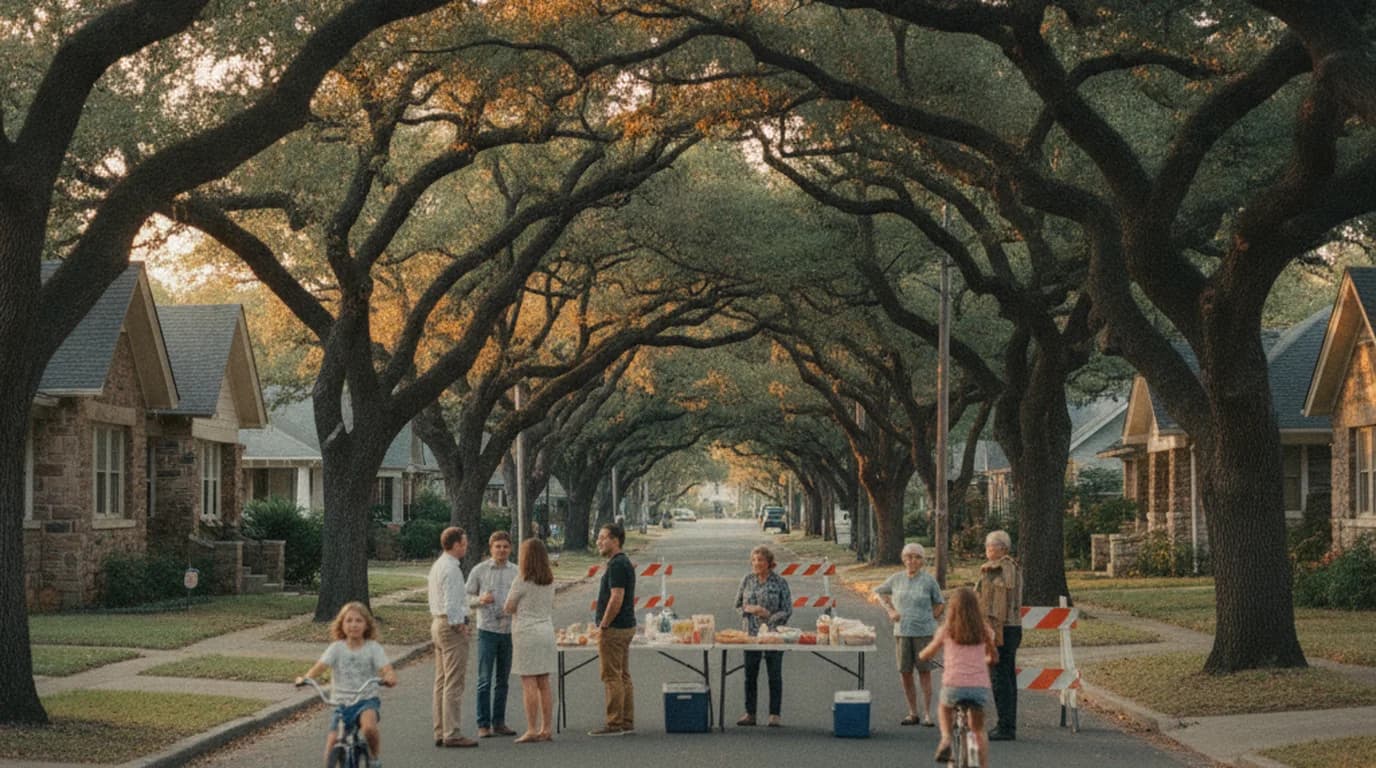
The Permit's Real Name
Ask for a "block party permit" and any city staffer will know what you mean, because the code uses that exact phrase. The form says Neighborhood Block Party (NBP), issued under City Code Title 14, Chapter 14-8, Article 3.
That chapter splits in two. Article 2 covers special events, which need a closure permit plus a separate ACE special event permit; Article 3 covers block parties, which need one permit and nothing else. Everything you need sits on the Living Streets program page and in Chapter 14-8 on Municode. Nothing routes through a council office or APD, and there is no lottery.
Fifty-Two Dollars, Barricades Included
The fee is $52 total: a $50 application fee plus a 4% processing surcharge. No second permit fee waits behind it, and there is no deposit or insurance requirement. What Article 3 wants instead is indemnification, under § 14-8-36, baked into the site map template you upload.
Barricades are free. Once you are approved, you can reserve the city's set: four barricades, four barricade lights, two "Road Closed" signs, two Living Streets signs, two vests, and two walkie-talkies. First come, first served, while supplies last. If the shelf is bare you upload a rental quote from a traffic control company instead, at whatever they charge; the city publishes no range.
You also do not pay at submission. Staff review first, the status flips to "Application Reviewed - Pending Payment," and then you pay and print the permit yourself. The track you are avoiding charges $198.67 to $298.00 just to process an application, another $117.55 to $235.00 to permit it, then $55 to $235 per block per day for the street itself.
Fifteen Days Is the Deadline. Do Not Actually Use It.
The program page and the portal say 15 calendar days. The ordinance says 10: § 14-8-33(D) sets that floor, and the conflict between two official city sources is live right now. Use 15, which is what the department publishes and its portal enforces.
Then ignore both numbers, because 15 days only measures when the paperwork has to be in. Staff review, revisions, an invoice, your payment, and barricade pickup all come after, and the free barricade sets go to whoever asks first. Submit at exactly 15 days and you may end up renting your own. Apply a month out.
Be careful with older advice, too: plenty of it still quotes 80% approval and 10 days notice. The city rebuilt the application in October 2025, so a page that never mentions the Living Streets portal predates the change.
Sixty Percent Sign, One Hundred Percent Hear About It
Two thresholds, and people conflate them constantly.
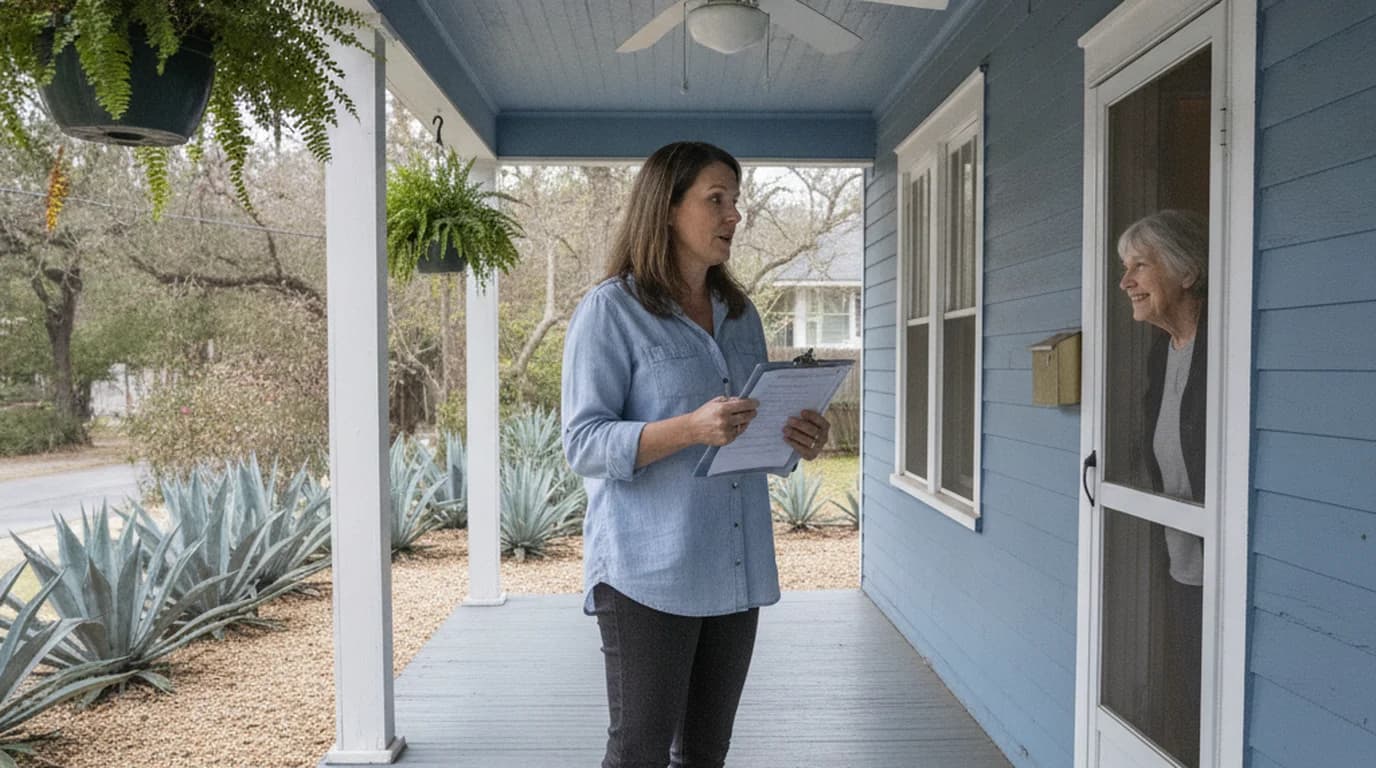
At least 60% of the households on your block have to approve, with signatures on the official Resident Sign-Off Form the portal hands you when you start an application. A sheet you typed up yourself will not count. Separately, 100% of the block has to be notified, reachable by flyer, postcard, door hanger, yard sign, or email, and you upload proof that you did it.
A school, a place of worship, or a business on the block each signs its own approval form on top of the 60%, with a timing constraint attached: the party falls outside school hours or scheduled services, and a business should not be open during the closure. Those blocks also lose the narrow emergency lane option below.
Go door to door for all of it, including the 40% a yard sign would technically cover. The person who calls 3-1-1 about the noise at 8 p.m. is nearly always the person nobody bothered to knock for. Twenty minutes with a clipboard on a Sunday morning is cheap insurance, and it doubles as your first save-the-date.
The Viability Map and Five Automatic Disqualifiers
Before the clipboard, check the city's Neighborhood Block Party Viability Map. Streets shaded purple are the likely-eligible ones.
Your block has to be a local road (Level 1 or lower) and at least 15 feet wide. It also has to be a complete single block that closes at a cross street on each end; midblock closures are not allowed. Land use has to be primarily single-family or duplex; multifamily gets a case-by-case safety review that can send you to ACE. Two of the disqualifiers below are in the ordinance itself and are not negotiable:
- A traffic signal at either end. An automated traffic control device is an automatic no.
- A Capital Metro bus or rail stop on the block.
- Paid parking on either side, which rules out a good chunk of central Austin.
- An intersection with a Level 4 street or higher. Level 3 is case-by-case.
- Arterial and collector streets, full stop.
Cul-de-sacs and dead ends qualify, but they use their own site map template and a stricter emergency lane width. One last trap: this permit covers City of Austin right-of-way, so an Austin mailing address sitting in unincorporated Travis County falls outside Chapter 14-8. Email LivingStreets@AustinTexas.gov if you are unsure; it is the only contact the city publishes, and there is no phone line.
What You Can and Cannot Do Once the Street Is Closed
The emergency lane is the rule that gets enforced. Austin Fire wants a clear, undisturbed path the whole time. You can narrow it to 15 feet only if the street has access from both ends. Dead ends need 25 feet, and so does any block with a building three stories or taller. School, church, and commercial closures need 25 at all times. Street parking is allowed only where a clear 25 feet survives with it, which usually means asking people to park around the corner. Two adult monitors in high-visibility vests, one at each end, work the barricades for emergency vehicles and residents.
Amplified sound runs 10 a.m. to 10 p.m., capped at 75 decibels. No separate sound permit appears anywhere in the NBP materials, unlike the special events track, where a sound evaluation alone runs $677.29.
No vendors, and no alcohol sales. A food truck can serve your party from private property. Whether neighbors can drink their own beer in a closed street is not addressed in any official NBP source I could find, so ask Living Streets rather than trusting a blog post, this one included. Grills are the same blank, and in this city that is worth asking about in writing.
Tents are allowed within limits: each 10 by 10 or smaller, total area up to 700 square feet with no sidewalls, or 400 if any has them. Bounce houses go on private property, along with anything else that cannot be moved fast.
The closure is one-time and capped at 24 hours. Closing a street without a permit is a Class C misdemeanor carrying a fine up to $500, each day a separate offense, and the director can halt the party on the spot. A denial gets 10 business days to appeal to the director, and that is the end of the road.
Pick the Month Before You Pick the Date
Applications are rolling. No lottery, no blackout dates, and no seasonal window appears in any official source, which means the constraint on your block party is not the city. It is August.
An Austin street in July or August is a griddle. Asphalt holds heat long after sunset, and a permit good until 10 p.m. is cold comfort at four in the afternoon. The good windows are late October into early December and March into April, which is also when everyone else wants the free barricades. Apply early. And if you are set on summer, start at six: you get four hours before the sound cutoff and a temperature that falls instead of climbing. Put your tent square footage where people will stand rather than over the food, and borrow a few summer party ideas built for heat.
How to Get a Block Party Permit in Austin, Step by Step
- Check the viability map for your block.
- Read the detailed block party rules in the portal and download the forms.
- Confirm you qualify against the eligibility list above.
- Create a Living Streets applicant account in the portal.
- Collect signatures from 60% of households on the Resident Sign-Off Form, plus the school or place-of-worship form if either applies.
- Notify the other 40% and keep proof. Photograph the flyer, save it as a PDF or JPEG.
- Draw the closure diagram on the template, which comes in street-block and cul-de-sac versions. It is also your indemnification agreement.
- Submit at least 15 calendar days out, ideally 30, and answer staff review fast. Every day you sit on a reply eats your own cushion.
- Pay the $52 invoice, then download and print the permit.
- Reserve the free barricade set or upload a rental quote.
- On the day, carry the permit, set the barricades the way the city's video shows, put a vested adult at each end, and keep the emergency lane clear.
- Afterward, pull it all down and reopen the street on time.
Not qualifying sends you to the TPW Office of Special Events at TransportationSpecialEvents@austintexas.gov or 512-974-6501, and to a much bigger bill.
Fifty-Two Dollars Buys You an Empty Street
The permit is the tedious half, and $52 later it is behind you. What you bought is a couple hundred feet of road with no cars on it and a guest list that lives within shouting distance. Food is where these usually fall apart, so assign it like a real potluck instead of hoping nine households independently think to bring ice. Austin is one of thirty cities in our block party permit walkthroughs, so pass the link to whoever is organizing on your cousin's street in Denver.
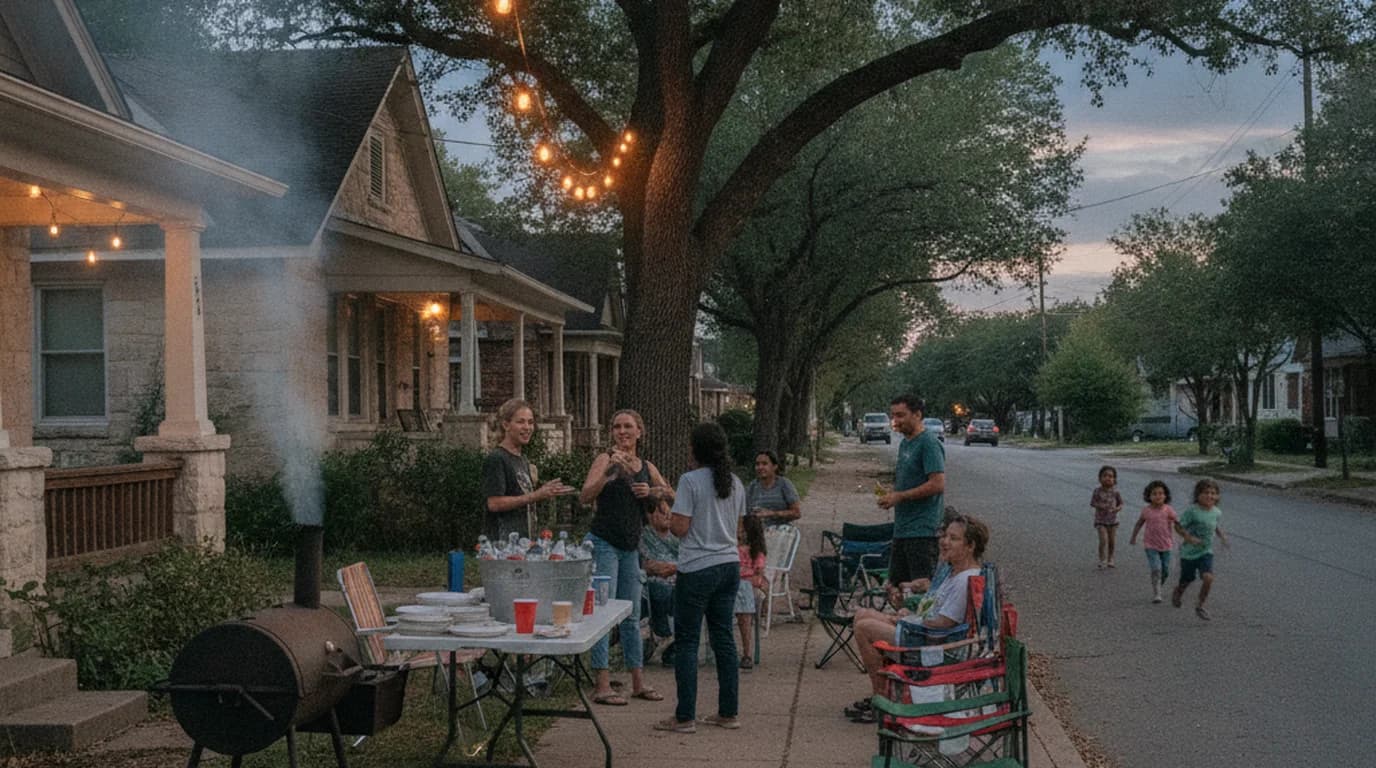
Use Lemonvite for the event itself, because a permit only gets you the street. Describe the party at Lemonvite and you get an invitation designed for it, sendable by text. Publish it and you also get a public RSVP link with a downloadable QR code, which is the piece that matters on a block this size: print it on a flyer, staple it to the poles at both ends of the closure, and anyone who walks past can scan and RSVP without you knowing their number. Then message everyone who said yes when the smoker goes on.