
How to Get a Block Party Permit in Phoenix
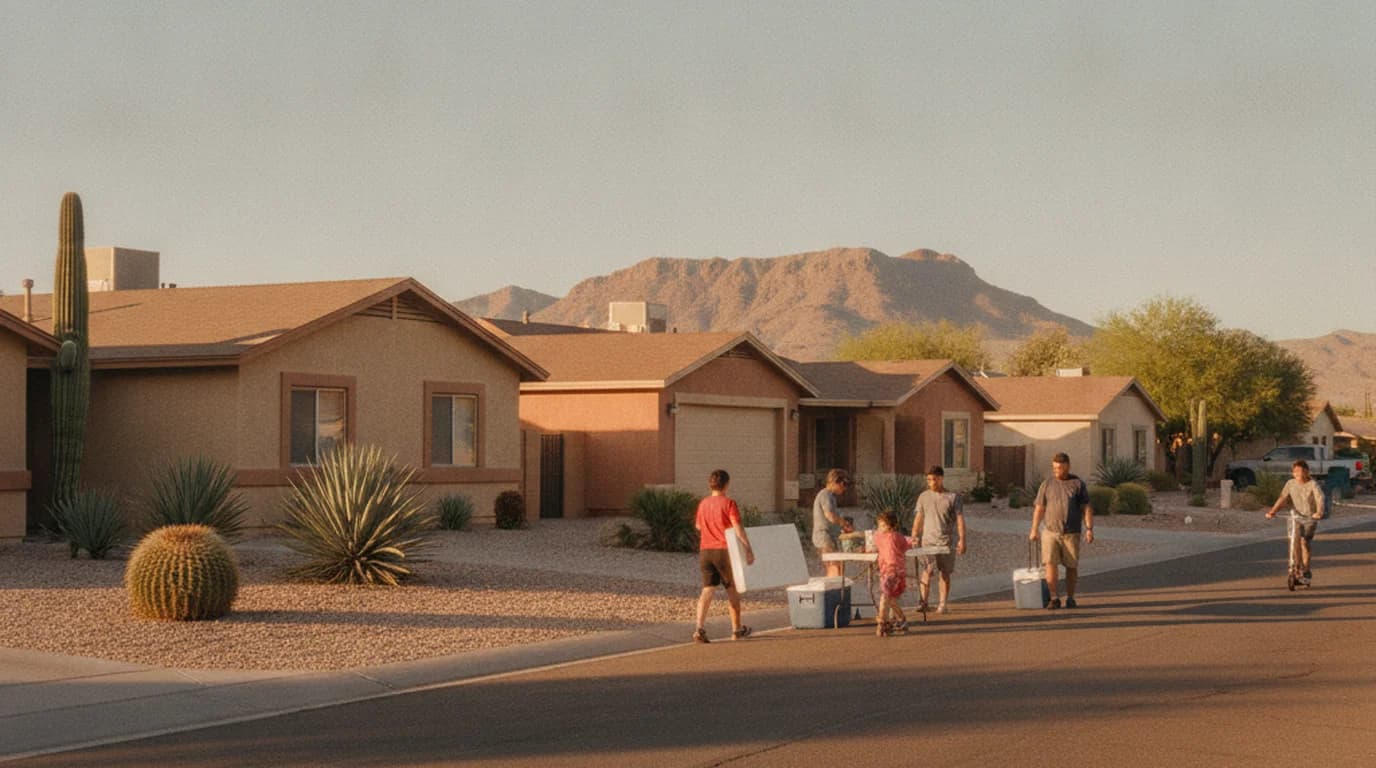
My neighbor Dana started planning a block party in July. She had the potluck spreadsheet built and a taco cart quoted before anybody asked whether human beings would voluntarily stand on a Phoenix street in July. They would not. We moved it to the first Saturday in November. Tables went out at four, and 43 people stayed until nine.
That is the real first decision. Getting a block party permit in Phoenix is one of the easier things city hall will ever ask of you: there is no fee, and the application is a single online form. Phoenix closes streets for nearly 200 of these a year. Your street in August is what argues back. Pick the date first, then do the paperwork.
Phoenix Block Parties Are an October-Through-April Sport
The city publishes no seasonal rule. No blackout window appears in any Phoenix block party document, no annual cap, nothing stopping you from closing your street on the third Saturday in July. So the constraint here is the climate rather than city hall: October through April, ideally November through March.
A block party happens on asphalt, and asphalt in Phoenix soaks up heat all day and hands it back after dark. A 7 p.m. start in June still means standing on a warm griddle. Kids sit on the curb. Dogs walk on it. And the older neighbors, the ones you most want at this thing, look at the forecast and stay inside.
Rough guide to the calendar:
- November through March. Start mid-afternoon and run into the evening. Four to eight is the sweet spot, and it is dark by six in December, so plan on string lights.
- October and April. Push everything later. Six o'clock start, and let the temperature fall into the party.
- May through September. Wait.
Shade is the thing people underestimate. Most Phoenix streets have nothing overhead, and newer subdivisions have thin young trees that throw a shadow the width of a yardstick. Get canopies over the food table, and buy about twice as much water as you think you need. The rest follows normal outdoor party ideas, with the sun treated as an actual adversary.
What the Permit Is Called and What It Costs
The City of Phoenix Street Transportation Department runs this, and the formal name is the Block Party Street Closure Permit. What lands in your hands is an authorization letter; the city's paperwork uses both terms. (People look in Neighborhood Services first. NSD lends cleanup tools and runs neighborhood grants, nothing that closes a street.)
The cost is nothing. The city's Block Party Street Closure Permit guidelines put it plainly: "There are no fees for a block party authorization letter. Your only cost is in furnishing the traffic barricades and signs necessary to close the street."
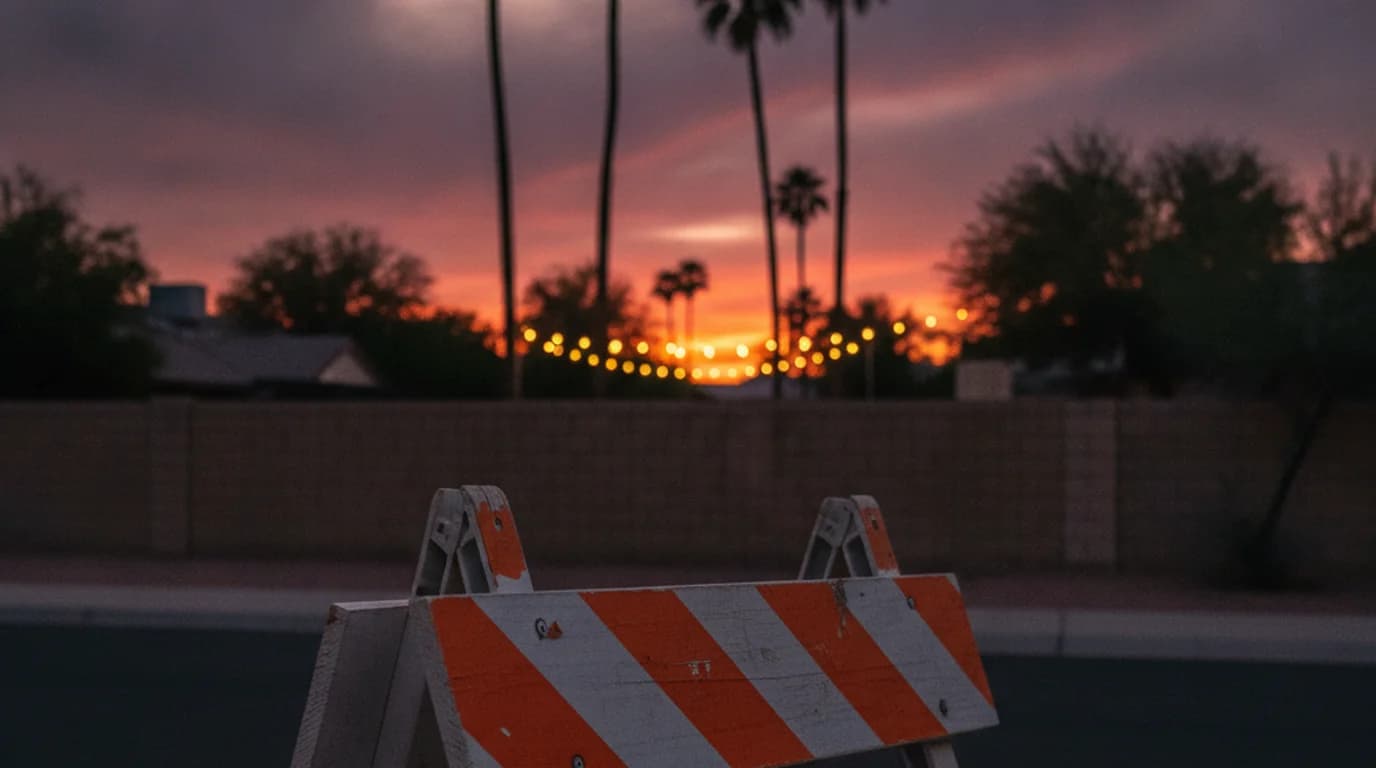
That second sentence is your whole budget. You need four Type I barricades, two at each end, with one "Street Closed" (R11-2) sign mounted on a barricade at each end. If any part of your party runs after dark, and in winter it will, add flashers. The city is blunt about whose problem this is: "The City does not lend or rent traffic control equipment."
Phoenix does not publish what that rental costs, and tells you outright that prices vary and you should call around. Ring 602-262-6235, Monday through Friday, 7 a.m. to 3:30 p.m., for the list of certified traffic control companies, then get quotes from several. Any dollar figure you find online is somebody guessing.
If you have seen photos of a city-owned block party trailer loaded with barricades and games, that belongs to another city's program. Phoenix does not have one.
The Rule That Disqualifies Most Block Parties
The guidelines document has a section that opens with "STOP!" You lose the free permit if any of this describes your party:
- It is advertised and open to people outside your neighborhood
- It has live entertainment or amplified sound
- Outside vendors are involved
Sit with the middle one for a second. Amplified sound. A DJ, a band, a rented PA, somebody's speaker stack aimed down the street. Almost everyone planning a block party assumes music is a given, and by the city's own rules it disqualifies you. Same story for Dana's taco cart.
(The city's block party FAQ renders this rule with a stray double negative: "you do not not qualify." You don't.)
If a DJ is non-negotiable, the fallback is the Street Closure Special Event Permit: a $400 nonrefundable application fee, submitted at least 90 days ahead, through str.specialevents@phoenix.gov or 602-495-7442. My advice is to shrink the party back inside the free rules. A speaker on a porch has settled this for a lot of streets.
Two more eligibility items. The closure has to be a local, non-emergency residential street; arterials and collectors are off limits, and Phoenix's grid means plenty of houses front a collector. The applicant also has to live on the street being closed.
Two Deadlines, and Nobody Warns You About the Second
- The application is due at least three weeks before the event. The guidelines PDF: "A block party online application must be completed and submitted at least three [3] weeks prior to the event or it could not be approved."
- The Hold Harmless Agreement is due at least two weeks before. Both the FAQ and the PDF say it: "Hold Harmless Agreements must be received two weeks prior to the party."
The city reviews your application and emails further instructions plus the Hold Harmless petition within two to three business days. Do the arithmetic and your canvassing window is about one week: apply on day 21, get the packet around day 18, and you have until day 14 to collect signatures from a whole street of people who work and travel.
Worse, the petition is not downloadable. You either wait for the city's email or call 602-262-6235 and ask them to send it, which is the move if you want a head start.
One caveat before you count backward on a calendar. The three-week deadline and the 70% threshold below both come from that guidelines PDF, marked Rev. 3.3.2020. The more recently updated FAQ repeats the fee, the 11 p.m. cutoff and the two-week Hold Harmless deadline, but never mentions either number. Call 602-262-6235 and confirm before you build a schedule on them.
Getting the Signatures
You have to notify and get signatures from residents of every household on both sides of the street you want to close. The city bolds the standard: "All addresses must be accounted for!" The guidelines document sets approval at 70% of the neighbors who live on your street.
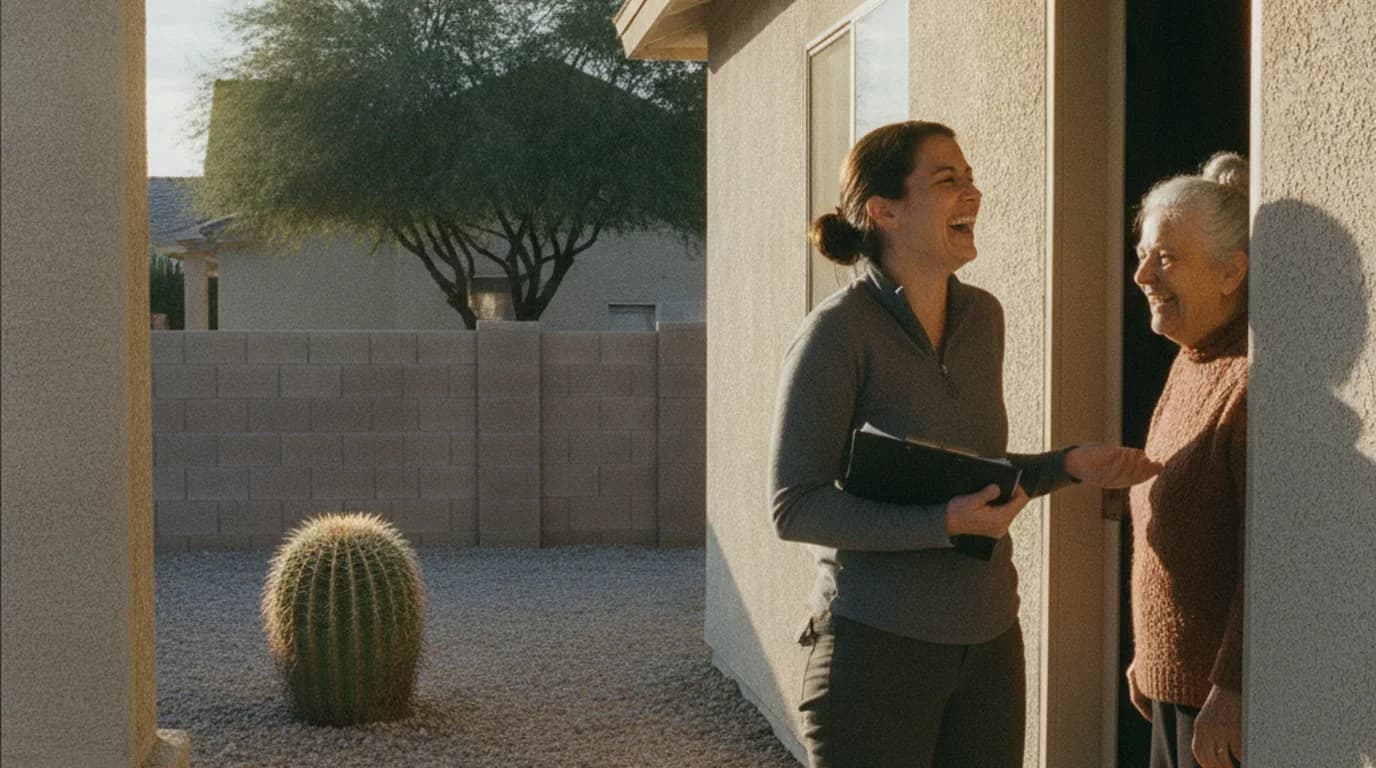
Accounted for is a gentler bar than it sounds. An owner on vacation, an owner who flatly refuses, a vacant lot: note it on the petition and keep walking. If nobody is home, leave a note on the door with a number to call you back on.
What works when you knock:
- Go in the early evening, five to seven in winter. Midday canvassing gets you nobody at the door and a sunburn.
- Lead with the exact times. "We are closing the street from four to eight on Saturday the 14th, barricades gone by nine" gets a signature. "We were thinking of doing a block party sometime" gets a shrug.
- Most refusals are logistics. Somebody works a 6 p.m. shift and needs the driveway clear. Ask what time they leave and it usually dissolves.
- Knock in person. The neighborhood Facebook group will get you seventeen opinions and zero signatures.
How to Get a Block Party Permit in Phoenix: The Steps in Order
- Confirm you are inside the City of Phoenix. Unincorporated county islands carry Phoenix mailing addresses.
- Check the street classification. It has to be local and non-emergency, so no arterials or collectors.
- Run the party past the disqualifiers. Your street's residents only, nothing advertised beyond the block, no amplified sound or outside vendors.
- Apply at least three weeks out at phoenix.gov/streets/blockparty.
- Wait two to three business days for the review email and the Hold Harmless petition.
- Canvass both sides of the street. Every address accounted for, 70% approval.
- Return the completed Hold Harmless Agreement at least two weeks out.
- Watch for your authorization letter. That is the permission slip.
- Rent the equipment. Four Type I barricades, two "Street Closed" signs, flashers after dark.
- Set two barricades and one sign at each end on the day.
- Wrap up by 11 p.m.
- Pull the barricades and put the street back the way you found it.
Highlighted in yellow at the bottom of the guidelines: "violation of these guidelines and instructions, may result in the denial of any future block party requests." Which means the guy who insists on rolling his speakers out at nine is spending next year's party too.
Two Real Gaps in What Phoenix Publishes
Alcohol. No Phoenix block party page, FAQ or PDF addresses it. What does exist is state law: A.R.S. section 4-244(20) makes it unlawful "for a person to consume spirituous liquor in a public place, thoroughfare or gathering," with narrow carve-outs including private property with the owner's permission. A closed street is still a thoroughfare, and nothing the city publishes says an authorization letter changes that. Keeping drinks in driveways and front yards is the conservative read; 602-262-6235 is where to get a real answer.
Grills, fire pits, bounce houses, kiddie pools. Not addressed in any block party document either, and neither is how long a block can be or how many households it can hold. Same phone number.
If You Are on a County Island, None of This Applies
Maricopa County has large unincorporated pockets that carry Phoenix mailing addresses and sit outside the city. Out there, block parties fall under MCDOT and ordinance P-36, which names "neighborhood block parties" outright as special events in the county right-of-way. That path is not free:
- Special Event Plan Review: $100.00 per sheet ($50 for subsequent sheets)
- Traffic Control Plan Review: $30.00
- Permit Processing: $50.00 per permit
- Liability insurance naming Maricopa County as additional insured, at $1,000,000 per person, $2,000,000 per accident and $1,000,000 property damage
MCDOT Permits and Records: 602-506-8600, mcdotpermits@maricopa.gov. Check which side of that line your address falls on first, because it changes the budget by three figures. The same trap catches people in half the cities we wrote up, Las Vegas worst of all.
The Canvass Already Did the Hard Part
Your authorization letter lands about two weeks out, which happens to be the right lead time for the invitation itself. Convenient, since you already wrote down every address during the canvass.
Then settle the potluck plan before somebody asks you what to bring, because on a closed street, somebody always asks.
The canvass already introduced you to seventy percent of the block, which makes this the easy half. Describe the party to Lemonvite for an invitation built around it, sent by text. Your published event also opens an RSVP page with a QR worth printing on a flyer for the doors where nobody answered. Every scan is an RSVP. Then use the same event to message everyone attending, because between October and April the good start time keeps moving.