
How to Get a Block Party Permit in Baltimore
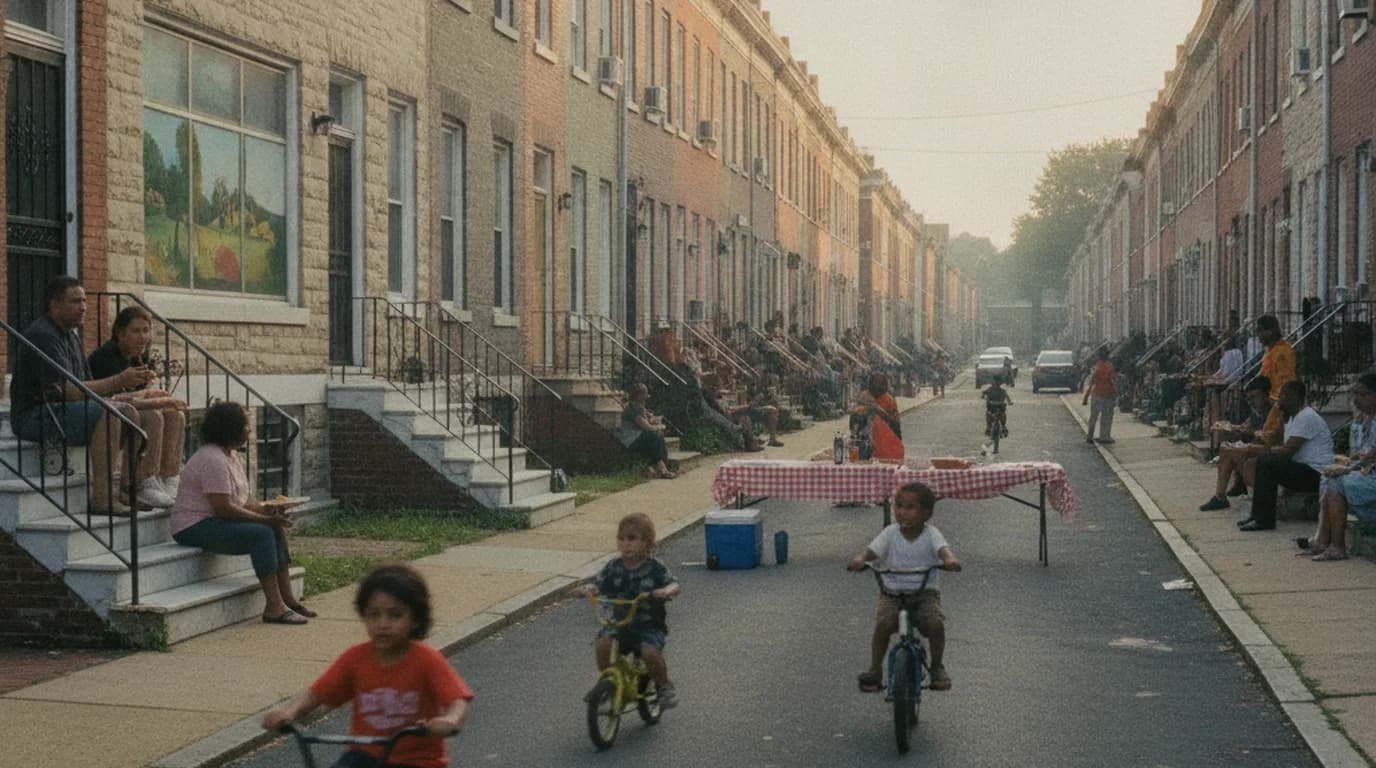
Baltimore built the block party into its architecture and never took credit for it. Rowhouses run shoulder to shoulder down the length of the street, front doors a single step off the sidewalk. Under every door, a slab of white marble. The stoop is a bench the city poured into the front of every house, and people sit on them the way other cities use a backyard, which is to say constantly and without planning it.
A block party is that habit with the cars gone. Getting a block party permit in Baltimore is more forgiving than the internet makes it look, once you settle one thing: which Baltimore you live in.
Baltimore City and Baltimore County are separate governments, with separate offices and separate forms. Search results blend the two constantly, and anything you land on at baltimorecountymd.gov is the wrong jurisdiction for a city street. Everything below is Baltimore City.
What a block party permit in Baltimore gets filed as
You are applying to the Baltimore City Department of Transportation, through its Right-of-Way Services Division, at a desk everyone just calls Special Events. What BCDOT issues is a Special Event Permit. No separate block party record type exists in the system.
"Block Party" is a designation you choose inside that one application. Picking it collapses a long special-event form into a short residential one and puts you on a cheaper fee line. Start at the city's Block Party page for the fee schedule and criteria; the application itself lives on the OpenGov permitting portal.
Two things will trip you on the way in. The PDF that still ranks at the top of search results for a Baltimore block party application is dead: the old 2021 BLOCK PARTY APP.pdf went 404 when the city migrated its site. Applying is online only now.
And the application describes itself, on screen, as being for "OPEN TO PUBLIC events that are 5 days or less," while a block party is required to be closed to the general public. That contradiction stops mattering once you select Block Party in the Designation of Event dropdown, but it stops plenty of first-time applicants cold.
One fee, and it climbs the longer you wait
| When you submit | Block party application fee |
|---|---|
| 8 or more weeks before the event | $50 |
| 6 to 8 weeks before | $65 |
| 4 to 6 weeks before | $80 |
Under four weeks there is no price at all. Applications must be submitted no less than four weeks before the day of the party. Miss that and you are outside the window entirely, at any price.
All fees are non-returnable, which is the city's own word for it. A denied permit does not come with a refund. Nothing stacks on top of that application fee for a qualifying block party. And ignore the "$25 for a period of three months" figure that surfaces in search-engine summaries; it appears on no official page and contradicts the published schedule.
If your block runs its party through an incorporated neighborhood association or another registered nonprofit, ask about the discount before you pay. The system carries a separate 501(c)(3) block party fee line, and the staff-side rate field spells out a 50% reduction on city charges. What that comes to in dollars is unpublished, so it takes a phone call to 410-396-1916.
Eight questions decide whether your block qualifies
The Block Party designation is gated behind eight yes-or-no questions. Answer no to any single one and the form tells you flatly that the event does not meet the criteria.
- Is the event for the residents of one block and their guests?
- Will attendance be 200 people or fewer?
- Is the event closed to the general public?
- Is the proposed block a local residential street?
- Is the block free of bus routes?
- Does the street closure exclude intersections?
- Will the event end before 9 p.m.?
- Will there be no sales of food and no sales of alcoholic beverages?
Four and five are where good plans die. Check your block against MTA routes and the Charm City Circulator before you get attached to a date. The Play Streets guide adds, describing rules it calls similar to a block party, that a designated truck route or an emergency route is out, as is a block with metered parking.
Six catches everyone who assumes "the block" runs corner to corner including the corners. Your closure stops short of the intersections.
The city sets no start time, only the 9 p.m. end, which is where Baltimore's baseline quiet hours begin.
Nobody signs anything, until you plug in a speaker
Baltimore asks for no petition. No percentage of households to hit, no frontage math, no consent sheet, no notarized anything. Having read through a stack of city permit processes for this series, I can tell you how rare that is. In most cities the signature sheet is the hardest part of the job.
Then you add music, and a consent requirement walks in from a different agency.
The block party permit does not cover noise. Amplified sound or music means you also need a Temporary Noise Exemption from the Baltimore City Health Commissioner. It lets you exceed the health code's permissible sound levels by no more than 25 decibels, it has to be filed at least 20 days ahead with the Bureau of Environmental Health, and it requires documents evidencing community support: letters from adjacent residences or from your community association.
Two agencies, two clocks. The shorter one is the easy one to blow. DOT wants four weeks minimum and eight for the cheap fee; Health wants twenty days. People file with DOT, then discover the noise window shut while they were waiting on approval. Run both at once.
The right noise form for a block party is 9-209, the private-event version, since a block party is private by definition. The city's Other Licenses page links the public-event form, 9-303, which works fine and is not yours. Every published link to 9-209 that I could find returns a 404, so call the Bureau of Environmental Health at 410-396-4427 and have them send you the current one.
Even with no signature requirement, canvass the block. For the Play Streets designation the city makes you: applicants must provide evidence of notification of all households, using a form on pages 10 and 11 of the Play Streets Organizer Guide that collects contact details rather than approvals. Whether DOT informally expects the same for a one-off party is not published anywhere. Do it regardless. It is the cheapest complaint insurance available.
What you can put in the street, and the line you cannot cross
Selling. That is the line. Selling food or alcohol does not add a fee to your block party, it disqualifies the whole application and pushes you into the full special-event process.
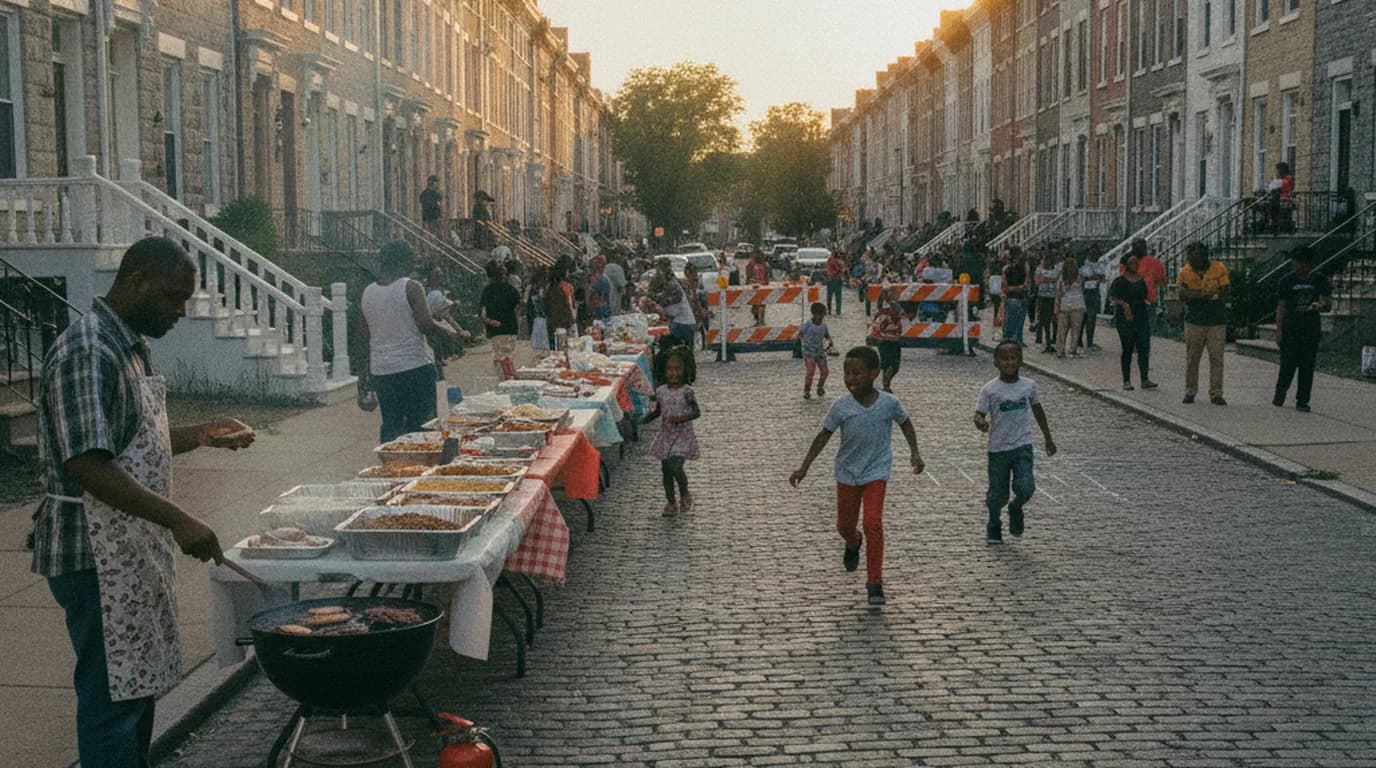
Giving food away is completely fine. The form asks whether food will be onsite and how it will be cooked, down to how many tents and tables you are setting up for it. Which makes a potluck the natural format, and a block-length potluck is worth structuring properly unless you want to finish the day with four pans of baked ziti and nothing to drink.
Grills are allowed, with conditions the city is specific about. You provide appropriate safety equipment, fire extinguishers included. Open burning and ground fires are prohibited. Grease and oil cannot be dumped onto city property, and you are liable for the damage if they are.
Moon bounces, amusement rides and animals are allowed too, but each triggers a liability insurance requirement, with the certificate due at the Permit Office two weeks before the event. Then you hit a wall the city built itself: the application's own link to the required insurance wording is a dead 404 nobody has replaced. A $1,000,000 figure circulates online in connection with Baltimore park permits, a different permit from a different agency. Do not assume it transfers. Get the wording from a human at Special Events before you buy a policy.
Tents go on your site plan, and anything over 400 square feet needs its own permit from the Fire Prevention Bureau.
On drinking, as opposed to selling: the DOT application never asks, and no city page addresses it. Only sales are covered. Read that silence as silence.
Three separate 72-hour rules
They sound like one rule. They are three, and each is on you.
- Post your NO PARKING signs at least 72 hours before the closure, without covering any existing street signs.
- Email a photo of the posted signs, plus your permit number, to parking.permits@baltimorecity.gov 72 hours in advance.
- Pick up the permit and your no-parking signs from the Special Events Office at 401 E. Fayette Ave within 72 hours of the event.
And the Special Events office is closed on Thursdays. Hours are Monday, Tuesday, Wednesday and Friday, 8:30 a.m. to 4:30 p.m. A quarter of the business week is gone, which matters a great deal when your party is Saturday and the pickup window opens Wednesday.
On the day, you may not use vehicles to block off the street. That rule is explicit in the permit conditions; barricades get coordinated with Special Events instead. Keep a 20-foot fire lane clear the whole time, hydrants included. And have an answer ready for the neighbor who needs their car off the block at four.
Filing it, in order
- Confirm you are in Baltimore City. County address, County process.
- Run your block through the eight criteria before anything else.
- Pick the date and back-plan the fee. Eight weeks out buys you the $50 tier. Inside four weeks you have missed it.
- Knock on doors. Optional for a standard block party, required for Play Streets, useful either way.
- Assemble the attachments: a site map (the application links a sample), a flyer or invitation, a timeline for the day, estimated attendance, and the name and phone of whoever owns cleanup. Add 501(c)(3) proof if the party will raise money, and the insurance certificate if an inflatable is coming. That flyer requirement catches people, because at eight weeks out most hosts have not thought about the invitation yet and there is a right window for sending one.
- Apply on the OpenGov portal and choose Block Party under Designation of Event. The form saves your progress, so you can start before every attachment is ready.
- Sign the indemnification clause and pay in the portal. Submitting is not approval. The city says so directly: applying "does not provide permission to conduct your planned event." Your green light is the issued permit.
- File the noise exemption in parallel if there will be music, at least 20 days out, with your community support letters.
- Handle all three 72-hour clocks, and remember that Thursday does not exist.
- Clean up afterward. The cleanup lead you named owns it, and the city has that person's phone number.
Questions go to Special Events at 410-396-1916 or specialevents@baltimorecity.gov. Anything running longer than five days cannot use the online application, so call.
If what you want is every Saturday, ask for Play Streets
Same permit, better deal. Baltimore's Play Streets program is a recurring, kid-focused street closure that BCDOT issues as a block party permit covering multiple dates across up to three months. One application instead of several. The city lends you the barriers and closure signs for the season, and a limited number of free Play Kits go out first come, first served. In exchange it wants the canvassing roster for every household plus a signed Safety Captain Agreement.
Baltimore leaves a few things unpublished, and guessing at a permit office is how you get turned away. There is no stated cap on block parties per block per year on any city page or inside the application logic. Do not import another county's three-per-year rule; it is not Baltimore's. The nonprofit fee amounts, the insurance coverage figure and whether Play Streets carries its own charge are unpublished too. Ask about all of them on the phone before you plan around a number.
The marble is already there
The permit is the part with rules. Getting fifty neighbors onto the asphalt is the part with stakes, and it fails without a sound. Paper taped to a rowhouse door on Wednesday is gone by Thursday, and the top-floor apartment at the end of the block never hears about any of it.
You already have the stoops. Close the street and use them.
The last job is telling the block, and it is the one that decides whether the street fills. Build the invitation on Lemonvite by describing the party rather than picking a template. Once it publishes you get a QR code for the public RSVP link, small enough to print on a half sheet and tape inside the vestibule doors along the row. Neighbors scan from the stoop and RSVP on the spot. You get a headcount, and one message reaches all of them when the tables go out.