
How to Get a Block Party Permit in Fort Worth
There is a specific wasted evening that happens only in DFW. You decide to close your street for a party. You find a city page that looks official, print the form, get as far as the cross streets. Then somebody at the end of the block asks why the header says Dallas.
A block party permit in Fort Worth comes from the Office of Outdoor Events, and nothing Dallas publishes carries over. Different ordinance, different form, different deadlines. The upside: Fort Worth runs one of the shorter processes among big Texas cities. Fifteen days of lead time and a clipboard.
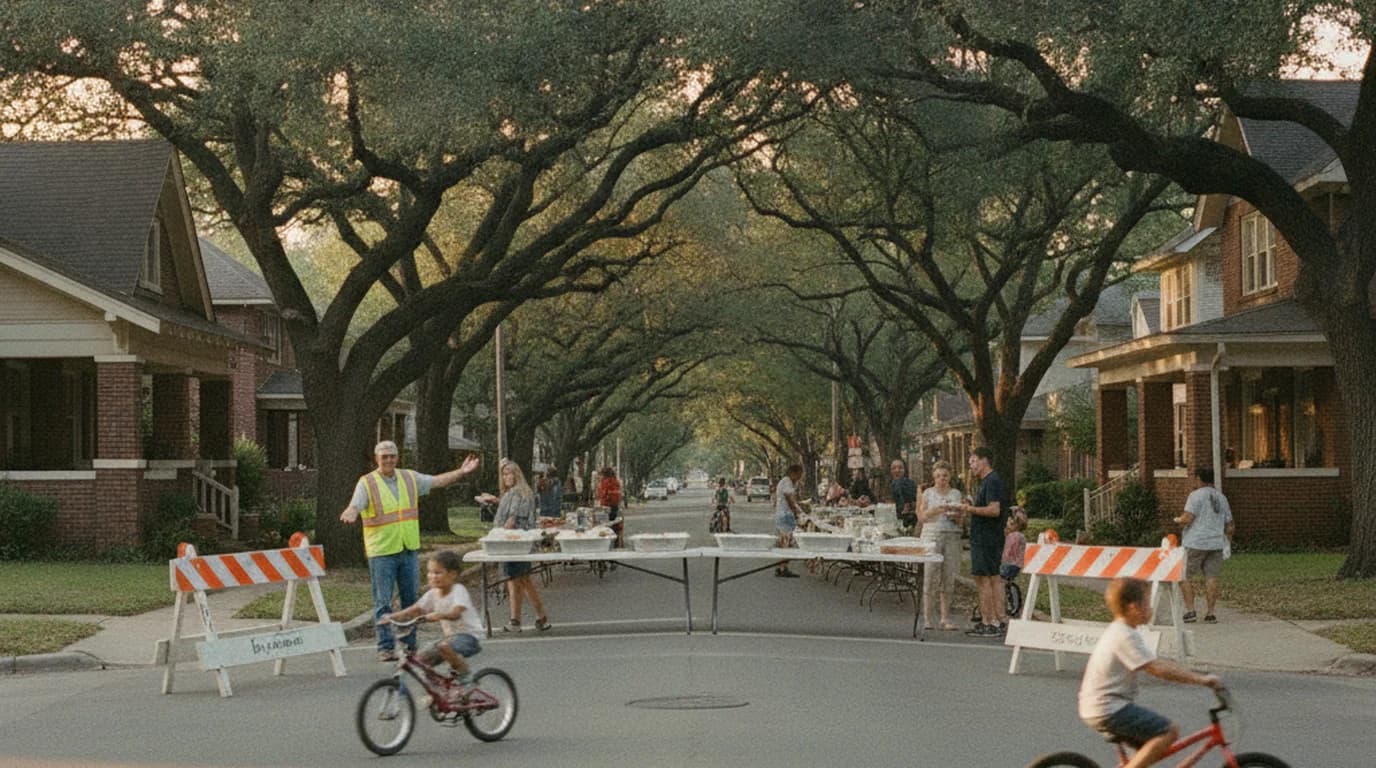
First, Confirm You Actually Live in Fort Worth
This sounds insulting until you look at a map of Tarrant County. Fort Worth's boundary is ragged, and small municipalities sit against it or inside it entirely: White Settlement, River Oaks, Westworth Village, Forest Hill, Everman, Benbrook. A Fort Worth mailing address proves nothing about whose ordinance governs your curb.
Settle it before you spend a weekend on signatures. Your property tax statement lists the taxing units, one of which is the city you file with. If none appears, you are in unincorporated county territory, and Fort Worth cannot close a street it does not control.
Faster: call 817-392-7894 and read them your address and both cross streets. They would rather answer that than reject an application later.
The Office of Outdoor Events, and the Ordinance Behind It
The office is the Office of Outdoor Events, inside Fort Worth's Public Events Department, and the staff role you deal with is the Outdoor Events Manager. You are applying for a Neighborhood Event Permit, one category of the city's Outdoor Events Permit. The form is the "Neighborhood Block Party Application," and the law behind it is Outdoor Events Ordinance No. 19255-08-2010, Division 9 of Chapter 20.
The definition is narrow. A Neighborhood Event is an outdoor gathering with fewer than 500 attendees at any one time on a residential street, sponsored by a neighborhood association or by people living on the block, that closes a street or public right-of-way. Cross 500 at any single moment and you become a Special Event instead, with lead times of 60, 120, or 210 days plus a security deposit.
No online portal exists. You submit by email, fax, or in person, and everything lives in one five-page PDF. Start at the Office of Outdoor Events page and download the 2025 block party packet from there rather than from a search result. A superseded 2022 edition is still on the city's servers, and it is what search surfaces first.
Nobody Will Quote a Price for a Block Party Permit in Fort Worth
The city's own pages contradict each other, so here is the whole conflict. The Office of Outdoor Events web page announces a flat-rate $300 permit fee, inside a paragraph otherwise about large-event deadlines. The block party PDF scopes that $300 to "Events that involve arterial streets," while the parade PDF says "parades" in the identical numbered item. And the 2012 amendment announcement says treating collectors as residential produces "no permit fee for the neighborhood event."
The defensible reading is that a qualifying block party pays nothing, since a Neighborhood Event sits on a residential street by definition and a fee scoped to arterials cannot reach one. But that is inference. No adopted fee schedule for this permit is published anywhere online. Call 817-392-7894 and confirm before you budget off any single page.
What actually costs money, though the city publishes almost no figures:
- No security deposit. Neighborhood Events are expressly exempt from it.
- Barricades are yours to rent, place, staff, and remove. The city supplies none and quotes no rate.
- Clean-up the city finds unsatisfactory, it finishes and bills you, and street damage works the same way.
- Recycle bins are loaned free, at $55 per bin not returned in clean working order.
Fifteen Days Out, But Start the Petition at Sixty
The deadlines are short. The trap is that one of them runs backward.
- The application is due at least 15 days before the event.
- The petition is due then too, but no signature may be dated earlier than 60 days before the event.
- Every resident has to be notified at least 15 days out.
That middle rule burns organized people. Your signature window opens 60 days out and closes 15 days out, so a neighborhood that gets ambitious in February for a June party collects everything twice.
A deadline landing on a weekend or city holiday rolls to the next business day. No seasonal windows or blackout dates.
Fifty Percent Plus One, and Then Everybody Else
You need signatures from at least 50% plus one of the residents on the affected street, on the city's own petition form. Note what that counts: individual residents. The form wants the number of homes on the street, then a signature and address per person.
The petition and the notice are two separate obligations, and people conflate them constantly. Half the street plus one has to sign. Every resident has to be notified, at least 15 days out, by mail, hand delivery, the newsletter, posted signs, or whatever channel your street normally uses.
The applicant must be a neighborhood association or somebody living on the block, which rules out an outside promoter. You also have to name a contact with a 24-hour phone number answered at all times during the event.
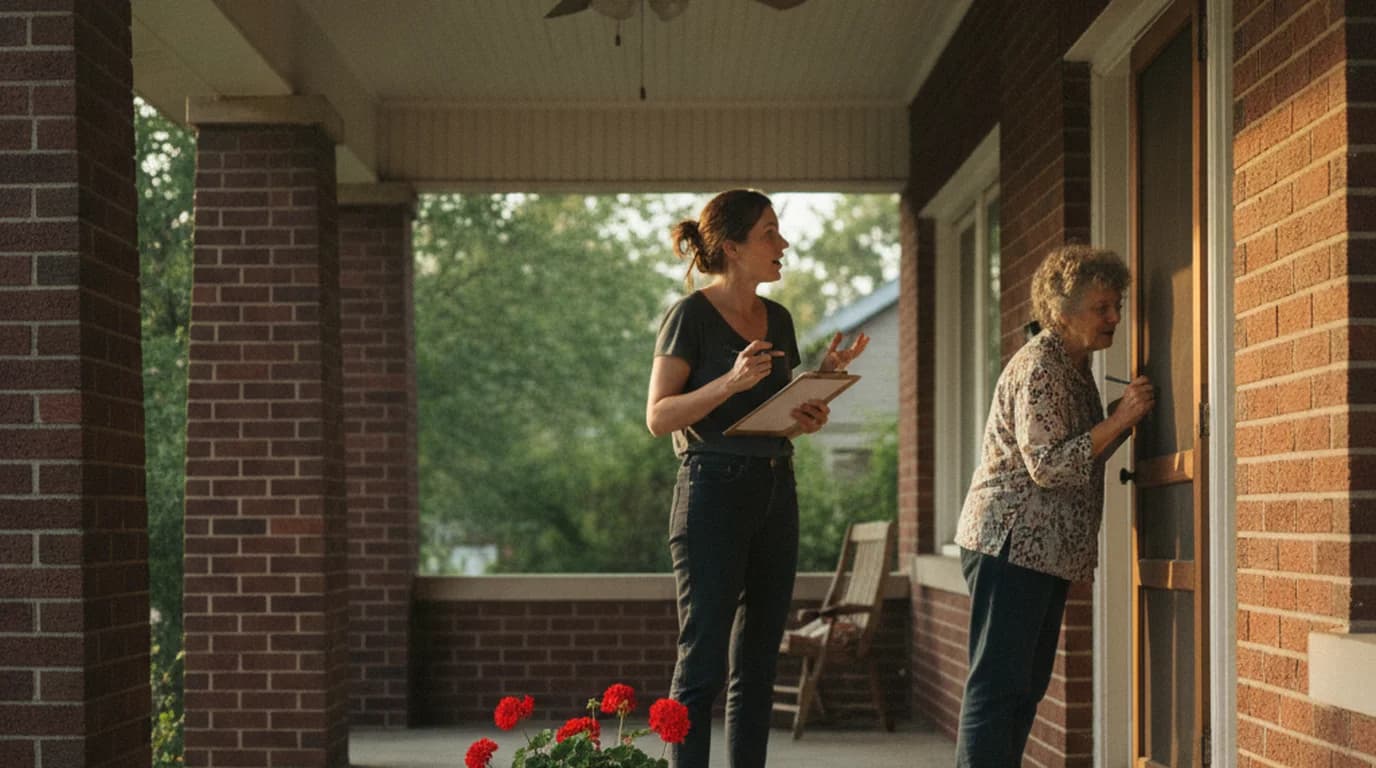
Which Streets Qualify
Residential streets only, as classified in the Master Transportation Plan. The ordinance and the event PDFs still call it the Master Thoroughfare Plan, so do not be thrown by the newer name.
Arterials are out. Collector streets are a judgment call: the 2012 amendment gave the Traffic Engineer flexibility to treat one as residential, which is how a collector-fronting block gets approved at all. Ask early rather than assuming either answer. Your footprint can run no more than 1,300 linear feet, or two blocks, whichever you hit first.
Traffic is what decides it. The ordinance names traffic movement as the primary factor in approval or denial, and no permit issues where a closure would deny emergency vehicles prompt access.
The Twelve-Foot Lane Reshapes Your Layout
One Fire Code rule reshapes your whole layout: a 12-foot unobstructed roadway must stay clear along every closed section. No structures in that 12 feet, on the sidewalk, or on the parkway. Tents, stages, and bounce houses are named specifically. Chairs and tables are fine.
So the inflatable goes on a yard or a driveway. Anything structural in the right-of-way triggers a certificate of insurance: $1,000,000 each occurrence and $2,000,000 aggregate general liability, the city named as an additional insured, plus $1,000,000 liquor liability if you serve alcohol.
Hours and barricades. Any day of the week, but the street reopens no later than 11:00 p.m., with your Type 1 barricades gone a half hour after your stated end time. Each needs somebody 18 or older in a reflective vest standing there the whole event, and every hydrant keeps three feet of clear space. An August block party here starts once the sun is off the asphalt anyway, the shape most good summer party ideas assume.
No admission fees. You cannot charge to attend, though donations are permitted. Selling food is out either way, so this is a potluck, and a potluck runs better on assignments than on hope. My potluck guide covers dividing it up without a spreadsheet nobody opens.
Amplified sound needs no permit. The 2021 noise ordinance caps residential sound at 70 dBA from 7:00 a.m. to 10:00 p.m. and 60 dBA overnight, but a permitted outdoor event is exempt. Your permit is the sound permit.
Alcohol is your problem. TABC permits and training are yours to obtain, at (817) 652-5912. Fort Worth separately restricts public possession in specific areas, reportedly including West 7th, which I could not verify against an official source. Confirm it if your block is near there. Food permits come from Code Compliance.
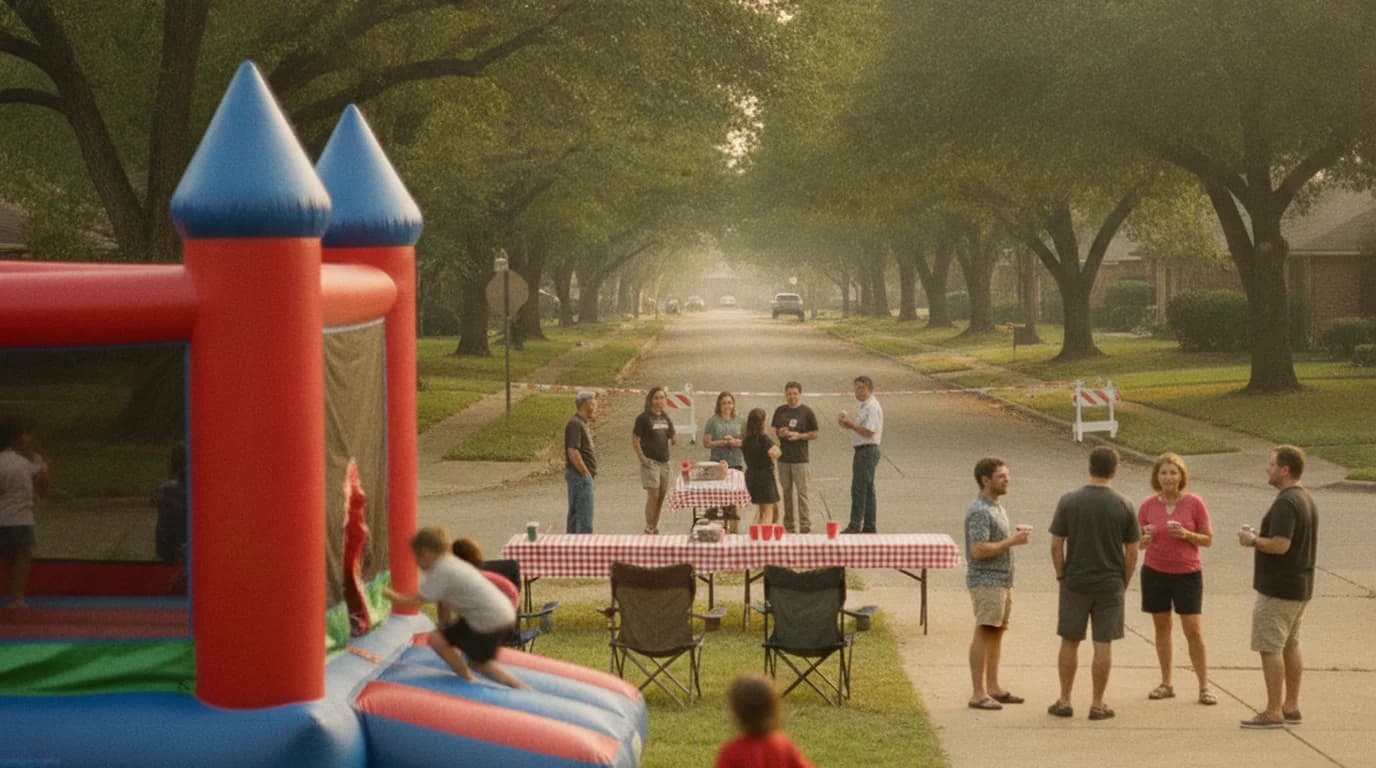
Ten Steps, Worked Back From 11 P.M.
- Check your street's classification on the Master Transportation Plan, and confirm under 500 people at once and 1,300 feet or two blocks.
- Set your hours backward from the 11:00 p.m. reopening and download the current packet.
- Circulate the petition, no earlier than 60 days out, recording the number of homes and the closure limits by cross street.
- Notify every resident at least 15 days out.
- Fill out the application: applicant contacts, event description, setup and removal times, attendance, cross-street limits, and your 24-hour contact.
- Submit both together, at least 15 days out, by email to specialevents@fortworthtexas.gov, attention Outdoor Events Manager.
- Handle insurance only if you triggered it, get TABC and food permits yourself, and sign the user agreement.
- Line up barricades and vested adults while review is underway.
- On the day, keep the permit on site through setup and clean-up, and hold the 12-foot lane and hydrant clearance.
- Afterward: barricades gone in 30 minutes, street open by 11:00 p.m., and a clean-up thorough enough that the city never finishes it at your expense.
Fort Worth Quirks Worth Knowing
- National Night Out is exempt from the permit entirely, but only on the national date, the first Tuesday in October, and only from 6:00 to 9:00 p.m. Outside that window it is a normal block party needing a normal permit.
- Recurring parties get a shortcut most residents never hear about. An association that has run the same event at the same location for two or more consecutive years qualifies as an "Established Neighborhood Event," eligible for one Annual Permit covering the next calendar year.
- Skip Transportation and Public Works. The 2012 amendment made the Outdoor Events Manager the single point of contact for street closures, and the TPW portal routes event requests back there.
- The office moved to New City Hall at 100 Fort Worth Trail and in-person help now needs an appointment. The packet prints two different fax numbers, so email is the reliable channel.
Fifteen Days, Then the Real Job
Fifteen days and one phone call to pin down the fee, and the city's half is done. What is left is a closed street and somewhere between forty and a hundred neighbors who have no idea any of this is happening. A flyer on the mailboxes reaches the people who already knew.
Fort Worth and Dallas are two of the thirty cities in this series, and they agree on almost nothing.
You confirmed the city, filed the paperwork, and now have fifteen days of nothing to do except make sure people come. Build the invitation on Lemonvite by describing the party, then send it by text. Your published event carries an open RSVP page and a printable QR, which is the version that works on a street where you know faces and not phone numbers. Scans become RSVPs. RSVPs become a list you can message when plans move.