
Anand Karaj (Sikh Wedding) Invitation Wording Guide
My friend Gurleen had the Gurdwara booked and the halwai confirmed, with a 280-name guest list spread across three notebooks, before she had written a single line of her own wedding card. When she finally sat down to it, the sentence that stumped her was the very first one: the invocation. "Do I open with Ik Onkar or Waheguru Ji Ka Khalsa," she texted me at midnight, "and is it disrespectful to put it in English?"
That is exactly where most people stall, because Anand Karaj invitation wording is a different animal from a generic wedding card. The ceremony has its own structure and its own opening blessing, plus a set of expectations from the elders you cannot fudge your way around. Get the form right and the rest falls into place. This guide walks through where the Anand Karaj sits in a Sikh wedding, what belongs at the top of the card, formal and casual wording you can copy, and the Gurdwara etiquette your invitation has to spell out for half your guest list.
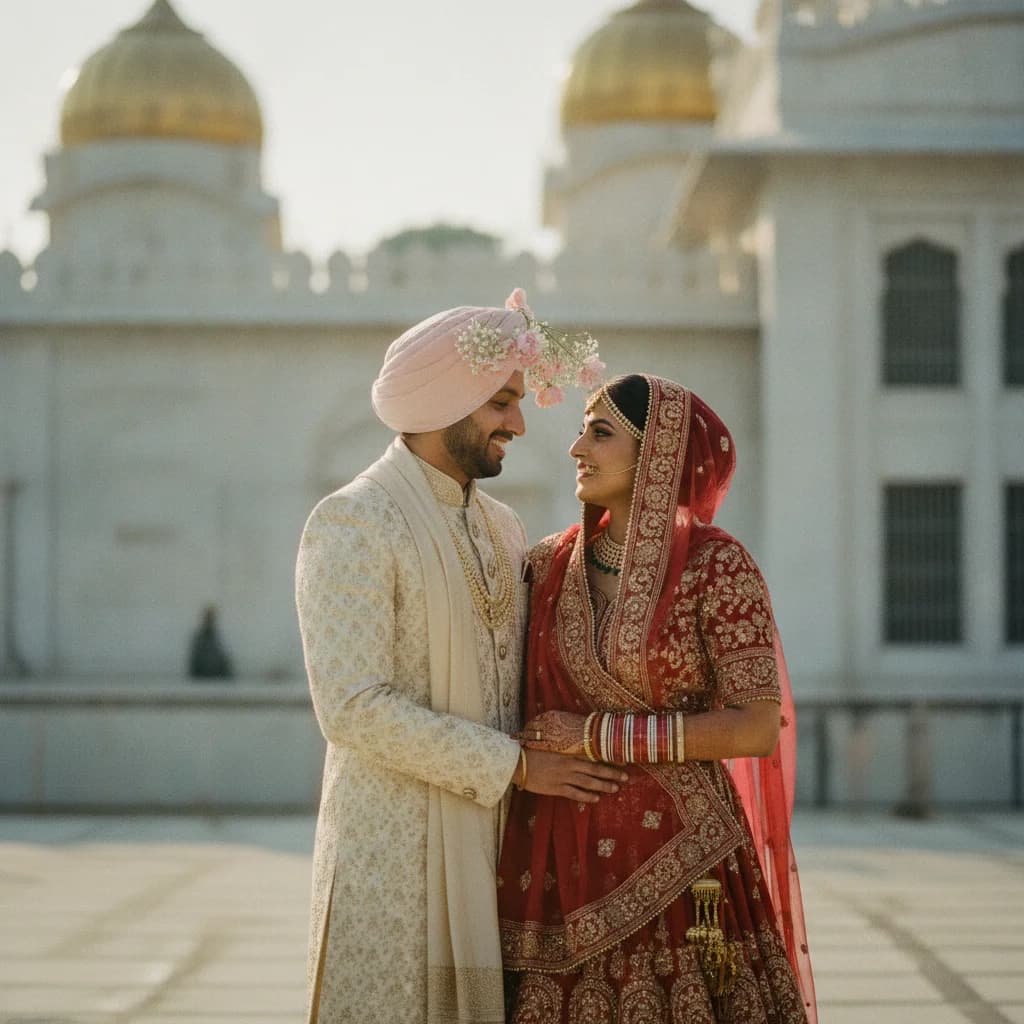
Where the Anand Karaj sits in a Sikh wedding
If you have only ever been to one kind of wedding, a Sikh one can look like a week of color and food with no map. Here is the shape of it, so the invitation makes sense.
It opens months ahead with the roka and the kurmai, the engagement that starts the whole season. Then the final stretch fills up fast. There is the maiya, the turmeric ceremony that is the Punjabi cousin of the haldi. The choora ceremony is when the bride's maternal uncle slides the red-and-white bangles onto her wrists. And the jaago night is the one where the family dances through the house carrying a decorated, candle-lit pot and nobody sleeps. Mehndi happens somewhere in there too.
Then comes the wedding morning. The groom arrives with his baraat. At the door the two families meet for the milni and garland each other, and then everyone moves inside for the Anand Karaj itself. The couple sit before the Guru Granth Sahib while a Granthi leads kirtan and the four Laavan, the wedding hymns composed by Guru Ram Das, are sung. With each Laav the couple circle the Guru Granth Sahib once, four rounds for the four stages of married and spiritual life. After Ardas and Karah Parshad comes the doli, the bride's tearful farewell as she leaves with her husband's family. A reception usually follows that evening.
The Anand Karaj is the heart of all of it: the marriage itself, performed in the presence of the Guru Granth Sahib in a Gurdwara. Knowing it is a religious ceremony and not a stage-and-DJ production is what sets the tone for the card.
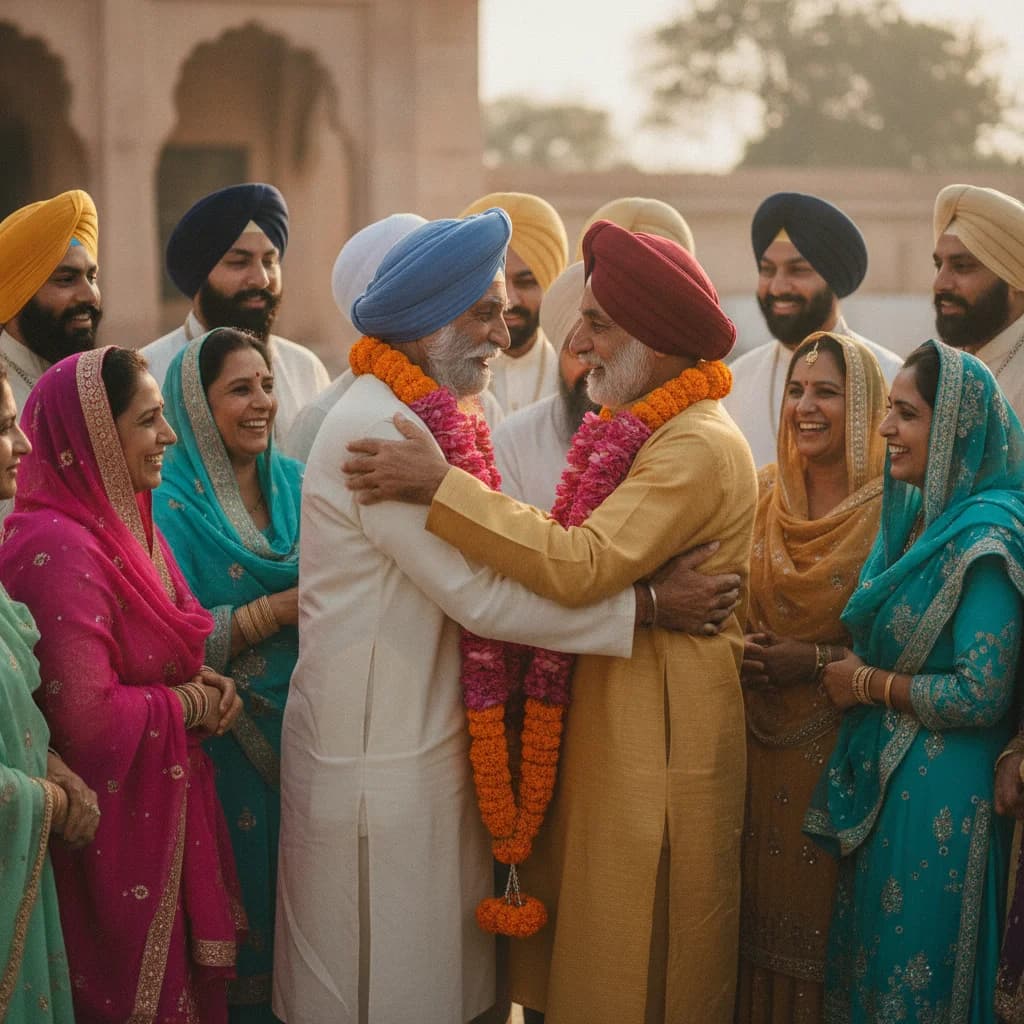
The invocation at the top of the card
A Sikh wedding card opens with the divine before it reaches any names, and leaving that off is the mistake people most often make. Two lines do the work.
At the very top sits Ik Onkar (ੴ), the statement that there is one God, the same line that opens the Guru Granth Sahib itself. Below it, or sometimes in its place, goes the Sikh greeting: Waheguru Ji Ka Khalsa, Waheguru Ji Ki Fateh. Plenty of families print both, the Gurmukhi script for the elders and a Roman transliteration underneath so younger and non-Sikh guests can read it too.
A short blessing line often follows, naming Waheguru as the one whose grace makes the marriage possible. You do not need a long shabad on the card. The invocation is there to set the tone, telling every guest before they reach the date that this is a wedding rooted in faith.
Anand Karaj invitation wording: the formal version
This is the card that goes in the box, the one the grandparents keep in a drawer for thirty years. A Sikh card carries the same bones as any wedding invitation, all of which I break down in the wedding invitation wording guide; what changes is the invocation up top, plus the honorifics Sardar and Sardarni and a closing note of Waheguru's blessing. A few you can lift and rename:
- "With the blessings of Waheguru, Sardar Harpal Singh and Sardarni Kuldeep Kaur request the pleasure of your company at the Anand Karaj of their daughter Simran Kaur with Arjan Singh, son of Sardar Bhupinder Singh and Sardarni Manjit Kaur."
- "The Gill and Sandhu families joyfully invite you to witness the Anand Karaj of Simran and Arjan as they are united in the presence of Sri Guru Granth Sahib Ji."
- "We seek your blessings as our children, Simran Kaur and Arjan Singh, are joined in matrimony according to Sikh rites. Anand Karaj to be followed by langar."
- "Together with their families, Simran and Arjan invite you to share in their Anand Karaj and the blessings of the morning."
Two things hold across all of them. The host line names the families doing the inviting, traditionally the parents and increasingly both sides together. And the verb stays gracious and understated, "request the pleasure of your company" or "seek your blessings," which works no matter whose side is paying for what.
The WhatsApp-ready version
Most of your list will never hold the printed card. They will get a forwarded image in a family group that already has 96 unread messages by 9 a.m. For that crowd the wording can warm right up, as long as the invocation and the respect survive the trip:
- "Ik Onkar. With Waheguru's blessings, Simran and Arjan are getting married! Join us for their Anand Karaj on Saturday morning, langar to follow. Cover your head and come with a full heart."
- "It is finally happening. Simran weds Arjan. Anand Karaj at 10 a.m. at Gurdwara Sahib, reception that evening. We would love you there for both."
- "Our Simran is getting married, and we want our whole family there. The Anand Karaj is Saturday morning, with the celebration to follow. RSVP inside so we can plan the langar."
Notice that even the loose version still opens with Waheguru and still tells people to cover their heads. That part you keep no matter how casual the rest of the message gets.
What your card has to teach first-timers
A lot of Sikh wedding cards forget one kindness. A good chunk of your guests, the work friends and the cousins marrying in from non-Sikh families, have never set foot in a Gurdwara and are a little anxious about putting a foot wrong. A few plain lines on the card or the details page save them the worry.
- Heads stay covered. Everyone in the hall, men and women, keeps their head covered. Tell people to bring a scarf or dupatta, and if you can, keep a basket of spare head coverings (rumal) at the door for anyone caught out.
- Shoes come off. There is a rack outside the darbar hall. Saying so on the invite means nobody is fumbling in their socks as the kirtan begins.
- It starts in the morning, and it starts on time. The Anand Karaj traditionally happens before noon, and the ceremony does not wait for late arrivals. If the card says 9:30, mean 9:30.
- Langar follows. The free community meal in the Gurdwara is part of the day, eaten sitting on the floor, open to every guest. Letting people know means they neither eat beforehand nor sit wondering whether lunch is coming.
You do not have to print every rule like a customs form. One warm note carries it: "The Anand Karaj is held in a Gurdwara, so please cover your head and remove your shoes at the hall. Modest dress is appreciated, and langar lunch will follow."
Wrangling a Punjabi guest list
Punjabi guest lists are their own category of problem. "Of course the whole Sandhu family is coming" is a sentence that adds fourteen people without warning, and the Anand Karaj plus the reception plus the langar count all need real numbers, because a seated lunch for everyone is also the bill.
A couple of habits keep a 300-name list from becoming a second job. Settle your stance on plus-ones before anyone asks, because someone always asks; the plus-one etiquette playbook holds even when the numbers are enormous. And accept that a lot of replies will be soft, especially from relatives flying in, so it helps to build a real maybe into your RSVP rather than forcing a yes out of an uncle still hunting for flights.
This is the point where paper falls apart, and where Lemonvite's design engine earns its keep. Describe the look you want, "deep maroon and gold with a Gurmukhi border and a soft palki canopy," and it designs the Anand Karaj invite for you, no template-hunting. Then it goes out by text, which matters for a guest list that is half WhatsApp-native cousins and half elders who will never open an email from an address they do not recognize. A text gets opened. One tap records the RSVP. The headcount builds in a single list instead of scattering across four group chats and a phone call from your mother.
You can run the Anand Karaj as one event inside a full wedding invitations set, so the maiya, the Anand Karaj, and the evening reception all live together and guests RSVP per event. When the Gurdwara shifts your slot by half an hour, and it might, one broadcast from the event page reaches everyone who already said yes.
So put Ik Onkar at the top and name the families who are hosting, then let "together with their families" smooth over whatever the family chart cannot. Write the dignified version for the box and the warm one for the chat, then build the working invite on Lemonvite and let it chase the replies while you go back to learning your bhangra steps. Gurleen's card finally went out the morning after that midnight text, and the yeses were in within the week.