
Wedding Invitation Wording: Formal and Casual Templates That Work
Wedding invitation wording is the only writing assignment where a comma can start a family feud.
I'm not exaggerating. A couple I know nearly derailed their own engagement dinner over whether his divorced parents' names could share a line. (They cannot, by tradition. They got their own lines. Peace was restored.) Another friend, Odette, agonized for a week over "request the honor of your presence" versus "request the pleasure of your company" before learning they aren't interchangeable at all: "honor of your presence" traditionally means a religious venue, and "pleasure of your company" means everywhere else.
So yes, there are real rules here, more than for any other invitation. But there's also a modern truth: most couples today don't need full Victorian protocol, they need wording that's correct enough for the formality they've chosen and sounds like them. This post gives you both ends and the messy middle.
The anatomy of a wedding invitation
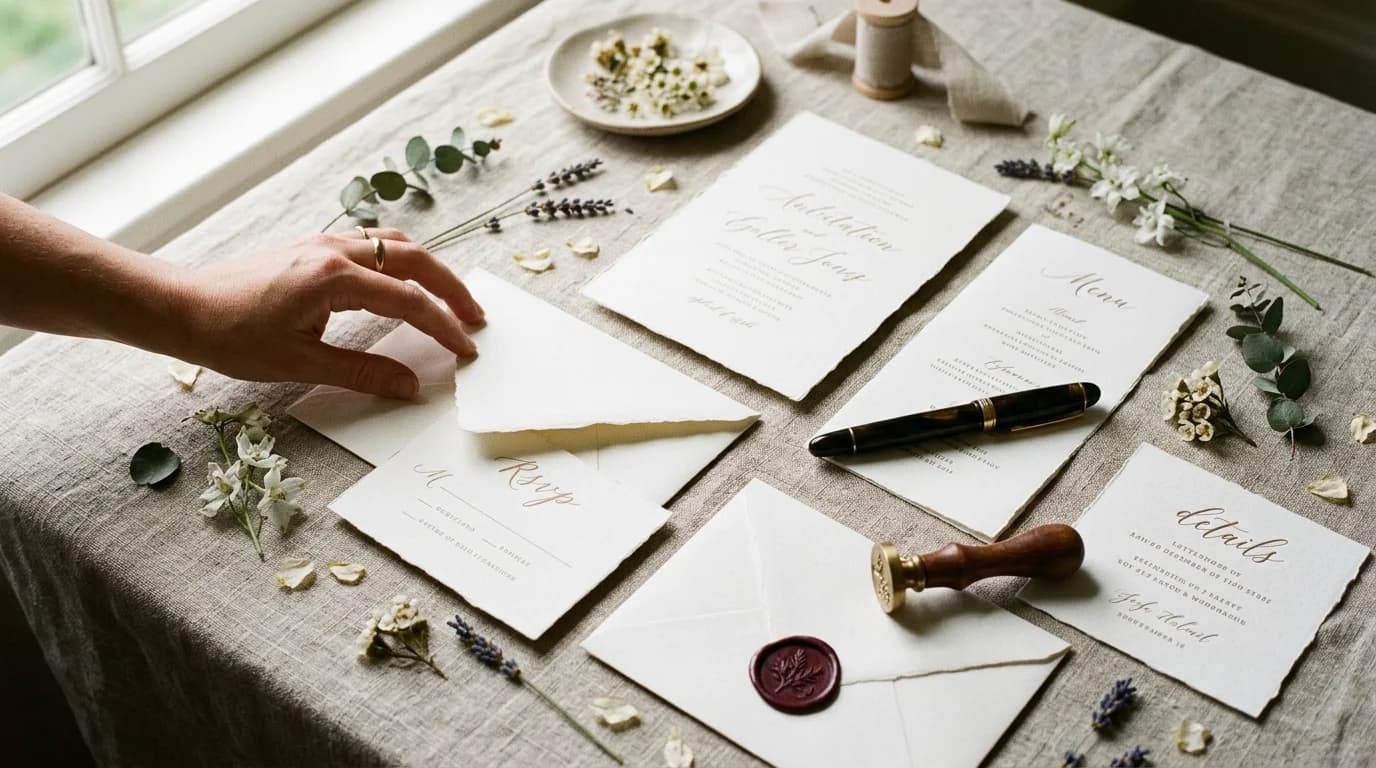
Every wedding invitation, formal or casual, carries the same six pieces in roughly this order:
- The host line: who's inviting people (traditionally whoever's paying, but read on).
- The request line: "request the honor of your presence" (religious venue) or "request the pleasure of your company" / "invite you to celebrate" (everywhere else).
- The couple's names.
- Date and time, spelled out fully on formal invites ("Saturday, the twelfth of September, two thousand twenty-six, at four o'clock in the afternoon").
- Location: venue name and city; street address goes on the details card or event page.
- What follows: "Reception to follow," "Dinner and dancing to follow," or the honest favorite, "Cake, dancing, and questionable speeches to follow."
RSVP details, dress code, registry, and hotel blocks live elsewhere: an enclosure card, or these days, the wedding's event page.
Formal wedding invitation wording, by who's hosting
This is where the rules are densest, because the host line is genealogy in miniature.
Bride's parents hosting (the classic):
Mr. and Mrs. Alan Whitfield request the honor of your presence at the marriage of their daughter Clara Jane to Mr. Theodore Marsh, Saturday, the twelfth of September, two thousand twenty-six, at four o'clock in the afternoon, St. Agnes Chapel, Savannah, Georgia.
Both families hosting:
Together with their families, Clara Whitfield and Theodore Marsh request the pleasure of your company at their wedding...
Couple hosting themselves:
Clara Whitfield and Theodore Marsh joyfully invite you to celebrate their marriage...
Divorced parents (the comma minefield): each parent gets their own line, no "and" joining them, mother's name first:
Ms. Diane Okafor Mr. Samuel Whitfield request the honor of your presence at the marriage of their daughter...
A widowed parent: "Mrs. Eleanor Marsh requests the honor of your presence at the marriage of her son..."
Honoring a deceased parent: the deceased can't "host" (hosting is an action), so they're woven in beside the couple instead: "Clara Whitfield, daughter of Alan Whitfield and the late Margaret Whitfield, and Theodore Marsh..."
If your family chart is more complicated than these, here's permission from someone who's watched the fights: "Together with their families" solves nearly everything. It credits everyone, ranks no one, and has rescued more invitations than any other five words in the genre.
Casual and modern wording
For the backyard wedding, the brewery wedding, the courthouse-then-party wedding. The structure stays; the starch goes.
- "Maja and Ruben are getting married! Join us for the vows, the dinner, and at least one tearful toast. Saturday, September 12, 4 PM, Hartley Farm, Hudson, NY."
- "After eleven years, two apartments, and one extremely spoiled cat, we're making it official. Come celebrate with us."
- "We're tying the knot and we want you there. Ceremony at 4, tacos at 5, dancing until they kick us out."
- "No long ceremony, no assigned seats, no chicken-or-fish. Just us, getting married, and the people we love most. That's you."
One strong opinion: casual wording still needs complete information. "Deets to follow!" on a wedding invitation is a crime against guests who need to book flights. Casual tone, rigorous logistics.
The enclosure lines everyone struggles with
Adults only: the cleanest method is addressing the invitation precisely ("Ms. Priya Nair," not "The Nair Family") plus one gentle line on the details card: "We respectfully request an adults-only celebration." Don't write "no kids" on the main invitation. Cold on card stock, somehow.
Dress code: name it plainly. "Black tie." "Cocktail attire." "Garden formal (heels will sink, plan accordingly)." That parenthetical is the most appreciated sentence I've ever put on a details card.
Registry: keep it off the invitation itself; it belongs on the wedding website or event page. "Registry and travel details at [link]" covers it.
Plus-ones: decided by you, communicated by the envelope or guest record, never by "and guest?" texts at midnight. Name the invited people exactly and the question answers itself.
Timing is part of the wording
The most beautiful invitation fails if it lands at the wrong moment. The short version: save-the-dates go out six to eight months ahead (more for destination weddings), invitations six to eight weeks ahead, RSVP deadline three to four weeks before the day so your caterer doesn't develop a twitch. The full calendar, including what to do about stragglers, is in my post on when to send party invitations.
Where the wording actually lives now
Most couples I know in 2026 run two layers: a paper invitation for the keepsake drawer if they want one, and a digital invitation doing the operational heavy lifting: the RSVPs, the meal choices, the song requests, the inevitable "wait, what time again?"
That second layer is where I'd point you at a wedding invitation on Lemonvite. You can give the design engine the same language you'd give a stationer ("ivory, hand-pressed botanicals, candlelit, serif everything") and get something that holds its own next to letterpress. It goes out by text, guests RSVP with one tap and can answer your custom questions (entrée choice, dietary notes, "will you need the shuttle?") in the same thirty seconds, and you watch the headcount build on a single page instead of a shoebox of reply cards.
Odette did exactly this (paper for the grandparents, Lemonvite for everyone else) and had 80% of her RSVPs back in nine days. The paper-only crowd took six weeks and two phone campaigns.
Choose your host line, spell out the date, and let "together with their families" absorb whatever drama remains. Then build the working version on Lemonvite, send it where people will actually see it, and go back to arguing about the playlist instead.