
Griha Pravesh (Housewarming) Invitation Wording and Puja Guide
When my cousin Divya did her griha pravesh in Pune, the muhurat the pandit gave her was 6:40 in the morning. Her flat was on the eighth floor, the lift hadn't been certified yet, and forty relatives were expected to climb up in the dark to watch a pot of milk boil over. The puja was the easy part. The thing she lost three full days to was the griha pravesh invitation wording: was this a formal blessing or a lunch invite, did she name her in-laws as the hosts, and how do you tell sixty people to show up at dawn without it reading like a court summons?
That last question is the reason this guide exists. A griha pravesh is really two events wearing one outfit: a proper Hindu housewarming puja with an auspicious entry time, and a party with the people you want inside your new home. The invitation has to carry both. Below: what the ceremony actually involves, how the muhurat gets chosen (and the stretch of the year when you can't do it at all), then a pile of wording you can lift, dignified for the elders and loose for the cousins' chat.
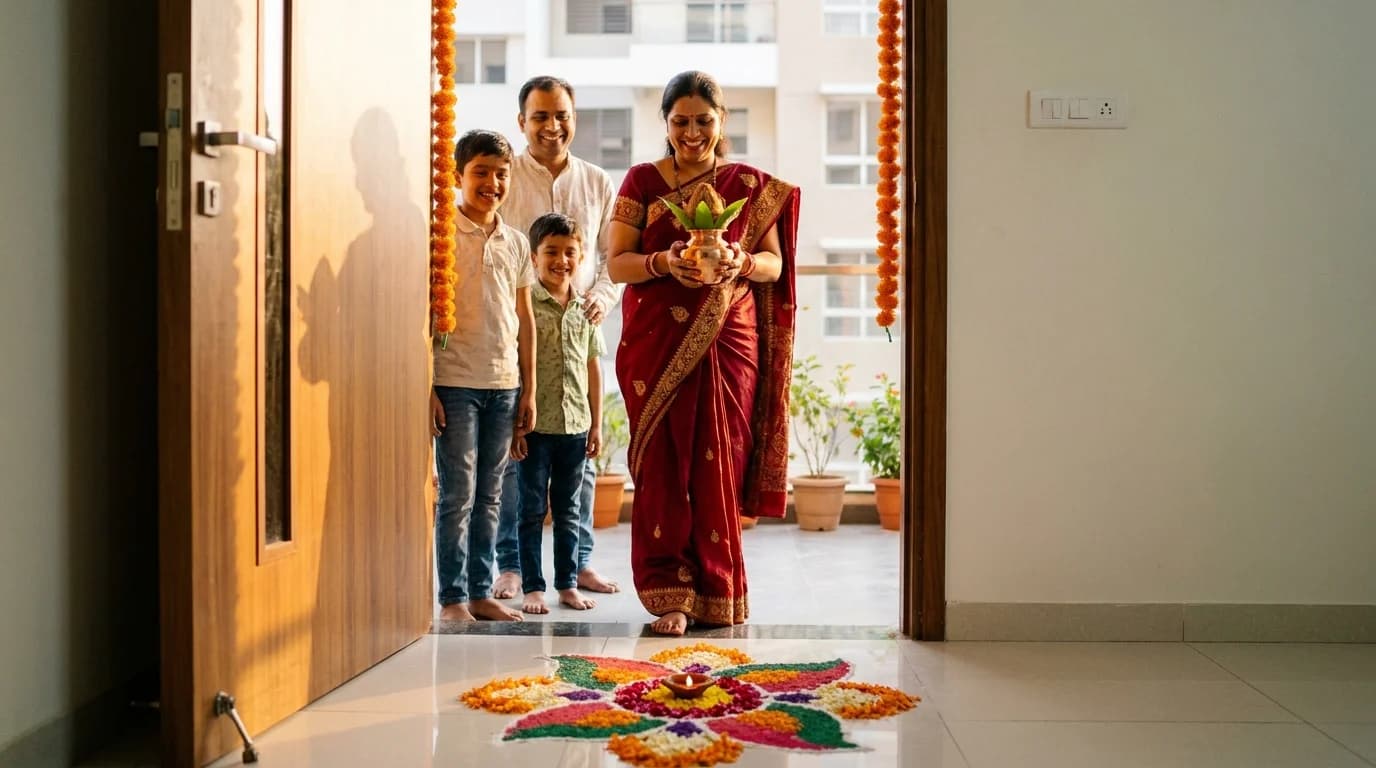
What a griha pravesh actually is
Griha pravesh means, plainly, "house entry": griha for home, pravesh for entering. It's the ceremony a Hindu family performs before they begin living in a new place, to settle the home and ask for a good life under its roof. In the South you'll hear it called gruhapravesam or gruhapravesham; the Tamil and Telugu households I grew up around just called it "the house pooja." Same idea, different soundtrack.
The scriptures actually name three kinds, and it's worth knowing which one you're throwing because it changes the tone of the invite. Apoorva is the first entry into a brand-new house built on fresh land, the big one most people mean. Sapoorva is moving back into a home you already own after a long stint away. Dwandwah is re-entering a house that was rebuilt after damage from fire or flood. Most readers here are throwing an apoorva, so that's the one I'll write toward.
Choosing the date is the hardest part
First-time hosts almost always have this backwards: you don't pick the date, the Panchang does. A griha pravesh muhurat is worked out from the lunar day (tithi), the constellation (nakshatra), the weekday, and the planetary positions, which is why two families moving the same week can land on dates a fortnight apart. Your pandit will give you the shubh muhurat for 2026; don't try to reverse-engineer it from a website.
A few rules of thumb hold across most traditions, though, and they'll save you from booking a date the elders end up vetoing. Monday, Wednesday, Thursday, and Friday are the favoured weekdays. Tuesday and Saturday usually get avoided. The nakshatras people reach for are Rohini, Pushya, and the Uttara group, with Rohini treated as the gold standard for a housewarming.
The big one, the rule that catches people every July: you cannot do a griha pravesh during Chaturmas. That's the roughly four-month window (around mid-July to mid-November in 2026) when Vishnu is said to be in cosmic sleep, and no new-home entry is performed in it. If you're eyeing a quick weekend pooja in early July, that's the trap. Confirm the date with a pandit first. The clean months sit on either side of the gap: the late-winter and spring stretch, then the post-Diwali run in November and December. Let the muhurat set your moving date.
What happens at the puja
You don't choreograph this yourself, the pandit runs it, but knowing the shape helps you word the invite and prep the house. It opens with a Ganesh puja to clear obstacles, then a Vastu Shanti puja to harmonise the home, often with a havan (the sacred fire) and a navagraha puja to settle the nine planets.
The visual centre of it is the kalash: a copper or brass pot filled with water, topped with mango leaves and a coconut, marked with a swastika in turmeric. The family carries it in at the muhurat. Tradition has the lady of the house step over the threshold first, right foot leading, often nudging a small pot of rice across the doorway so grain spills into the home for prosperity.
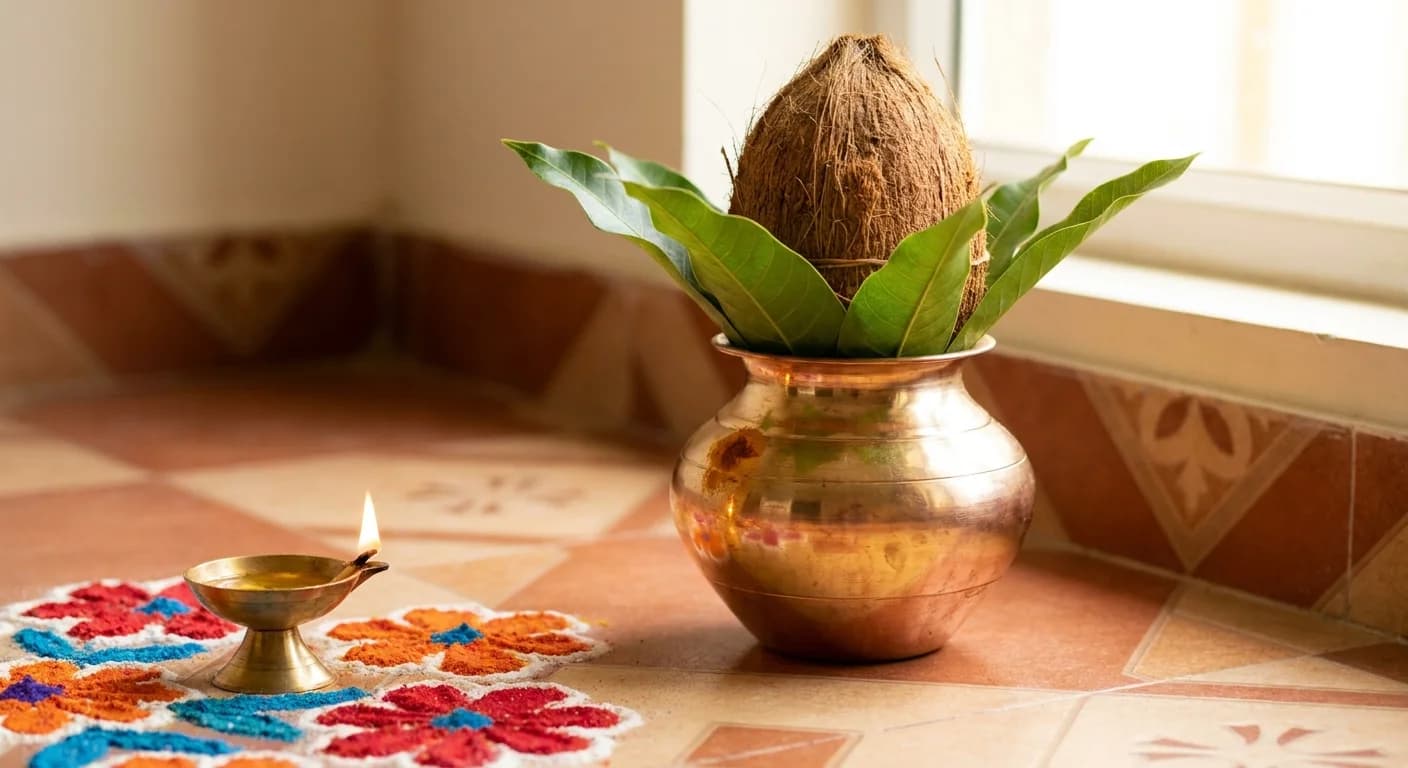
Then the bit everyone actually waits for: boiling milk in the new kitchen until it froths up and spills over the rim. The overflow is the whole point, an image of Lakshmi's abundance pouring into the house, so a slightly-too-full pot is a feature. In many South Indian homes that becomes the first dish cooked, a paal payasam offered to Agni and then shared around as prasad. Once the milk's gone over, the ceremony loosens into a party. That hinge, from solemn puja to open-house lunch, is exactly what your invitation has to manage.
Griha pravesh invitation wording: the traditional version
For the version the grandparents will approve of, the one you'd print or send as a tidy card. Formal griha pravesh wording names the family as the hosts and opens with a line of devotion before it hands off from puja to lunch.
- "Om Shri Ganeshaya Namah. Mr. and Mrs. Rao request the honour of your presence at the Griha Pravesh of their new home. Satyanarayan puja at 8 a.m., lunch to follow."
- "By the grace of God, we step into our new home. The Iyer family seeks your blessings at our Gruhapravesam ceremony and the lunch after."
- "We have built a home and would be grateful for your blessings within it. Join us for the housewarming puja and prasad. Your presence is our blessing."
- "With the blessings of our elders, Mr. and Mrs. Nair warmly invite you to the Griha Pravesh of their new home, followed by lunch."
Notice the host line does the heavy lifting. Naming the couple, or both sets of parents, is how the formal invite signals respect, the same instinct that drives a sangeet invitation to name the families first. "Seeks your blessings" is the safe, gracious phrase; it asks for goodwill rather than gifts, and it lands the same with the devout relatives and the ones who just like you.
The modern, WhatsApp-friendly version
Most griha pravesh invites today never see a printer. They travel by WhatsApp, into a family thread already three hundred messages deep about who's bringing whom. So write them to be opened on a phone: short, warm, honest about the early start and the food.
- "We finally have keys and a doorbell that works. Come bless the new place! Griha pravesh pooja Sunday morning, brunch right after, address below."
- "We did the impossible and bought a flat in this city. Help us warm it. Puja at sunrise for the brave, lunch at noon for everyone else."
- "New home, first milk on the stove, and you're on the list. There'll be a kalash, a slightly nervous pandit, and far too much payasam. Come for the blessings, stay for the food."
- "Housewarming time! Pooja's at the muhurat (yes, it's early), lunch is the reward. Bring nothing but an appetite."
The trick is being upfront about the dawn muhurat without apologising for it. "Sunrise for the brave, lunch for everyone else" gives the devout their slot and lets everyone else show up in time to eat. That two-tier framing is the most useful move in a griha pravesh invite.
What every griha pravesh invite must say
The puja can run on faith. The logistics cannot. However you word it, the invitation has to answer these so nobody has to text you back at 9 p.m. the night before:
The muhurat time and the come-anytime time. Spell out both. "Puja at 6:40 a.m., lunch from 12" tells the devout when to arrive and tells everyone else they've missed nothing by sleeping in.
The full address, carried flawlessly. This is the one party where your guests have never been to the venue, because the venue is the news. Put the complete address on the invite: flat or block number, parking notes, the gate or society code people need at 6 a.m. For relatives flying in from abroad, get the invite out early and make it easy to send across borders and time zones so the visa-and-flights crowd can plan.
Whether it's puja-only or a full lunch. Say it plainly. South Indian sit-down lunches on a banana leaf run long, and people pace their day around whether food is happening.
A word on footwear and dress. Shoes come off for the puja and there's floor seating, so a quick "traditional wear if you can" line saves a dozen WhatsApp questions.
The gift question
Griha pravesh gifts are genuinely optional, and your invite sets the tone. The honest "no gifts" is always welcome, and the kindest thing is to say so on the invitation rather than leave people guessing. If you'd rather steer than refuse, a soft line works: "Your blessings are gift enough, but if you must, we love plants for the balcony." Plenty of families are secretly hoping for the small Lakshmi-Ganesh idol or a brass diya for the new mandir, and a hint toward that is fair game. What you want to avoid is silence, which just produces a pile of mismatched decorative bowls.
Sending the thing
On paper, this is the part that breaks. A griha pravesh guest list is half tech-native cousins on WhatsApp and half elders who will never open an email from an address they don't recognise. A text gets seen by both. You can describe what you want to Lemonvite's design engine, say "marigold and brass, a kalash and a diya, warm morning light," and get a custom griha pravesh invite without hunting through templates, then send it by text so the full address, the muhurat time and a map link all arrive in one tap. Guests RSVP from the same message, so the headcount the caterer needs builds in one list instead of scattered across four chats and your mother's phone calls.
It also handles the inevitable. When the lift certification slips or the muhurat shifts by twenty minutes, one broadcast reaches everyone who said yes. The mechanics of running an open-house lunch (the food math, the flow of people) are the same as any housewarming, so the housewarming planning guide carries over cleanly. And you can build the whole thing as a proper housewarming invitation, puja and lunch on one page.
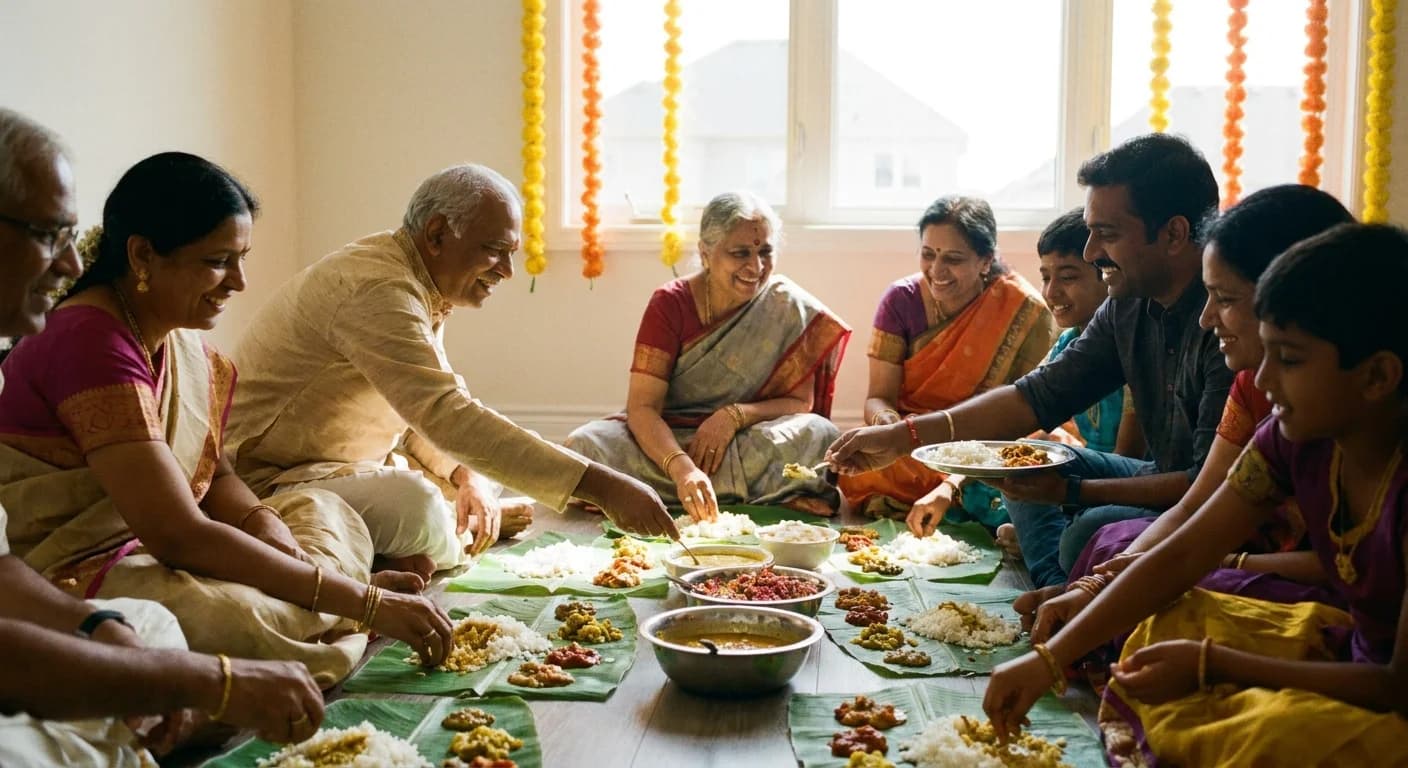
Get the date blessed, get the wording right for the home you actually built, and let the invite chase the RSVPs while you go make sure that milk really boils over. The house is ready. Send the address.