
Why 'Maybe' Is the Most Honest RSVP (And How to Handle It)
There is one button on an invitation that makes most hosts wince, and it's the Maybe. For years I hated it. I read it as a cop-out, a polite way of saying "I am waiting for a better offer," or a soft no from someone too sheepish to just decline.
So I removed the option from my Evite invitations and forced everyone into a binary: yes or no. I figured I was being clever and squeezing out a real commitment. That turned out to be a mistake.
Cutting the Maybe didn't earn me more yeses. It earned me more ghosts. Accepted: 12. Declined: 3. No Reply: 25.
That No Reply column is where a headcount goes to die, and by forcing a binary choice I was shoving people straight into it.

The Truth About Indecision
A few dozen dinner parties and birthdays later, I understand the silence better. When people don't RSVP, the usual reason has nothing to do with whether they like you. They genuinely do not know yet.
Life is complicated. One person is waiting on a work schedule that hasn't posted; another can't lock anything in until they find a babysitter. This is the same friction I dug into in the psychology of the RSVP.
Force one of those people to pick yes or no right now and they just freeze. They don't want to decline, because they actually want to come, but they can't promise a yes either. So they close the tab and tell themselves they'll deal with it later. Then they forget, and that's one more guest you'll never hear from.
The Maybe button isn't your enemy. It's a pressure valve that lets a guest acknowledge the invite and flag their interest before the logistics line up.
Better an Honest Maybe Than a Lying Yes
Give me five Maybes over five people who panic-clicked Yes and then bail two hours before the party.
A Maybe is honest data. It says "I'm interested, but something is in the way," which is far more than a non-response gives you. When someone taps it, I know they saw the invite, I know they care enough to answer, and I've got a line of communication open.
Once that clicked, I stopped trying to bulldoze the gray area and went looking for tools to actually manage it.
Turning Maybes into Yeses
This is where Lemonvite changed how I host.
On most platforms a Maybe is a dead end: a list of names you have to go text by hand later, which is exactly the chore you were hoping to avoid. On Lemonvite, the Maybe status is something you can actually act on.
Last week I was planning a surprise party for my wife, and three days out I still had 12 people sitting on Maybe. I needed to order the food. The old way meant copy-pasting the same text to 12 different people.
"Hey, are you coming? Need to know for food."
That kind of message feels needy and a little desperate.
So instead I used Lemonvite's broadcast feature. I clicked Send Update and set the target audience to everyone on Maybe.
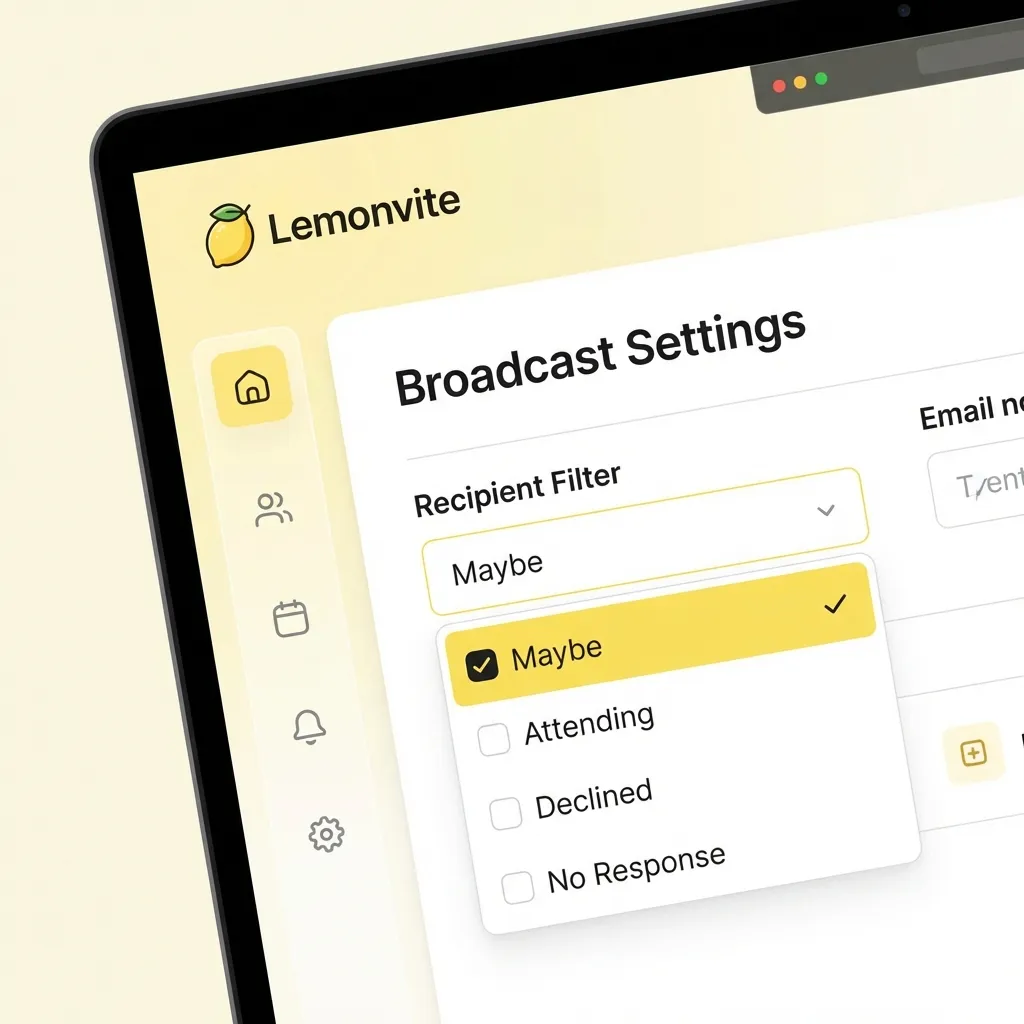
I wrote one simple message:
"Hey friends! Finalizing the taco order tonight. If you think you can make it, let me know by 5 PM so I can count you in! No pressure if you can't."
Because Lemonvite sends this as an individual SMS rather than a group-chat blast, it landed personally with each of them. And it isn't just a US thing anymore: my friends with phone numbers outside the US and Canada get the very same nudge over WhatsApp, so nobody on a Maybe slips through the cracks. Gentle, aimed at exactly the right people, and it worked.
The Result
Within an hour, 8 of those Maybes turned into yeses and the other 4 politely declined.
My headcount was solid and the food was ordered, and I never had to corner anyone in a one-on-one text. The point was never to wring a yes out of everyone. It was to get clarity. Give guests room to be uncertain early and you build trust and strip out the guilt that fuels ghosting, so when it's finally time to commit they're far more likely to give you a straight answer.
Embrace the Gray Area
Your friends are busy people juggling kids and jobs and the general chaos of a given week. Sometimes they honestly can't hand you a clean yes or no the second your invite lands.
Don't punish them for it. Give them the Maybe button to keep the line open, then lean on the right tools to nudge them off the fence when the food order is due. The uncertainty isn't the problem; ignoring it is. If your replies are thin to begin with, it's worth figuring out why no one is RSVPing before the next invite goes out. Start managing the gray area with Lemonvite.
Keep Reading
More on the strange science of getting people to show up:
- Start with the psychology of RSVPs and why no one is RSVPing to your event.
- Guest list dilemmas, solved: plus-one etiquette, what to do when you've invited too many people, and how to gracefully uninvite someone.
- And when life happens anyway, here is how to handle last-minute cancellations.