
Karva Chauth Get-Together Ideas
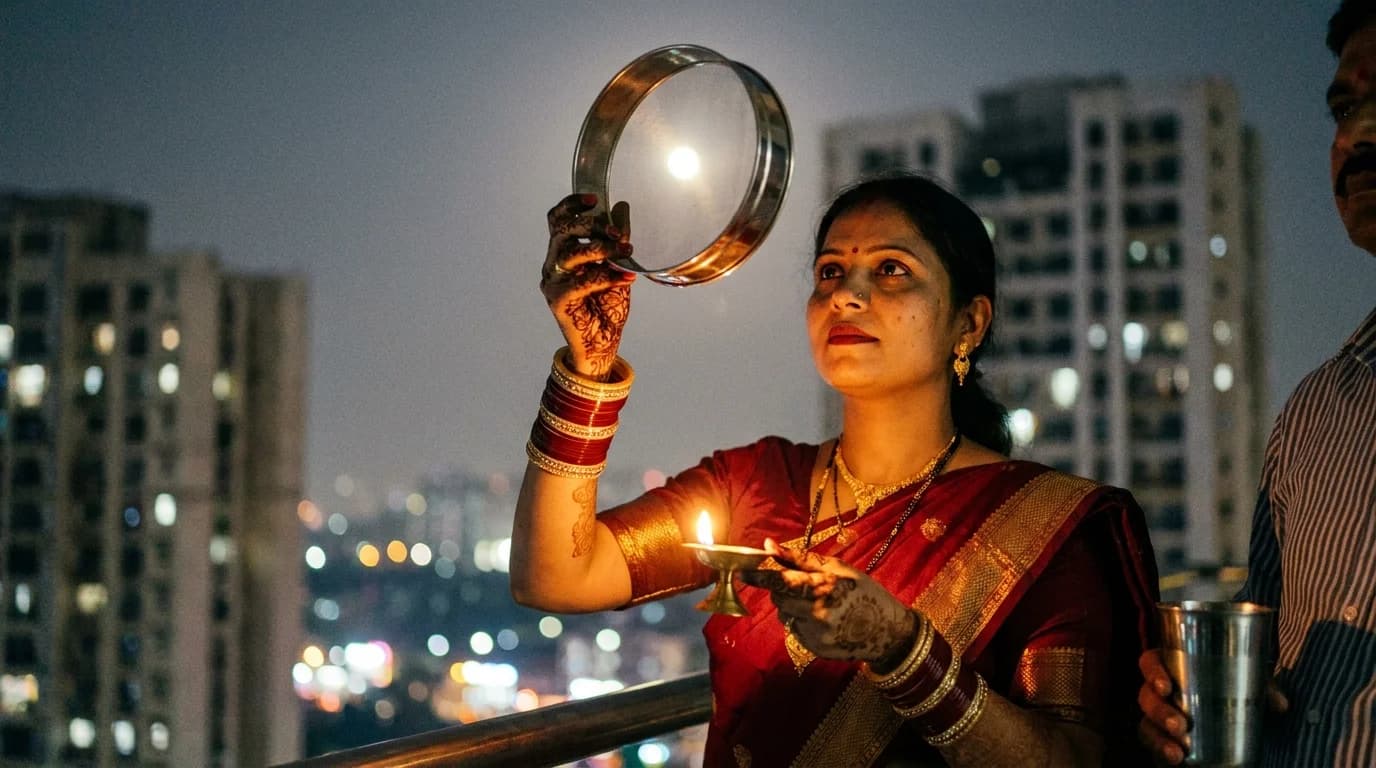
The first Karva Chauth I hosted, I got the moon wrong. I told everyone seven-thirty, off a number I half-read on some website, and the moon over our patch of Gurgaon didn't clear the tower opposite until nearly nine. Eleven women in full jewellery stood on my balcony for ninety minutes squinting at a haze the colour of weak tea. My neighbour Ritika eventually sat down on the floor and asked, very flatly, whether the moon was coming at all.
I've hosted every October since, and most of the Karva Chauth get-together ideas below came out of repairing that evening. The timing app was the small mistake. The bigger one was running the day like the other parties I throw. This is a fast that begins before sunrise and ends when a specific object clears the skyline, and everything social about it is squeezed into the ninety minutes after that. Your job is to protect those minutes, then fill the fourteen hours in front of them.
Settle the date and the moonrise before anything else
Karva Chauth 2026 falls on Thursday, 29 October. The Chaturthi tithi runs from about one in the morning until ten at night, so the whole observance sits inside the single date. In Delhi the evening puja muhurat runs roughly 5:40 to 7:00 pm, with moonrise expected close to 8:15.
That Delhi number gets forwarded across the country every year, which is why half of us end up on balconies at the wrong time. Chandrodaya shifts by city. West of Delhi the moon comes later on the clock; the east sees it earlier; a tall building on your eastern side adds twenty minutes to whatever the panchang says. Look up your own city, then tell guests a slot fifteen minutes after it. Being early is a kindness to a woman who hasn't had water since dawn.
It's a working Thursday, which shapes everything. People will be logging off at five or stuck on Golf Course Road, so a 5:15 start is a fantasy. The date also sits in the worst crush of the year, with Dussehra just over a week before and Diwali roughly ten days after. If you're hosting a Dussehra get-together too, book your mehndi artist and caterer in September, while anybody answers the phone.
The Karva Chauth get-together that matters is the puja circle
Everything else on the day is optional. The circle is the actual event.
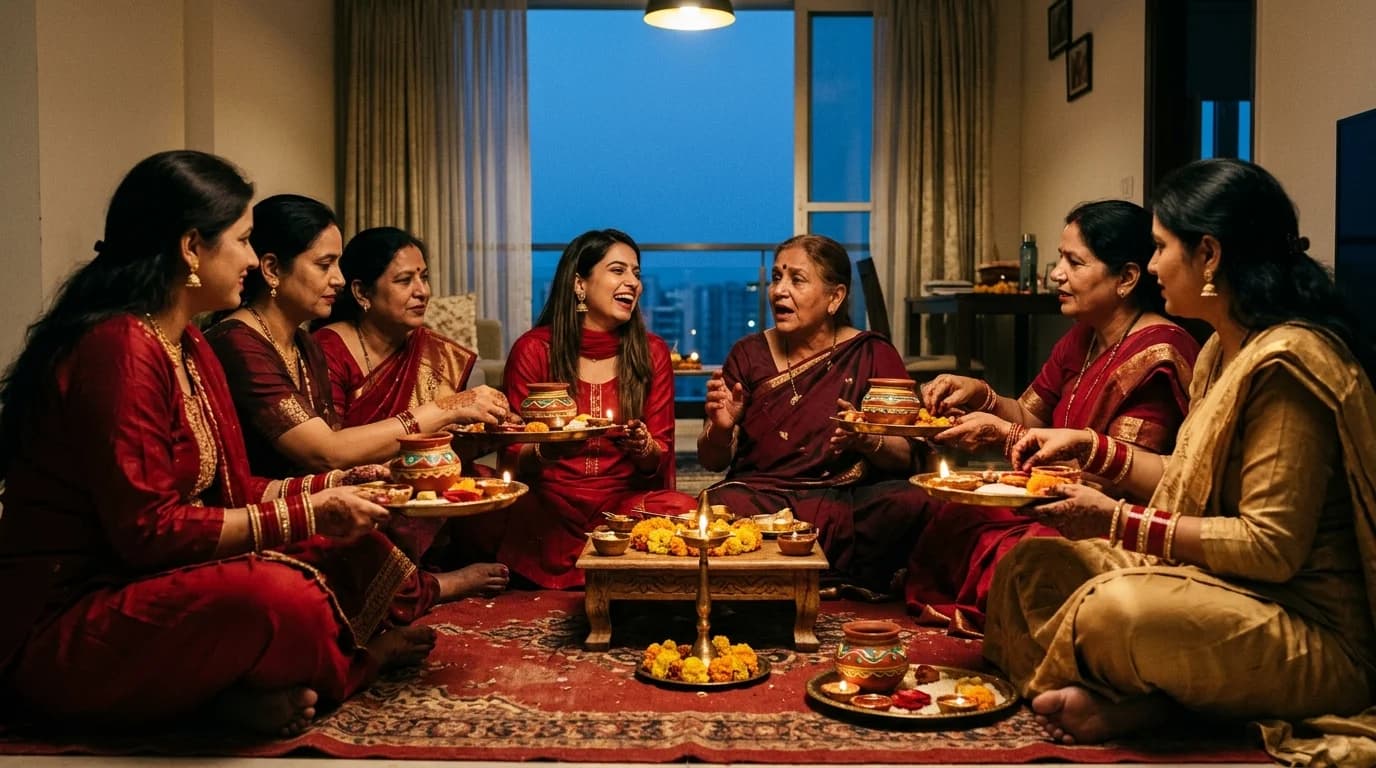
In a village or an old mohalla it convened itself. The women of the street gathered in a courtyard before moonrise and sat in a ring with their thalis and karvas, passing them round to the phera song while the oldest woman present told the katha of Veeravati from memory. In a tower block where your saas is four hundred kilometres away and your neighbours came from four different states, nobody convenes anything unless you do. That is the hosting job.
A few things I've learned about running one:
- Start at the front of your muhurat. Everything overruns, so build the slack in early.
- Decide a week ahead who is telling the katha, so you don't discover at 6:15 that nobody knows it and end up holding a phone on speaker while ten women sit in silence. Ask the aunty in your building who does, or print it out and read it properly yourself.
- Say on the invite that everyone brings their own karva and thali. You are not stocking eleven of anything.
- Cap it around eight to fourteen. A ring of thirty stops being a circle and turns into a queue.
- A durrie and floor cushions beat dining chairs. One low chowki at the centre for the idols and diya is the whole setup.
Don't hire a photographer for the pheras. I've watched a man crouch inside the ring asking women to pass the thali again, better this time, and it drained the room. Take your photographs before and after, and while the circle runs, phones live elsewhere.
Feed people at the right end of the day
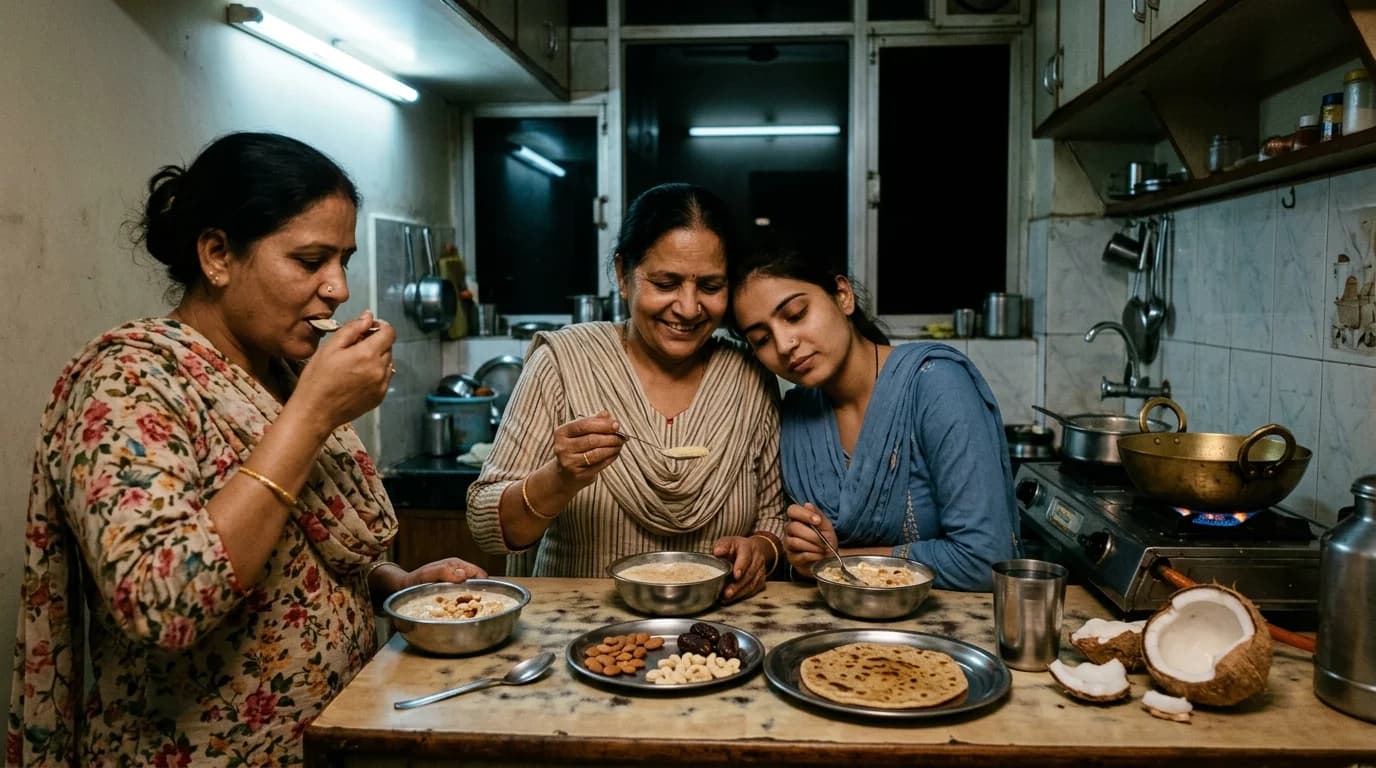
Sargi first. It's the pre-dawn meal, traditionally made or sent by the mother-in-law, and the feni in warm milk is what makes it a sargi instead of an early breakfast. If your saas is in Ludhiana and you're in Bengaluru it still works: she couriers the feni a week ahead, and you eat it at a quarter to five with her propped up on a video call.
Or you do what our building does, a sargi in someone's kitchen at half past four. Three or four of us, nobody's makeup on, mostly not talking, tube light buzzing. It sounds bleak on paper. It has become my favourite hour of the whole festival.
Eat feni and milk, a paratha if you want one, dry fruit, and as much water as you can hold up to the last minute. Go light on salt and skip the chai; tea at 4:30 am buys you acidity by noon, and a salty sargi makes the thirst worse by three.
Then nothing, and mean it. Do not lay out a snack table because guests arrived early. I did this in my second year, samosas and nimbu paani at four in the afternoon, in front of women who hadn't drunk anything in eleven hours. It was the cruellest piece of hosting I have ever done.
The dinner after moonrise is where most hosts fall over. The woman who has fasted fourteen hours should not be plating poori for twenty at half past eight. Cook it the day before, or split it using the rule from our potluck guide that saves you every time: assign by category, or four people arrive with kheer and nobody has brought a sabzi.
Then start gentle. Water from her husband's hands and a bite of mithai, then ten minutes of nothing before the real food lands. Going straight from a nirjala fast into chole bhature at 8:40 pm is how somebody ends up lying down in your bedroom by nine. Matar paneer, hot poori, a raita, kheer at the end. Nobody wants a twenty-dish thali at that hour.
Give the fourteen hours before it some shape
The last two hours of a fast are the longest two hours on the calendar. Fill them on purpose.
Mehndi the night before is the tradition I'd protect at any cost, partly because it's lovely and partly because it eats a whole evening. Book your artist by the first week of October; every mehndi wali in a North Indian city is committed to Diwali by mid-month, and Karva Chauth is her warm-up act. Hosted as its own evening, the logistics match any mehndi function: twice the chairs you planned for, and someone whose job is feeding the women who can't use their hands.
Then there's the getting-ready hour, four to six, one flat, one mirror everybody fights over. Chooda coming out of tissue paper, someone doing someone else's eyeliner badly. Put it on the invite as a real slot, because it's the part people enjoy most. For the dead stretch before it, find something that stays off the subject of food: cards, or antakshari if yours is that sort of group. And there will be a film on, and yes, it's DDLJ, and no, I won't pretend I don't watch that scene every year.
One firm veto: no restaurant. Every decent place in Delhi and Gurgaon that night runs a forty-minute wait, and a woman fourteen hours into a fast holding a token by the door is not a celebration.
Leave room for the people who observe it differently
I'd push hardest on this, because the day has grown far more varied than the invitations have.
Plenty of husbands now fast alongside their wives. Plenty don't. Neither version needs defending at your dinner table. Friends fast for each other. Some women do a phalahari fast with fruit and water because they're pregnant or diabetic or simply forty-three and sensible, and if you have a nirjala purist who pulls a face at that, seat her somewhere else.
Be careful, too, about who this day is hard for. A friend widowed last winter, or one in the middle of a separation nobody has been told about, should not have to decline a Karva Chauth invitation inside a group chat with twenty-two people watching. Invite her one to one, and make no as easy to say as yes. She may want the dinner and none of the puja, so write the invitation so that arriving at half past eight is an ordinary thing to do.
Put the times on a real invitation
A Karva Chauth invite is almost entirely made of times, and times are the first casualty of a message forwarded through a family group. Sargi at 4:30 if you're doing one, getting ready from four, circle at 5:45, moon expected around 8:15, dinner straight after. All of that has to sit somewhere a guest can find at six in the morning without scrolling past nine Diwali sale forwards.
So I describe the evening to Lemonvite's design engine, something close to "Karva Chauth, deep red and gold, chalni against a full moon, warm diya light," and it designs the festive invitation in seconds. It goes out by text and WhatsApp, which is the only reason the women on my floor reliably open it, and each guest taps once to RSVP. My sister-in-law in Toronto gets the same link as the cousins in Chandigarh.
The headcount earns its keep more here than at an ordinary dinner, because the food has to be hot at a minute you don't control. Nine or nineteen is the difference between one deg of matar paneer and two. For the handful who never answer, I use the approach in our guide to chasing RSVPs: one nudge in writing, then a phone call. A woman deciding whether to fast this year wants to know there's a circle to sit in.
Where mine has landed
Nine years on from that balcony, our circle is eleven women. Two of them fast alongside their husbands and one does the fruit version. Ritika has never once let me forget the haze. We start at a quarter to six. The katha comes from an aunty on the fourteenth floor who has known it by heart since 1974. Dinner is cooked the day before by whoever isn't fasting and is on the table by 8:40.
If you're the one convening the circle this year, claim the date in the first half of October, while a free Thursday still exists in anybody's month. Build the invitation on Lemonvite and let it gather the RSVPs while you argue with the mehndi wali about timings. By the 29th there'll be nothing left to organise but the sky.