
How to Get a Block Party Permit in Seattle
I have read a lot of city block party pages this summer. Most want a signature sheet and six weeks of lead time. The first time I read Seattle's, I scrolled back up assuming I had missed the part where they ask for money.
I hadn't. Getting a block party permit in Seattle is one of the friendliest versions of this process in any big American city. The permit is free, and there's no petition to circulate and no percentage of neighbors who have to sign off.
So relax about the paperwork. Two things decide whether your block party happens: which street you live on, and whether you started two weeks out. The rest is a twenty-minute form and some trash cans.
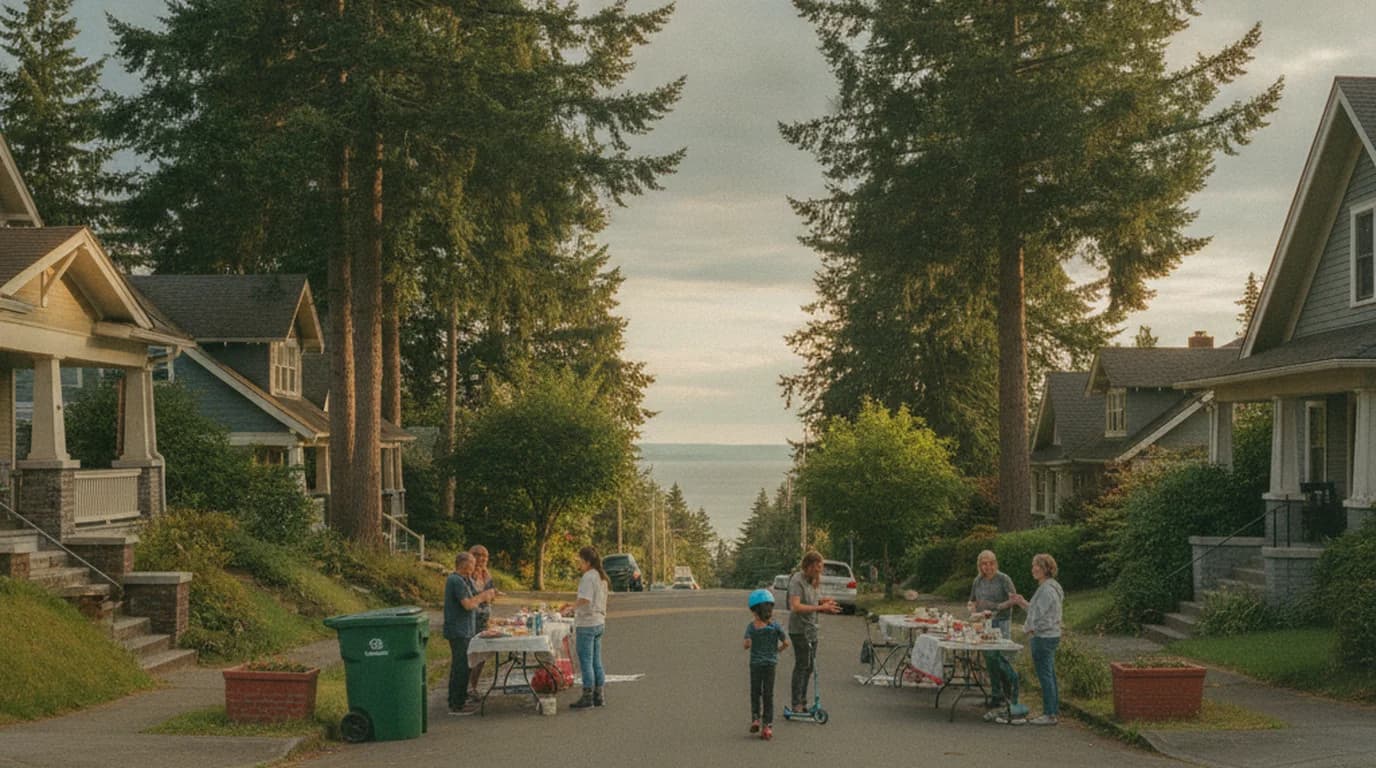
Block party or play street? Same form
Seattle runs this through the Department of Transportation's Street Use division, on a page called Block Parties and Play Streets. Two names, one street closure, separated by intent: a block party is a one-off gathering, and a play street is the same closure set up to recur for open play, up to three days a week.
Either way you file the Block Party record type in the Seattle Services Portal, under Permits – Street Use, inside Short Term Use. Anything over the thresholds below goes to SDOT's Street and Sidewalk Activities permit instead.
A block party permit in Seattle costs zero
SDOT says so flatly, and the binding document agrees: the 2026 Street Use Fee Schedule lists your use code, 54B, in Table A2, "Uses with No Base Permit Fee." No application fee, no separate issuance fee. Some cities split those into two charges. Seattle charges neither.
Money can still find you in one place. Your application names a Financially Responsible Party even though the permit is free, and if complaints trigger an inspection, SDOT bills that person $367 an hour ($737 overtime). Inspections are rare, SDOT says. Pick that contact deliberately anyway.
The page never mentions insurance at all. There's no certificate requirement and no coverage amount anywhere on it, only an indemnification clause. Be aware that SDOT also never affirmatively writes "no insurance required," so if your situation is unusual, email publicspace@seattle.gov.
Fourteen days, and no season
SDOT's wording: "Try to submit your application at least 14 days before your first event. Applications received less than 14 days prior to the event date may not be processed by the requested date."
Phrased gently, with a real consequence behind it. No turnaround time is published either, so treat fourteen days as a hard deadline.
The rest of the calendar is easy. Applications are taken year round, with no seasonal window or blackout dates. A recurring play street takes one application with the repeating days written in.
The expensive mistake is discovering late that you're over a threshold, because the Street and Sidewalk Activities permit that catches you wants eight weeks or more. That's a party this month versus a party in October.
The streets Seattle won't close
This is the real gate, and it's geographic rather than bureaucratic. Your street has to be non-arterial, and SDOT gives you a field test you can run from the sidewalk: if there's no solid or dashed centerline painted down the middle, it's probably non-arterial. Confirm it on the Streets Illustrated street type map. Requesting an arterial closure disqualifies you outright.
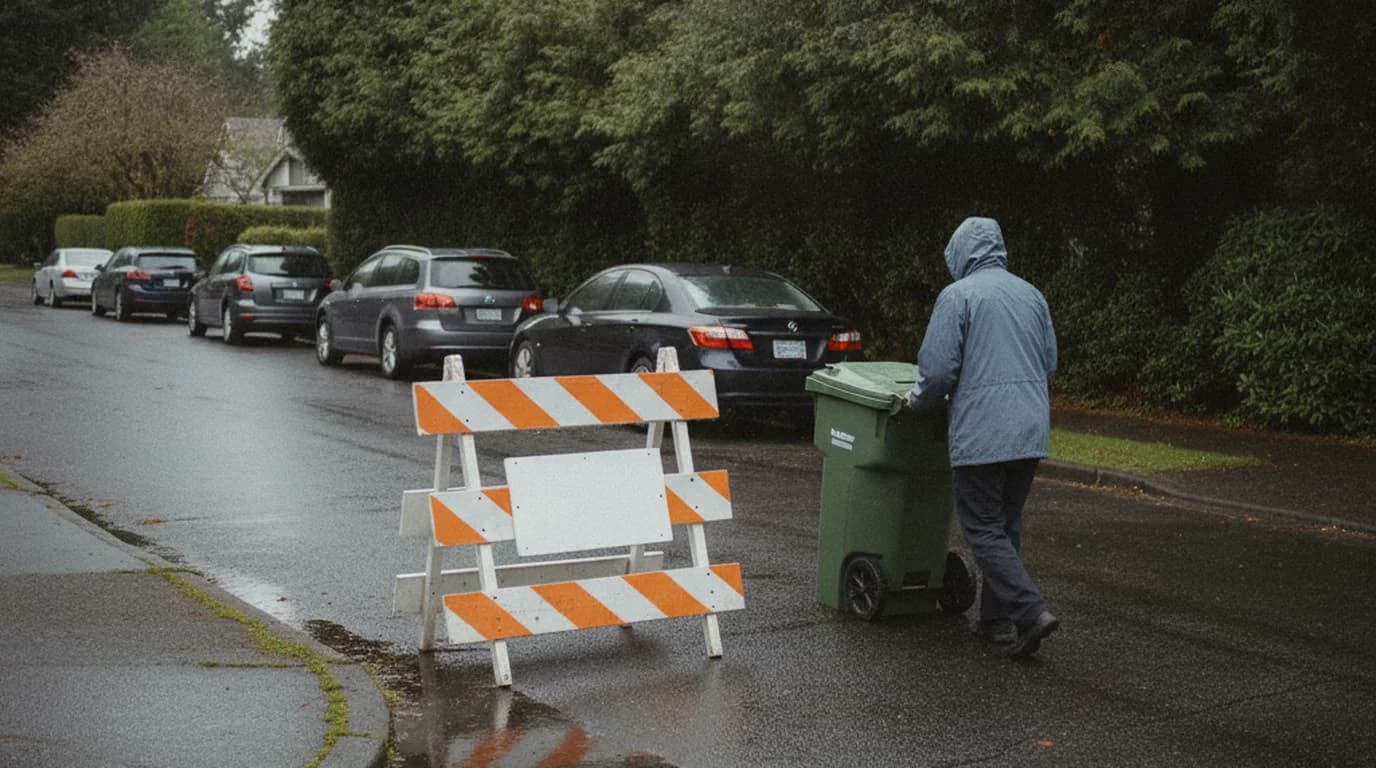
Your street also can't carry a bus route or an emergency vehicle route, for reasons that explain themselves the moment you picture a Metro coach nosing into a closed block. The closure covers one block, with no intersection inside it. Half-block closures are fine, and cross streets can be arterial without any problem.
So a busy street with a painted centerline gives you your answer before you fill out anything. Ask the neighbors one street over whether they'd host.
The neighbor rule Seattle doesn't have
Most big cities gate this permit behind neighbor consent: a petition, a percentage of the block frontage, sometimes a veto if enough people object. Seattle asks for none of it. SDOT's language is "we encourage you to communicate with your neighbors before applying," and the page hands you a sample email and a printable flyer.
Do it anyway, and do it early. It's how you learn that the house on the corner has a concrete pour scheduled that Saturday, and it's how you recruit the person who'll watch a barricade while you refill the cooler.
One warning. A 2018 paper form is still on seattle.gov, still ranking in search, and it contradicts the current rules: it claims neighbor notification is mandatory with a signed log, and it sets barricade spacing at five feet where the live page says six. If a search result hands you a PDF, check the year first.
Hours, headcount, and the inflatable rule
Hours run 9:00 AM to 10:00 PM, and that window includes setup and cleanup. A party ending at 10 is out of compliance if you're still folding tables at 10:15. You're also capped at three days and twelve hours a week.
Your party has to be free and open to the general public. That one isn't boilerplate. You can't charge admission or restrict the street to an invited list. That's the trade for a free permit.
Attendance stays under 100 people at any one moment. Cross it and you're pushed into the eight-week permit.
The street closes to through traffic only, so a 20-foot fire lane stays clear all day and everything in the roadway has to be immediately movable. One adult stays on site, visible from both barricades, ready to pull one aside for a neighbor or an ambulance.
| Thing | Where Seattle lands |
|---|---|
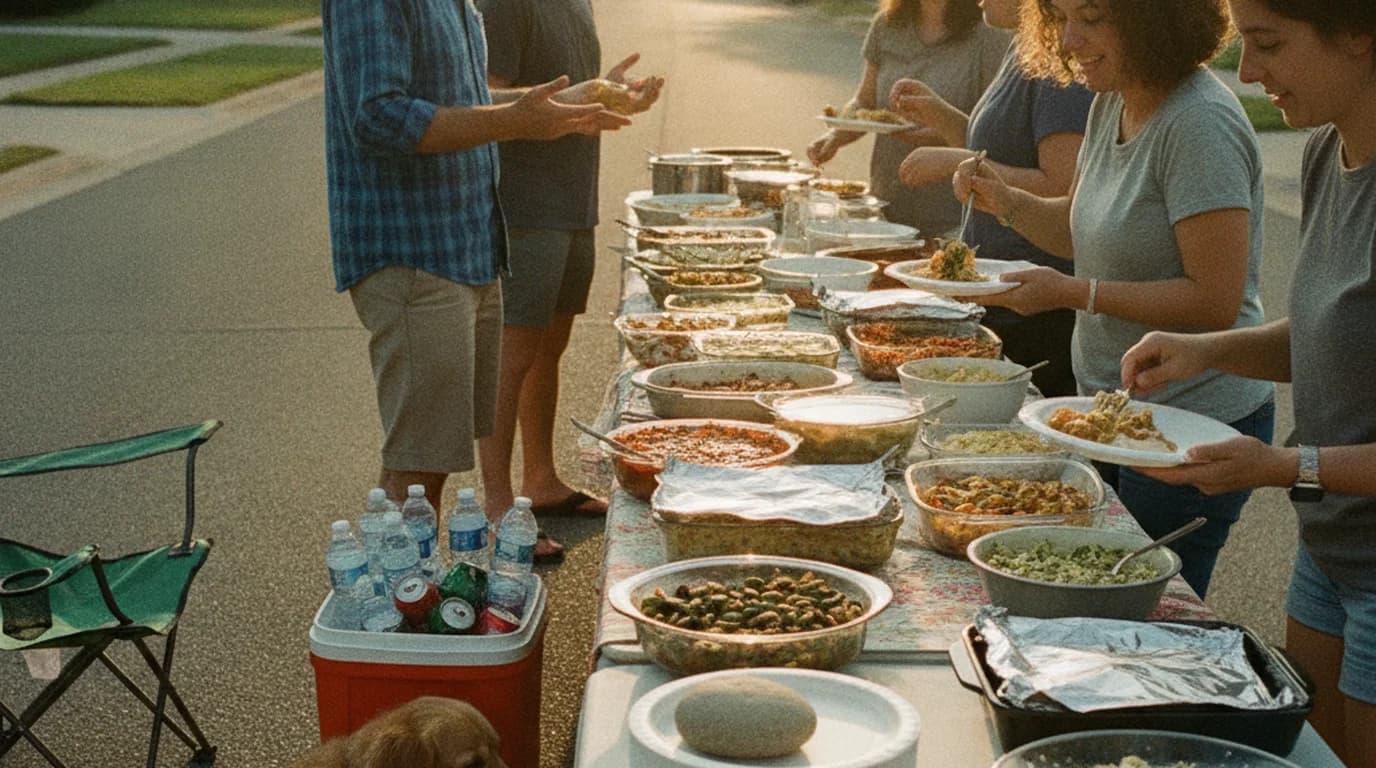
| Potluck food | Fine |
| Food truck in the street | Only with the vendor's own vending permit |
| Food truck in a driveway or yard | Fine, no extra permit |
| Alcohol sales | Disqualifies the permit |
| Bouncy houses in the street | Prohibited |
| Bouncy house in a yard | Fine |
| Stages or large structures in the roadway | Prohibited |
| Amplified music | Allowed, governed by the City Noise Ordinance |
The inflatable rule catches somebody every year, since plenty of cities allow them. Put it on the lawn.
Two things the city leaves genuinely unanswered. Grills appear nowhere on the SDOT page in either direction: food is allowed and grills aren't banned, but there's no explicit rule and no fire review step. Alcohol consumption is the same. SDOT names alcohol sales as a disqualifier and says nothing about BYOB, while the tier above bans consumption outright, which makes the silence ambiguous. Email publicspace@seattle.gov before planning around either.
Barricades and the after-dark rule
You set up the closure yourself. Barricades go at both ends of the block, no more than six feet apart, linked with rope and set behind the sidewalk extension so people can cross. At a non-arterial cross street you can use Type 2 barricades or, delightfully, household items at least 3 feet tall by 2 feet wide. Trash bins and patio furniture are explicitly allowed. An arterial cross street needs Type 3 barricades plus no-turn signs, with no trash-can fallback.
A 36" by 24" "STREET CLOSED" sign goes at the center of the street on the barricade, at least a foot above grade. Print the city's PDF, or email publicspace@seattle.gov with proof of permit and borrow SDOT's free from the Seattle Municipal Tower lobby.
The after-dark rule matters in August, when the light holds until nine. Past sunset your barricades have to be retroreflective. Type 2 and Type 3 units already are; household items need banding on all sides at the width SDOT publishes. The loaner signs aren't reflective.
How to apply for a block party permit in Seattle, step by step
- Check your street on the street type map, and confirm your closure is one block with no intersection inside it.
- Size the event honestly against the caps above.
- Pick your dates and hours, then go tell your neighbors.
- Fill out the full closure PDF or the partial closure PDF, and set up a Seattle Services Portal account if you've never used one.
- Apply in the portal, at least 14 days out. Create New, then Permits – Street Use, then expand Short Term Use and pick Block Party. The city's click-by-click walkthrough is worth keeping open.
- Fill in the form: location, dates and times, expected attendance, a short description of the plan, plus four separate contacts.
- Upload the template and submit for your record number. The portal's help article also lists a Letter of Authorization where the main SDOT page mentions only the template, so have one ready in case.
- When the permit issues, read the Street Closure Instructions attached to it and find your approved diagram on the Documents tab. Then gather barricades and signs, adding reflective treatment if you'll run past sunset.
- On the day, close the street before you start the party. Afterward, clear it out and reopen it. Borrowed signs go back inside a week.
The August night that needs no permit
National Night Out runs the first Tuesday evening in August, and SDOT isn't involved. Seattle Police Department Crime Prevention organizes it, you register on SPD's Night Out page, and no street use permit is needed. In 2026 that was August 4; registration has closed and typically reopens in May.
The sixty households within a two-minute walk
The last piece is the one that decides whether anyone shows up. The street stays open to the public, so this isn't a guest list in the gatekeeping sense. It's making sure the sixty households within a two-minute walk know it's happening, and giving yourself a headcount so you buy the right amount of ice.
Then go knock on the two houses that never check their phone. Some things still work best in person.
Seattle came out the easiest of the thirty cities we walked through. Houston came out hardest, by a distance.
Free permit, no petition, fourteen days. The only real work left is making sure sixty households hear about it. Describe the party to Lemonvite and the invitation comes back made for it, sent by text. Publish it and you also get a public RSVP link with a QR code you can download and print onto a flyer for the porches within a two-minute walk. Scanning is easier than typing a number. The RSVPs give you a headcount, and one message reaches all of them if August turns wet.