
Onam Celebration Ideas for Singapore's Malayali Community
My first Onam in Singapore, I almost let it slide past. It was a midweek workday, I had a deadline, and Kerala felt very far away from a fourth-floor flat in Tampines. Then my mother sent a photo of the pookalam at our gate in Thrissur, marigolds wide as a cartwheel, and I felt about two inches tall standing in a kitchen that didn't contain a single flower. I went down to Tekka the next morning and bought a bag of blooms with no real plan. I've hosted Onam here every year since.
Onam away from Kerala is a different animal. Back home the whole state exhales for it, and the festival just happens to you whether you organise it or not. In Singapore you have to make it happen on purpose, around a work week that doesn't pause for Thiruvonam and inside a flat that has no courtyard for a flower carpet. The upside is that the Malayali community here is large and very, very good at this. So these are my Onam celebration ideas for the Singapore Malayali, whether you grew up in Serangoon or landed last year for a job, built around two things Kerala never had to think about: a calendar that doesn't cooperate, and a city that does.
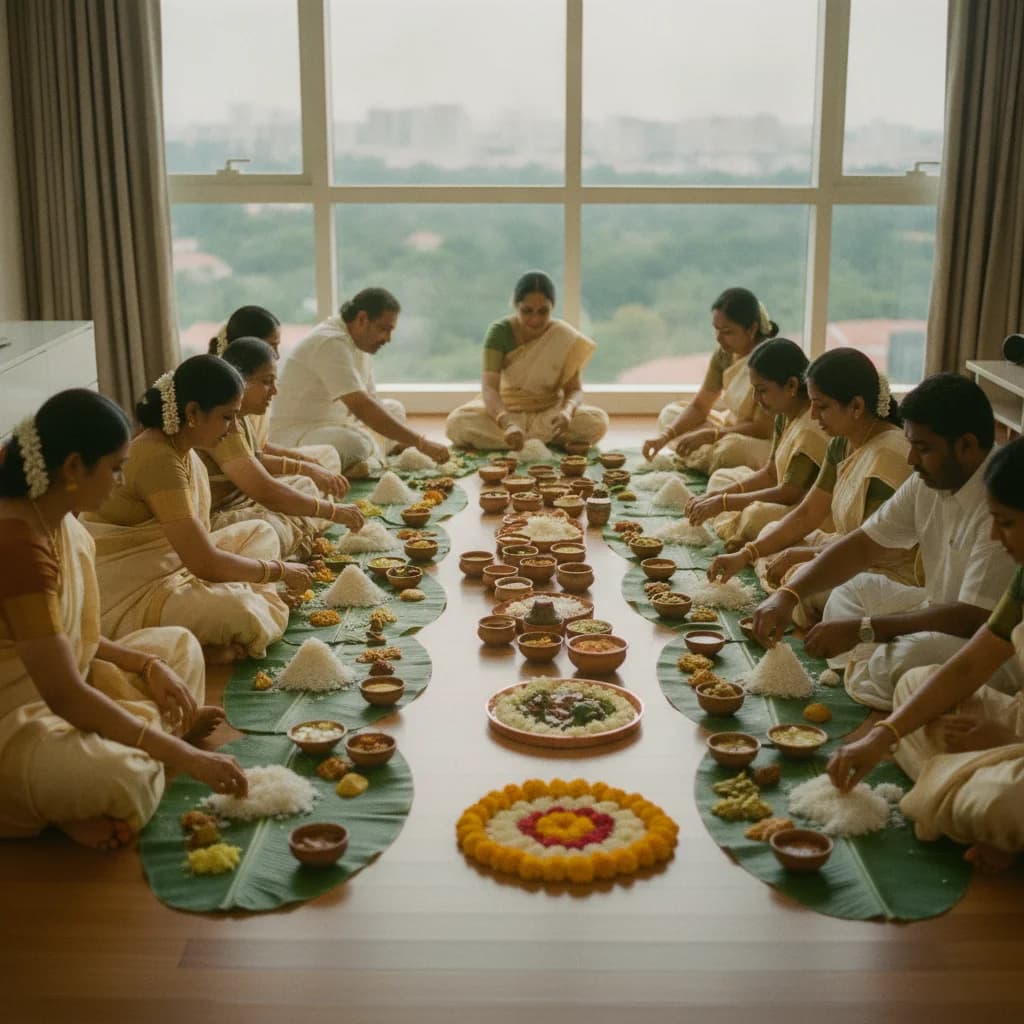
When Onam 2026 actually falls
Thiruvonam, the main day, lands on Wednesday, 26 August 2026. The festival runs ten days, opening with Atham in the middle of the month and building from there, because Onam follows the Malayalam solar calendar and is fixed to the Thiruvonam star in the month of Chingam rather than to a Gregorian date. That's why it drifts a little each year.
The catch for hosting here is the day of the week. 26 August is a Wednesday, and nobody is serving a twenty-dish banana-leaf lunch on a Wednesday with work the next morning. So decide your date early. The big community celebrations usually fall on the weekend nearest Thiruvonam, and most home sadhyas I've been to here happen on the Saturday or Sunday on either side. Pick yours and tell people now, and you'll dodge the annual scramble where three families realise in the same week they've all booked the same caterer.
Go to the big community do, then host your own anyway
Onam in Singapore really has two layers, and you want both.
The community Malayalis here have been celebrating together for a very long time. The Singapore Malayalee Association has been bringing Keralites together since 1917, and groups like it run the large-scale Onam season every year: pookalam competitions in Little India, classical music and dance in air-conditioned halls, a sadhya that feeds an entire function room, and the snake-boat race the diaspora has long staged out on Jurong Lake when the backwaters of Kerala are a continent away. Go to one of these. It's where your kids see Onam at full scale, and where you bump into the Malayali you didn't know lived two MRT stops over.
Then host your own smaller table at home. The community sadhya feeds the whole hall; your living room feeds the dozen people who actually know your children's names. One is for belonging to something big. The other is for the friends who'll still be sitting on your floor at four in the afternoon arguing about whose ammumma made better olan. You need the second kind too.
A pookalam that fits a flat
You don't need a doorstep in Kerala to lay a pookalam. You need flowers and a flat surface, and Singapore supplies both.
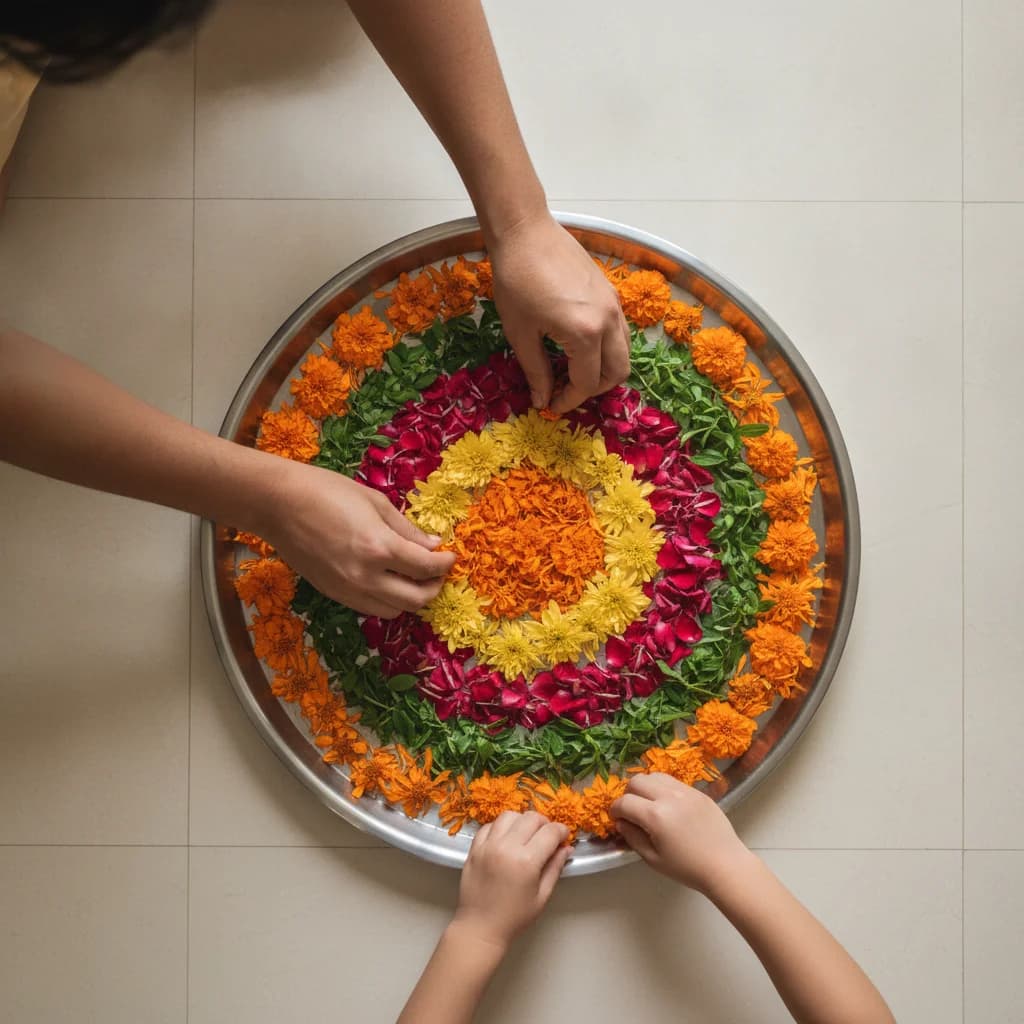
Tekka Market and the Little India florists are full of marigold, chrysanthemum and rose by the bag through the Onam fortnight, and they're cheaper than you'd guess. If you've got a proper landing or a corridor your neighbours won't mind, lay it on the floor. If you're in a compact condo or an HDB flat with the door opening straight into the living room, do what most of us do: build it on a large steel tray or a round of cardboard and set it on the dining table or by the entrance. Nobody has ever once complained that the flowers were on a tray.
The technique is the same anywhere, and I won't repeat the whole thing here because my Onam sadhya and planning guide walks through laying the rings cleanly and the order of the ten days in detail. The Singapore-specific bit is just sourcing and scale: smaller and on a tray, started a few days before so it grows toward Thiruvonam. Get the kids who were born here down on the floor with you. A slightly lopsided pookalam a seven-year-old helped make is the thing that makes Onam theirs and not just a story about a place they've visited twice.
The sadhya: cater it, cook it, or split the difference
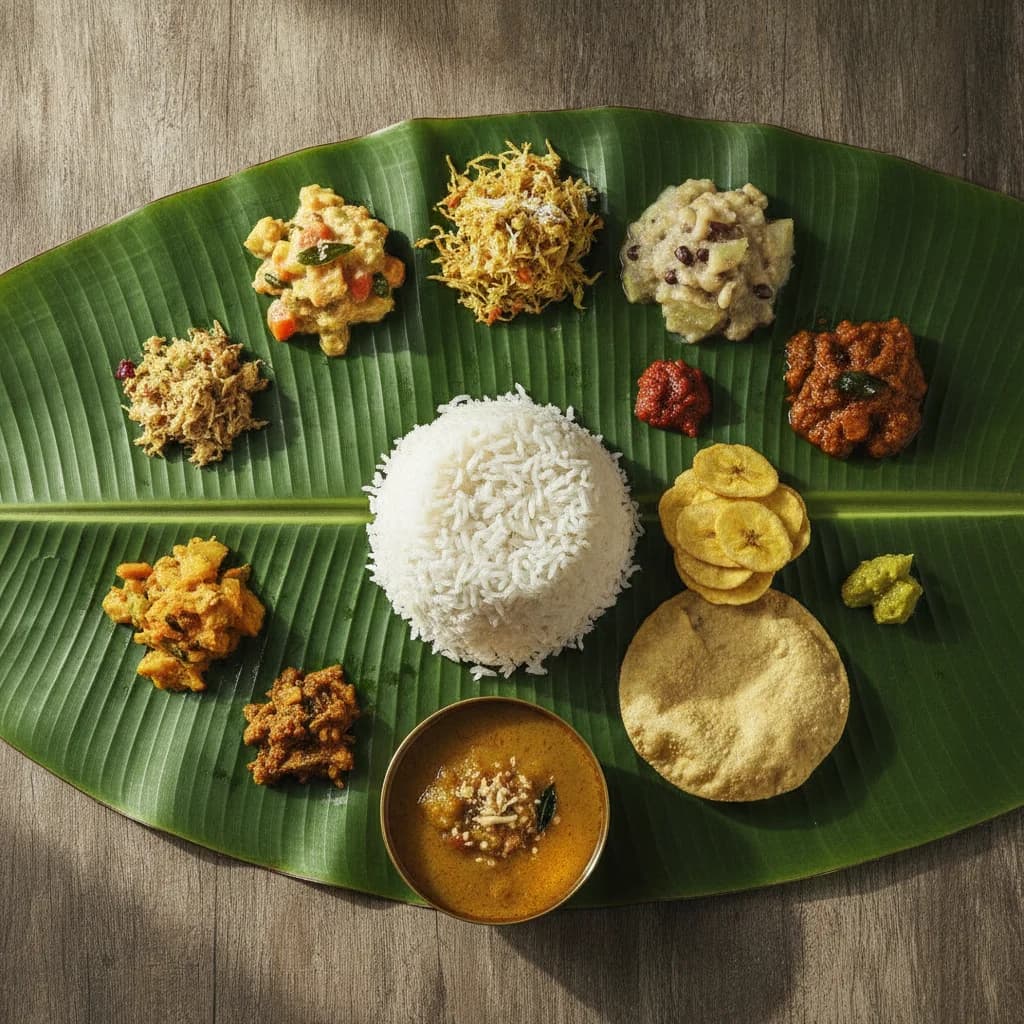
Singapore makes this part easier than the homesickness lets you believe. A full Onam Sadhya is a vegetarian banana-leaf spread that can run past twenty-six dishes, and recreating that from scratch in a flat is a real undertaking. You have three honest options, and none of them is cheating.
Cater the whole thing. Kerala restaurants and caterers across the island do proper banana-leaf sadhya for Onam, from the polished places to the twenty-seat Palakkad family on a back lane in Little India whose avial Kerala natives rate above their own mother's. They book out weeks ahead, though, so order now and treat it as a this-week task. Collect the leaves and the food, and spend the day with your guests instead of at the stove.
Cook the spine and dabao the rest. This is what I do. I make the rice, the sambar, the avial and one payasam, the dishes that set the tone, and I order the thoran, the olan and the pappadam from a caterer or pick them up from a Kerala stall. The leaf still looks full, and I'm not a wreck by noon.
Split it like a potluck. If your Onam is a friends' affair rather than a family one, assign dishes the way you'd assign any shared meal, so you don't end up with five thorans and no rasam. My potluck guide lays out how to divide a menu by category, and a sadhya maps onto it almost perfectly. For the order things go on the leaf and which payasam to make from scratch, the sadhya guide has the full playbook.
Whatever you choose, source your provisions in one trip. Mustafa and the Little India grocers carry Matta rice, fresh plantain leaves, jaggery and curry leaves right through the season.
Make room for your non-Malayali friends
One of the best things about Onam is that it's a harvest festival, not a religious one you have to be inside to enjoy. It's among the easiest Indian celebrations to share with a mixed Singapore guest list, and the sadhya does most of the work for you, because it's fully vegetarian and skips the dietary minefield before you've even thought about it.
So invite the colleagues. Invite the neighbour. The legend carries the evening on its own: Mahabali, the good king the gods exiled underground, is allowed home once a year to see that his people are happy, and the whole celebration is about looking like a household worth visiting. People who've never heard the story love it, and crouching over the pookalam to ask what the flowers are for handles the awkward first twenty minutes of any gathering. If your guest list spans a few communities and you want everyone genuinely fed and comfortable, my notes on hosting a multicultural celebration in Singapore go deeper on the food and the small graces that make a mixed room feel like one room.
Where to actually hold it
Be honest about your space. A banana-leaf lunch wants people seated and a bit of elbow room, and a 4-room flat seats fewer than the whole extended family and the friends you promised. Two formats work. A staggered open house, where family come at noon, friends from three, and the kopi-and-payasam crowd drifts in by five, keeps the flat full without ever cramming it. Or, if your list has outgrown the living room, book the void deck or your block's multi-purpose hall through the Residents' Network, the way you'd book any larger do downstairs. The same early-booking discipline I went on about in my HDB housewarming ideas applies here: the good slots and the good caterers both go to whoever asks first.
Tell guests to come in their onakkodi, the new clothes for Onam, kasavu mundu and set saree or just whites and golds, and the room photographs beautifully with no effort from you.
One jio, from Tekka to Thrissur
For all the fuss over the food, the genuinely hard part of an Onam in Singapore is the headcount. Your people are scattered across three time zones: half the relatives still in Kerala, a cousin in Dubai, your sister in Melbourne, and the friends here who live entirely inside WhatsApp. A forwarded poster and a "you're coming na?" voice note loses track of all of them, and with a banana-leaf lunch you portion by the head, so a vague count is a genuine problem.
So I send a real invitation now. I describe what I want to Lemonvite's design engine, something close to "Onam, pookalam in marigold and red, banana-leaf border, warm Kerala festive, gold and deep green," and what comes back looks hand-painted, the kind of art you'd find on an old sweet box, with no template hunting. It designs a custom festive open-house invitation in seconds. Then it goes out by text, where people actually open it, and the relatives overseas get the same invite on WhatsApp, so the cousin in Dubai taps the link as easily as the neighbour downstairs. Each guest RSVPs in one tap, and I get a live headcount, which is the whole game once a caterer wants a firm number. "Maybe thirty?" is not a number a sadhya kitchen can cook to.
Maveli only comes home once a year, and the least you can do is not spend his visit hunched over a pot, panicking about the rice. Settle your date and decide whether you're cooking or ordering. Then put the invite together this week. You can build it on Lemonvite in about the time it takes your first payasam to thicken, and have it on every phone, here and back home, by tomorrow.