
Space Birthday Party Ideas for Little Astronauts
"Dad. In space, no one can hear the vacuum cleaner."
That was my five-year-old, Nora, the morning after her space birthday party, narrating from inside a cardboard box she refused to exit for two days. The box was her spacecraft. The party had been, in her official post-mission report, "the best day of the entire solar system."
Here's what I knew going in: a space birthday party can go two ways. There's the version where you buy a galaxy's worth of foil decorations and the kids ignore all of it to fight over one balloon. And there's the version where you understand the actual appeal (kids don't want to look at space stuff, they want to be astronauts) and you build the party as a mission instead of a display.
We built a mission. Total spend was modest, the structure did all the work, and one activity involved a fizzing planet that parents were elbowing kids aside to try. Full debrief below.
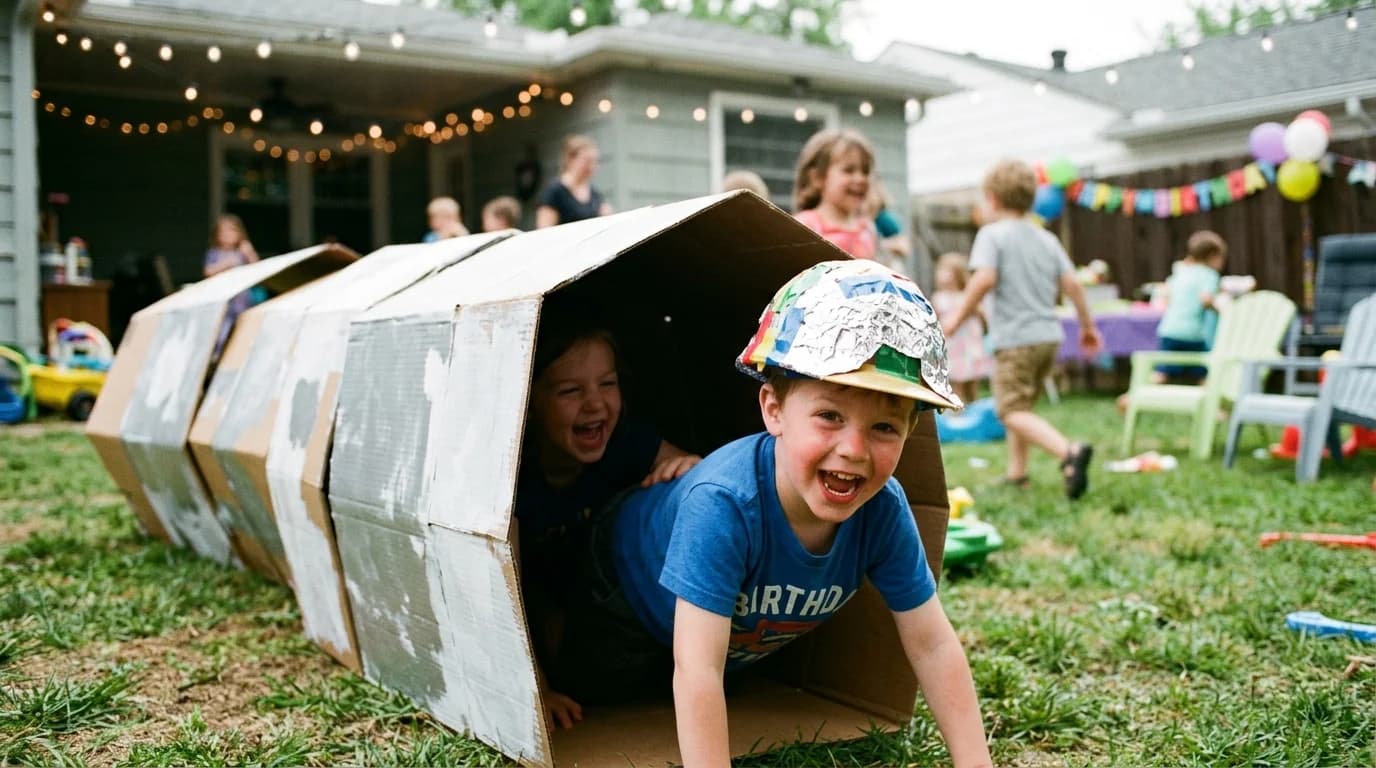
Frame the whole space birthday party as astronaut training
This is the move that organizes everything else: the party isn't a party, it's a training program, and every kid graduates as an astronaut. Kids this age are desperate for structure that takes them seriously, and "training" is structure with a jetpack.
When kids arrive, they check in at "Mission Control" (a table) and get a sticker name badge: CADET NORA, CADET JONAH. Then they rotate through stations:
Station 1: Spacecraft assembly. The cardboard boxes. Collect big boxes for a month beforehand (appliance stores hand them over happily), pre-cut some windows, and set out aluminum foil, paper plates for control panels, and crayons. Kids build and decorate their craft. This was Nora's box. You know how that ended.
Station 2: The asteroid field. Crumpled-foil "asteroids" scattered across the lawn; kids cross it on a winding masking-tape path without touching one. Then they throw the asteroids into a laundry-basket "containment unit" from increasing distances. Cost: foil you own.
Station 3: Moon rock retrieval. Grey water balloons or grey-painted rocks hidden around the yard, collected in paper bags, weighed ceremonially at Mission Control. It's an egg hunt in a spacesuit. Works every time.
Station 4: The fizzing planets. The showstopper, and it's a baking-soda trick: form baking soda mixed with a little water and food coloring into balls, freeze them, then give kids droppers and cups of vinegar. The "planets" fizz, foam, and erupt color as they're "explored." This held the entire party (including, I want the record to show, four adults) for half an hour. Pennies per planet.
End with a graduation: each cadet gets a paper certificate and does one lap of the yard in "zero gravity" (slow-motion running, which five-year-olds perform with devastating commitment).
Staffing note: stations need station chiefs, and the chiefs are the other parents. Most parents at a drop-off-age party hover awkwardly anyway; deputizing them ("Raj, you're running the asteroid field, here's your clipboard") converts hoverers into crew and means you, Mission Director, can float between problems instead of being pinned to one. The clipboard is decorative. The clipboard is also essential. Adults handed a clipboard take any job seriously.
Decor: darkness is your budget's best friend
The galaxy aesthetic has a secret: space is mostly dark, and dark is cheap.
If the party's indoors or runs to evening, the whole look is black and navy balloons, a couple strings of warm fairy lights ("stars"), and glow-in-the-dark star stickers you'll honestly want to leave up afterward. One black plastic tablecloth becomes "deep space" under the snacks. If you can get the room dim, a $15 star projector turns the ceiling into the night sky and produces actual gasps.
Daytime outdoor version: lean silver instead of dark. Foil everything (the asteroid field doubles as decor), plus white and silver balloons in clusters as "moons."
The footprint trick from every good kid party works here too: cut moon-boot prints from white paper and trail them to the front door. "Someone landed here" beats any banner.
What to skip: the licensed astronaut gear, the $40 helium arch, and themed cutlery. A fork is a space fork. NASA uses regular forks.

Mission rations (food that survives re-entry)
Space food naming is even easier than most themes because half of it is already named:
- Star-shaped sandwiches (cookie cutter, ten minutes): "star bites"
- Cheese sticks: "fuel rods"
- Banana halves with a paper cone taped on: "rockets" (Nora's idea, fully ridiculous, completely devoured)
- Blueberries and blackberries in cups: "asteroid clusters"
- A bowl of popcorn: "moon dust"
- Capri-style drink pouches, relabeled or not: astronauts drink from pouches; the kids already know this; you've done nothing and you're a genius
The cake: a "moon cake." Round, grey-tinted vanilla frosting, craters pressed in with the back of a spoon, a tiny flag with the birthday kid's name on a toothpick. Easier than any character cake and more impressive in photos. If baking isn't your mission profile, a store-bought chocolate cake covered in crushed-cookie "moon surface" with a toy rocket on top takes four minutes of assembly.
Launch the invitation like a countdown
The invite frames the mission, so write it as one: "CADET RECRUITMENT NOTICE: Nora turns 5 and needs a crew. Astronaut training begins Saturday at 1400 hours (that's 2 PM). Report to base in clothes that can survive an asteroid field."
For the design, I gave Lemonvite's design engine the description "children's space birthday invitation, friendly rocket launching through stars, deep navy with coral and gold accents, retro illustrated poster style" and got something that looked like a vintage planetarium poster. Sent by text to the parents (the only communication channel parents reliably see), with one-tap RSVP, an allergy question built into the response, and a broadcast three days before launch to the families still floating in silence. Cake math, certificate count, and fizzing-planet inventory all depend on that headcount, and chasing it manually is the part of kid parties I refuse to do anymore.
Two companion reads for the rest of the operation: the kids' party planning guide for guest-count and timing doctrine, and, if your astronaut is more of a moon-faced lump in a onesie, the first birthday party ideas post for the version where the mission is mostly photographic.
Start hoarding boxes now; that's the real lead time. When you're ready for liftoff, design the cadet-recruitment birthday invitation, text it to the crew, and start the countdown. T-minus one cardboard spacecraft your kid will live in until October.