
How to Plan a Graduation Party on a Budget
I remember my own college graduation party. My parents rented a banquet hall, hired a caterer, and ordered custom printed invitations that arrived two weeks late. The total bill? Somewhere north of $3,000. For a four-hour party where half the guests stood around the appetizer table.
It was lovely. But it did not need to cost that much.
A graduation party is not a wedding, no matter what Pinterest implies. It does not need a florist or a DJ or hand-calligraphed seating cards. What it needs is good people and decent food in a space that says "I did the thing." That is the whole assignment.
You can pull that off for a fraction of what most people spend. Here is how I do it.
Set Your Budget Before You Set Your Theme
This sounds obvious, but almost nobody does it. They start browsing party ideas, get emotionally attached to a vision that costs $2,000, and then scramble to cut corners that make the whole thing feel cheap.
Flip the order. Pick your number first. For most graduation parties, $200 to $500 is more than enough to host 30 to 50 people comfortably. Write that number on a sticky note and put it on your laptop.
Here is a rough breakdown that works for a $300-ish party:
- Invitations run $5, which is one Lemonvite event credit.
- Food and drinks are the big line, anywhere from $100 to $250 depending on what you serve (more on this below).
- Decorations should stay around $30 to $75 if you focus your spending.
- A photo setup costs $15 to $30, mostly string lights and clips.
- Leave a $50 buffer for the stuff you forgot.
That is it. You skip the venue rental when you use a backyard or a park pavilion. You skip the professional photographer when you set up a good selfie station. And you skip printed invitations, which look worse than digital ones anyway.
Skip the Printed Invitations (Seriously)
I have a strong opinion on this: printed graduation invitations are a waste of money. Once you add up the design and the printing and the postage, they cost $1 to $3 each. For 40 guests, that is $40 to $120 just to tell people to show up.
What stings is what happens next. Half of those envelopes get opened, glanced at, and then dropped in the recycling. The other half end up in a stack of mail on someone's counter, slowly buried under takeout menus.
Digital invitations have a 98% open rate when sent via SMS. People actually see them, and they can RSVP in two taps. You get a real-time headcount instead of playing the "so... are you coming?" game two days before the party. If you're skeptical that texting an invite works, here's why SMS invitations work better than email ever did.
On Lemonvite's design engine, you describe your vision and it creates a completely custom invitation. Not a template. Not a Canva rectangle with clip art. Something that actually looks like your party is going to be worth attending. If you get stuck on what to actually say on it, our graduation invitation wording guide has lines you can lift.
My prompt: "Navy blue and gold celebration, elegant but youthful, confetti falling, dark background with warm metallic accents, feels like a milestone moment."
The result cost me $5 for the event credit. Compare that to $80 at the print shop.

The Food Strategy That Actually Works
Catering is where budgets go to die. A standard catering order for 40 people runs $400 to $800 depending on your area. That is your entire budget blown on chicken skewers.
Instead, pick one of these three.
A taco bar is my default. Buy tortillas and seasoned ground beef or chicken, then set out bowls of toppings: rice, beans, salsa, cheese, sour cream, whatever you like. Feeding 40 people this way runs roughly $80 to $120, and guests love building their own. I have never once seen a taco bar disappoint a room.
A potluck is not the cop-out it used to be. Organized well, it is actually more fun, because people bring the dishes they are proud of. Coordination is the whole game here. Use Lemonvite's "What to bring" section so guests can claim items in advance, and you avoid the nightmare of twelve people showing up with bags of chips while nobody brings a main.
A brunch party is the sneaky-cheap option. Who decided graduation parties have to be dinner? A late-morning spread of pancakes, fruit, and Costco pastries with a big coffee setup costs half of what dinner would. People also drink less alcohol before noon, so that line item shrinks too.
Decorations That Look Expensive But Are Not
Good party decor comes down to focus. Do not try to decorate every surface. Pick one spot to make a statement and let the rest stay simple.
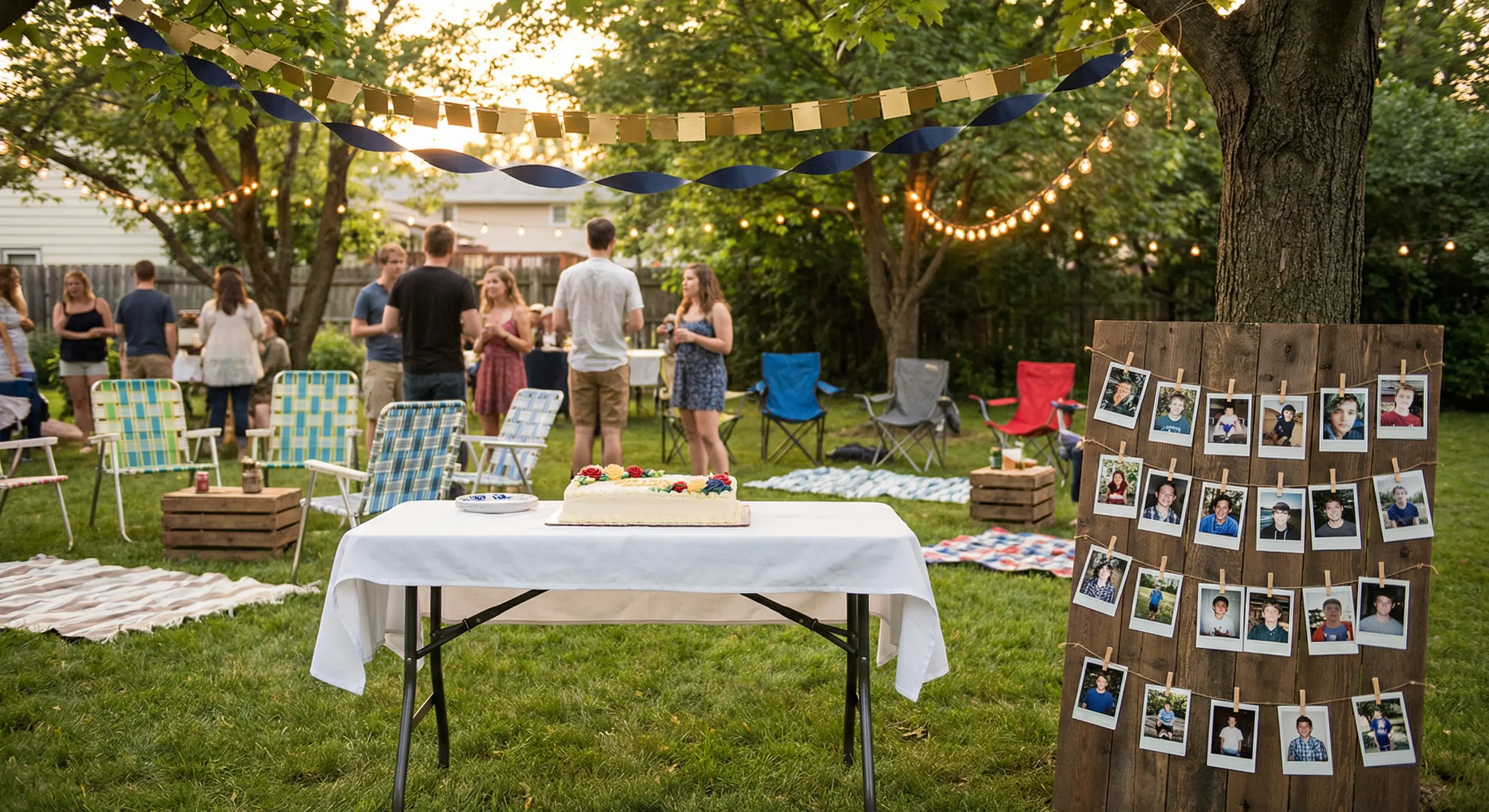
Make that spot a photo wall. String some fairy lights on a blank wall or fence, then hang photos of the graduate from kindergarten through senior year using mini clothespins and twine. About $15 in lights and clips, and it becomes the centerpiece of the party, because everyone loves looking at old photos and the graduate gets adorably embarrassed.
Paper tassels handle the rest. A pack of tissue paper tassels in the school colors runs $8 on Amazon. Hang them over the food table or the entryway. They photograph well and make the whole space look like you meant to do this.
Skip the balloon arch. Those Instagram-worthy garlands cost $50 to $100 for the kit, take two hours to assemble, and sag by hour three of the party. Put that money toward food.
Use Co-Hosting to Split the Work
If you are a parent, here is my biggest tip: do not plan this alone.
Lemonvite lets you add up to 10 co-hosts to an event, so the graduate's other parent or their best friend or a roommate can pitch in on the guest list and the RSVP tracking. Spread the work around.
Here is a division of labor that works. You create the event and run the food. One co-host owns decorations and setup. Another takes music and the photo station. The graduate gets to approve the guest list, since it is their party after all.
Everyone has access to the same RSVP dashboard, so nobody is relaying headcounts down a chain of text messages.
The RSVP Trick That Saves You Money
One thing quietly costs hosts hundreds of unnecessary dollars: over-preparing for guests who never show up.
When RSVPs are vague ("I'll try to make it!"), you buy food and supplies for 50 people and 30 walk through the door. That gap is real money in the trash.
Lemonvite gives guests three clear options. They are either Attending or Declined, or Maybe if they genuinely don't know yet, and you can see exactly where your headcount stands at any moment. Because guests don't need to create an account to RSVP, you actually get responses instead of radio silence.
Plan your food and supplies for the confirmed attendees plus about half of your "maybes." That math has never let me down. You end up with enough without drowning in leftovers.
Send Updates Without the Group Chat Chaos
Two days before the party, you will need to send logistics. Parking instructions. What to wear. A reminder to bring a lawn chair.
Do not start a group chat for this. You will regret it within 15 minutes when someone replies-all with "Who's bringing the cooler?" and kicks off a 47-message thread.
Use Lemonvite's broadcast feature instead. You send a targeted update to everyone who RSVP'd "Attending" without bothering the people who declined, and it goes out via SMS, so people actually see it. Guests with phone numbers outside the US and Canada get the same message over WhatsApp now, so the cousin studying abroad sees the parking instructions too. One message goes out, and the reply-all spiral never starts.
The Timeline That Keeps You Sane
Here is the timeline I follow.
Three to four weeks out, create your Lemonvite event, describe your design vision, and send the invitations by SMS and email. Book the venue now too if you need one, like a park pavilion or a community room.
At the two-week mark, check your RSVP count, start the food shopping list, and order any decorations that ship from Amazon.
One week before, send a broadcast reminder to anyone who hasn't RSVP'd yet and lock in the menu. Buy the non-perishables while you're thinking about it.
Two days before, send a logistics broadcast covering parking, timing, and what to bring, then do the fresh-food and drink run.
The day of, set up early and then make yourself stop. You planned for this. Go enjoy it.
What Actually Makes a Graduation Party Good
The best graduation parties I have been to were not the expensive ones. They were the ones where the host was relaxed and present instead of running around patching problems all afternoon.
Budget planning is not about being cheap. It is about being intentional with where your money goes, so you can spend the day on what matters: celebrating someone's hard work with the people who care about them.
Look at what each of these choices buys you. The $5 custom invitation gets a 98% open rate. The taco bar feeds 40 for under $100. The co-hosting team means you are not doing it alone, and the broadcast feature kills the group chat before it starts. None of that requires a big budget, just a good plan.
Start planning your graduation party on Lemonvite and put the money you save toward something the graduate actually wants. Like a graduation gift. Or their student loans.