
Best Free Online Invitation Makers: What You're Actually Getting
I have spent an unreasonable amount of time testing free online invitation makers. Every time I plan an event, I end up down the same rabbit hole: searching for a free digital invitation tool, clicking through five or six platforms, and slowly discovering that "free" rarely means what I thought it meant.
If you have ever searched for a free online invitation maker, you have seen the same names show up over and over. Evite, Canva, Punchbowl, Greetings Island. They all promise beautiful free digital invitations. And technically, they deliver on that promise. But the experience of using them, and the experience your guests have receiving them, tells a very different story.
I want to give you an honest breakdown of what each of these platforms actually offers for free, where the catches are, and why I eventually stopped trying to get invitations for $0.
Evite: The Original Free Invitation Maker
Evite has been around since the late 1990s. It is probably the first name that comes to mind when you think of free digital invitations, and for good reason. The free tier hands you a large template library, plus basic RSVP tracking and email delivery.
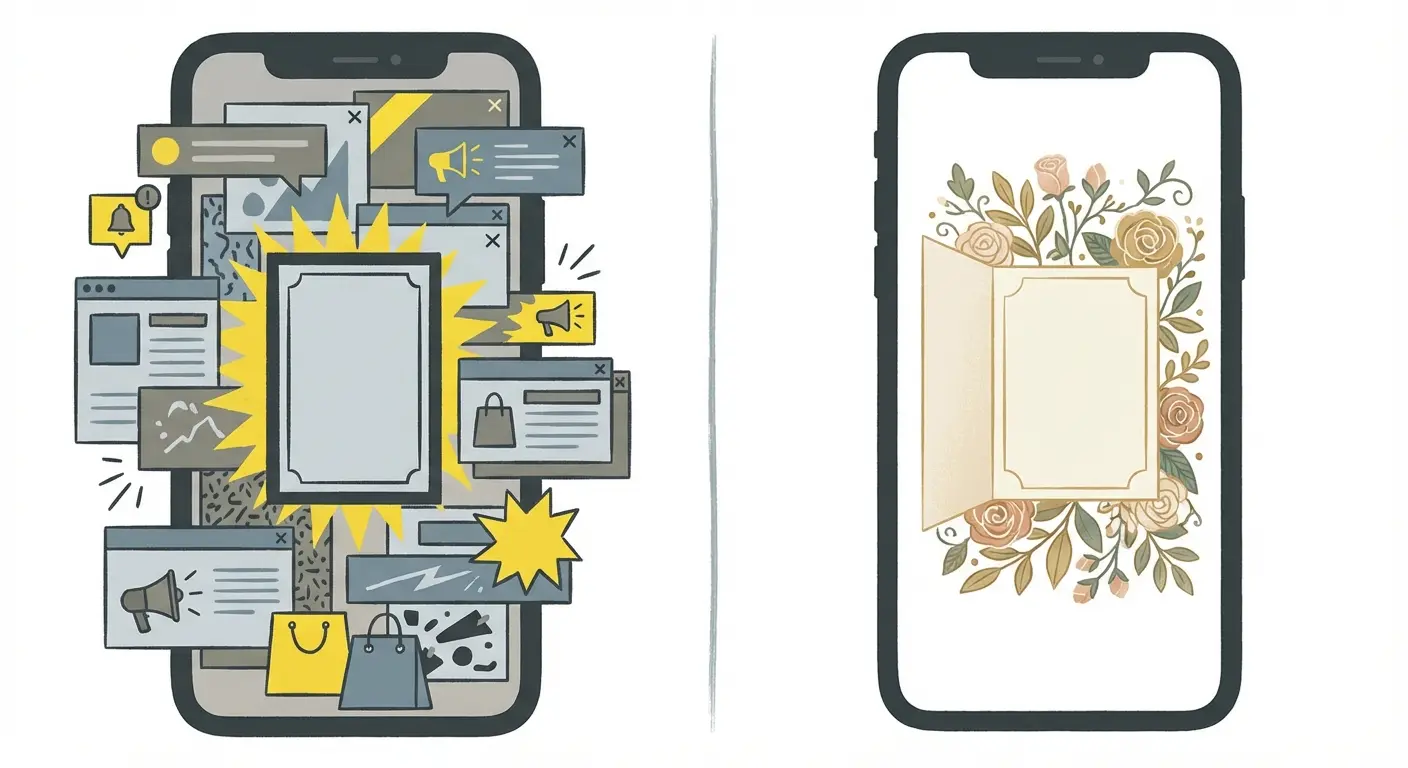
But the free tier is ad-supported, and the ads are not subtle. When your guests open your invitation, they see banner ads flanking your event details. Sometimes those ads are for car insurance, sometimes for meal kits. Either way, your carefully chosen birthday party invitation ends up looking like a billboard on the side of a highway.
Beyond the ads, the free templates tend to feel generic. You are picking from the same catalog as millions of other hosts, and many of the designs have not been updated in years. Customization is limited to swapping text and maybe adding a photo. If you want ad-free invitations or access to the nicer designs, you need to upgrade to a paid plan.
What you actually get for free: templates, email delivery, and basic RSVP tracking, all wrapped in ads your guests will see whether you like it or not.
Canva: Free Design, But Not Free Invitations
Canva is an excellent graphic design tool. I genuinely use it for other things and recommend it for visual projects. But calling Canva a free online invitation maker is a stretch.
Yes, Canva lets you design a beautiful invitation on its free tier. You get a massive template library and genuinely good drag-and-drop editing, and the designs come out looking professional. The problem is that Canva only handles the design part. Once you export that gorgeous image, you are completely on your own.
Canva has no guest list management and no RSVP tracking, and there is no way to send the thing from inside the tool. You have to manually text or email the image to every guest, then track responses in a spreadsheet or group chat and chase down the stragglers yourself. The "invitation" is really just a picture file. Everything that makes an invitation actually useful, getting it to people and knowing who is coming, is left entirely to you.
What you actually get for free: a beautiful image file and nothing behind it. No delivery, no RSVPs, no guest management. You become the delivery system. (I go deeper on this in Canva vs Lemonvite if you are weighing the two.)
Punchbowl: Cleaner Free Tier, Same Limitations
Punchbowl positions itself as the more modern, more stylish alternative to Evite. And honestly, it delivers on that promise to some extent. The templates are noticeably better-looking than Evite's, and the browsing experience feels less cluttered.
The free tier covers RSVP tracking and email delivery, plus a selection of templates. The ad situation is less aggressive than Evite, but ads are still there. Your guests will see them, just not quite as many.
The bigger limitation is the template selection. The best designs are locked behind a premium subscription. If you are browsing and find the perfect invitation, there is a solid chance it has a "Premium" badge on it. The free designs work fine for casual events, but they start to feel limiting if you want something that stands out.
What you actually get for free: nicer templates than Evite plus email delivery and RSVP tracking, still with a few ads. The premium designs require a paid plan.
Greetings Island: Free Downloads With a Catch
Greetings Island is a platform I see recommended a lot in "best free invitation" roundups, and it does have a genuinely large selection of free templates. You can customize text, colors, and layouts, and the designs are generally attractive.
The catch is the delivery and export model. Some features require a premium subscription, and the platform pushes you toward upgrading at several points during the creation process. The free experience works, but it feels like a funnel toward paying. And like Canva, the emphasis is on the design itself rather than the full invitation workflow. You are still responsible for getting the invitation to your guests and managing responses separately.
What you actually get for free: customizable templates, but with a chunk of the good features gated, delivery limited on the free tier, and only basic RSVP management to fall back on.
The Pattern Behind "Free"
After testing all of these platforms, the pattern became obvious. A free invitation maker has to pay for itself somehow, and it usually picks one of a few methods.
The most visible one is ads. Your guests see advertisements right next to your invitation, and the platform makes its money by renting out your guest list's attention. The quieter method is gating the good stuff: the best templates, ad removal, and premium delivery sit behind a paid tier, so free gets you in the door and then the product keeps nudging you to upgrade. And then there are the design-only tools that hand you a great-looking image but leave the delivery, the tracking, and the chasing-down-replies entirely to you.
None of this is evil. These are businesses, and they need to make money. But as a host, you should know what you are signing up for when you choose "free." Either your guests look at ads, or you settle for stripped-down features, or you do a pile of manual work that the platform skipped.
The question I kept coming back to was whether saving a few dollars was actually worth all that.
Why I Stopped Chasing Free
For casual events where I did not care much about the experience, free tools worked well enough. But for events that mattered to me, birthdays, showers, dinner parties where I wanted things to feel polished, the free options always left me wanting something more.
That is what led me to Lemonvite, and I should be transparent: I built it. But I built it specifically because I was frustrated with the tradeoffs I just described.
Lemonvite costs $5 per event. No tiers, no subscriptions, no ads, ever. Events with larger phone guest lists may need additional credits to cover texting costs. Here is what that $5 actually buys.
Instead of a template catalog, you get a design engine. You describe your event and what you want, and it generates an invitation no one else has. There is no scrolling through hundreds of options hoping to find something that works, and no chance you end up with the same design your friend used last month.
Delivery goes out by text message, which has a 98% open rate. Email invitations land in spam folders or get buried under everything else in a crowded inbox, but a text gets seen. And if your guest list reaches past the US and Canada, those invitations go out over WhatsApp instead, so everyone gets the same tap-to-respond experience no matter where they are. RSVP tracking is built around that link: guests tap it, see your invitation, and respond Attending, Maybe, or Declined. No account, no password, no sign-up loop. Every response shows up on your dashboard in real time. Guests can attach a note, and you can add your own RSVP questions (a meal choice, an allergy field) so you do not need a separate form.
The hosting tools are where the $5 really earns its keep. When the venue or time changes, one broadcast message reaches everyone at once, and you can filter it to nudge only the people who have not replied yet. You can add up to 10 co-hosts so a partner or a couple of friends can manage RSVPs and send updates without you relaying every detail. For potlucks and picnics there is a "What to Bring" section that replaces the usual sign-up spreadsheet. And when guests open the invitation, they see your design and your event details and nothing else. No banners, no pop-ups, no "special offers" wedged in next to the address.
Is $5 Worth It?
I will be the first to admit that free is a powerful word. If you are sending a quick, casual invite and you do not care about ads or the guest experience, a free tool will get the job done.
But if you are hosting something you actually care about, $5 buys a completely different experience: a one-of-a-kind design, delivery that reaches people, and a clean page your friends and family will enjoy opening. If you want to see how that stacks up against the incumbent, I wrote a longer Evite vs Lemonvite comparison that goes feature by feature.
Five dollars is less than a single drink at most bars, and less than a greeting card at the drugstore. For that price you get a full invitation platform with nothing held back for a Pro tier.
The Bottom Line
Free online invitation makers are not bad products. They serve a purpose, and millions of people use them every year. But "free" always comes with a cost: ads on your event page, generic designs you share with strangers, or hours of manual work that eat into your planning time. If you are still comparing options, my roundup of the best digital invitation apps covers the newer paid tools too.
If you would rather skip the tradeoffs and send something your guests are genuinely glad to open, build your first event on Lemonvite. It takes about three minutes, and the invitation will look like nothing else in their inbox.